


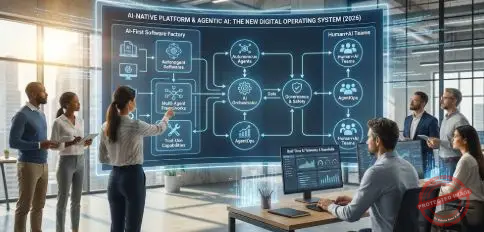
AI-native platforms and agentic AI: The new operating system for digital transformation
In 2026, digital transformation stops being a slide-deck slogan and becomes an AI-native operating model. Software is no longer just “AI-enabled”; it is conceived, built and run on platforms where generative and agentic AI are the primary interface for work. Development teams move from manually wiring pipelines and writing boilerplate code to orchestrating swarms of AI agents that reason, plan and act in complex environments.
Across industries, this shift is redefining how organizations ship software, reimagine processes and scale innovation. AI-native platforms and agentic AI are becoming the most critical building blocks for transformation strategies in 2026.
From copilots to AI-native development platforms
The first wave of AI in software development focused on copilots that suggested code inside an IDE. Those tools delivered useful but incremental productivity gains. Recent research shows that generative AI assistants typically boost developer throughput by 10–15%, but many companies have struggled to convert that into business value because saved time is not systematically redirected to higher-value work. Bain
In 2026, that pattern is changing as organizations adopt AI-native platforms rather than isolated AI tools. These platforms sit at the center of the software delivery lifecycle and integrate code generation, documentation, testing, security scanning and deployment as AI-orchestrated workflows. Systems like SkillBench and other AI-native development environments decompose complex work into tasks, certify outputs with experts and trace human–AI interactions for governance and learning. Dora
Cloud providers and vendors are racing to embed these capabilities. Amazon is pushing internal teams to use its Kiro AI coding tool, which allows applications to be built from plain-language prompts across global engineering teams. Reuters Anthropic has upgraded its Claude Opus 4.5 model with deeper coding and agentic capabilities, helping enterprises automate complex workflows such as financial modeling and large-scale data analysis. Reuters Google’s Gemini 3 Pro, meanwhile, is being integrated into Google Search, the Gemini app and developer tools so that multi-step coding, simulation and content generation can be automated with multimodal prompts. Android Central
The result is a shift from “copilot as helper” to “platform as AI teammate.” Instead of scattering AI across tools, organizations design AI-first software factories where agents handle routine work and humans focus on architecture, governance and value.
The rise of agentic AI in the enterprise
Agentic AI extends beyond single-turn interactions into systems where autonomous agents sense, plan and act over time to achieve goals. AWS describes autonomous agents as the next major evolution in AI, capable of reasoning, planning and executing complex workflows on behalf of humans, from managing enterprise applications to orchestrating back-office tasks. Amazon Web Services, Inc.
A new ecosystem of agentic AI products is emerging. CRN’s ranking of 2025’s “coolest agentic AI platforms” highlights offerings from AWS, Google, Microsoft, Databricks, CrowdStrike, and others, spanning domains from cloud infrastructure management to cybersecurity and CRM. CRN These platforms typically include: multi-agent frameworks, where specialized agents collaborate; tool-use capabilities that connect agents to APIs, database,s and applications; and safety and observability layers that monitor actions and enforce guardrails.
Enterprise-grade frameworks are also maturing. Domino’s guide to agentic AI frameworks for enterprise teams describes systems in which agents observe their environment, evaluate goals, plan multi-step workflows, and adapt based on feedback, working hand in hand with human experts. Domino Data Lab. In practice, this might mean an “agentic swarm” researching a market, drafting strategy options, running simulations, generating financial models, and preparing board-level presentations, all within a governed environment.
AI orchestration roles and operating models
As AI-native platforms spread, entirely new roles are appearing in global capability centers and digital transformation programs. An EY pulse report notes the emergence of AI orchestrators, agent operations managers (AgentOps), AI governance architects, multimodal interaction designers and LLM site reliability engineers, among others. The Times of India
These roles are not just technical. They sit at the intersection of process design, risk management and experience design. An AI orchestrator, for example, may define how agents interact with ERP systems, CRM data and collaboration tools, while ensuring every agent action is auditable and aligned with policy. A “business process agent designer” maps value streams and decides which segments will be mediated by agents, which by humans, and which by hybrid teams.
This restructuring has implications for leadership. CIO and CDO roles are evolving toward “chief transformation officer” and “chief human experience officer” profiles that explicitly focus on maximizing value from AI and protecting human well-being in agent-mediated organizations.
AI-native platforms as the backbone of digital transformation
For digital transformation leaders, AI-native platforms and agentic AI are not nice-to-have features; they are becoming the backbone of transformation roadmaps. Several trends are converging:
Development velocity is being reanchored around AI. Instead of measuring only story points delivered by human developers, organizations are measuring the ratio of work performed by AI agents versus humans, and the cycle time for end-to-end value delivery rather than code commits.
Governance is shifting from static rules to continuous telemetry. AI-native platforms record every prompt, response and action, providing a rich audit trail for compliance, debugging and optimization. This makes it feasible to allow agents to operate autonomously in production under policy-driven constraints.
Skills strategies are moving toward “AI plus domain” rather than purely technical specialization. Engineers, analysts, marketers and operations staff are being trained to design prompts, supervise agents and interpret AI-generated insights. GCCs and transformation offices are building structured “AI talent journeys” with role-based upskilling and live agent-building projects. The Times of India
Risks, guardrails and change management
The power of AI-native platforms and agentic AI comes with significant risks. Poorly governed agents can introduce security vulnerabilities, generate biased outputs or trigger costly actions in connected systems. The Amazon Autonomous Threat Analysis program shows both the potential and the risk: it uses multiple AI agents in offensive and defensive “red team/blue team” simulations to detect software vulnerabilities, with human oversight before any changes reach production. WIRED
Forward-looking organizations are therefore embedding guardrails into the platforms themselves. Typical elements include approval workflows for high-impact actions, fine-grained permission models for agents, continuous hallucination and drift monitoring, and attestation of training data lineage. Some are experimenting with “agent review boards,” where cross-functional teams evaluate agent designs before deployment.
Change management is equally critical. Developers may resist AI-native workflows if they feel surveilled or fear job loss. Business stakeholders may distrust autonomous decisions. Transformation leaders must communicate clearly that AI agents are augmenting, not replacing, human expertise, and that new career paths in AI orchestration, safety and product management are opening.
Closing thoughts and looking forward
By 2026, AI-native platforms and agentic AI will define how leading organizations build and operate digital systems. The winners will be those who treat AI not as a sidecar to existing processes but as the central nervous system of their digital transformation strategy.
Over the next three years, we can expect AI-native platforms to converge with other transformation pillars: platform engineering will standardize the infrastructure on which AI agents run; spatial computing will provide immersive canvases where agents and humans collaborate; hyperautomation will expand agents across every process; confidential computing will protect agent data at runtime; and preemptive cybersecurity will use its own swarm of agents to anticipate and neutralize threats.
For digital leaders, the imperative is clear: design your transformation roadmap around AI-native platforms and agentic AI now, while the ecosystem is still taking shape, rather than bolting them onto legacy architectures later.
References
-
“From Pilots to Payoff: Generative AI in Software Development” – Bain & Company – https://www.bain.com/insights/from-pilots-to-payoff-generative-ai-in-software-development-technology-report-2025/
-
“State of AI-assisted Software Development 2025” – DORA – https://dora.dev/research/2025/dora-report/
-
“Anthropic bolsters AI model Claude’s coding, agentic abilities with Opus 4.5” – Reuters – https://www.reuters.com/business/retail-consumer/anthropic-bolsters-ai-model-claudes-coding-agentic-abilities-with-opus-45-2025-11-24/
-
“The Rise of Autonomous Agents: What Enterprise Leaders Need to Know About the Next Wave of AI” – AWS – https://aws.amazon.com/blogs/aws-insights/the-rise-of-autonomous-agents-what-enterprise-leaders-need-to-know-about-the-next-wave-of-ai/
-
“Agentic AI Frameworks: A Guide for Enterprise Teams” – Domino Data Lab – https://domino.ai/blog/agentic-ai-frameworks-a-guide-for-enterprise-teams
Phil Giroux, Co-Editor, Digital Transformation, Montreal, Quebec.
Peter Jonathan Wilcheck, Co-Editor, Miami, Florida.
# SEO words
#DigitalTransformation #AINativePlatforms #AgenticAI #GenerativeAI #SoftwareDevelopment #EnterpriseAI #AIOrchestration #AIPlatforms2026 #EnterpriseTransformation #AIProductivity
Post Disclaimer
The information provided in our posts or blogs are for educational and informative purposes only. We do not guarantee the accuracy, completeness or suitability of the information. We do not provide financial or investment advice. Readers should always seek professional advice before making any financial or investment decisions based on the information provided in our content. We will not be held responsible for any losses, damages or consequences that may arise from relying on the information provided in our content.
 AAPL
AAPL AMD
AMD CIS.HA
 DELL
DELL IBM
IBM INTC
INTC MSFT
MSFT GOOG
GOOG HPE
HPE NVDA
NVDA TSLA
TSLA TMC
TMC MSI
MSI NOK
NOK ECDH26.CME
 OPEAZZX