


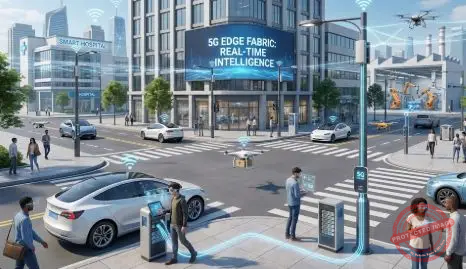
Edge computing promises real-time intelligence, but it cannot deliver without a communications fabric that matches its ambitions. In 2026, that fabric is 5G and its evolving beyond-5G variants. High-throughput radio links, ultra-low latency and the ability to connect massive numbers of devices allow edge platforms to coordinate fleets of machines, vehicles and sensors as if they were components of a single, distributed computer.
Why 5G is foundational for edge architectures
Fourth-generation networks were built for human-centric applications such as video streaming and web browsing. Fifth-generation networks, by contrast, were designed with machines in mind. Their specifications emphasize enhanced mobile broadband, massive machine-type communications, and ultra-reliable low-latency communication. Studies highlight how 5G can reduce latency to the order of milliseconds, support up to a million devices per square kilometer, and deliver peak data rates an order of magnitude higher than 4 G. SuperAGI+4MDPI+4PMC+4
For edge computing, this transforms what is feasible. Real-time control loops that once required dedicated wired networks can now operate wirelessly. Mobile assets such as autonomous vehicles, drones, and robots can remain continuously connected to local edge nodes and central orchestration services. IoT deployments can scale to thousands of sensors in a factory, port, or hospital without saturating the airwaves.
Autonomous vehicles and mobility at the edge
Few applications illustrate the synergy between edge computing and 5G better than autonomous vehicles. Research shows that combining 5G with edge and cloud techniques enables cooperative perception, dynamic map updates and coordinated maneuvers that go beyond what an individual vehicle can achieve alone. ScienceDirect
In a 2026 city, roadside units equipped with edge servers receive video and lidar data from multiple vehicles and infrastructure cameras, fuse them into a shared situational model and broadcast time-critical warnings. Vehicles subscribe to these feeds over 5G, allowing them to “see” around corners or through obstructions. Meanwhile, software-defined networking and network slicing ensure that safety-critical traffic receives guaranteed bandwidth and latency, even when the network is congested with other services.
Beyond passenger cars, similar patterns apply to ports, airports, logistics hubs and mines where fleets of autonomous machines move goods and materials. Edge nodes placed strategically across these environments coordinate traffic, allocate tasks and adapt to disruptions in real time, using 5G links as their nervous system.
Smart healthcare, AR and industrial automation
Healthcare is another sector where 5G and edge computing are converging. Peer-reviewed studies document how low-latency wireless links combined with edge processing can support remote diagnostics, telesurgery and continuous patient monitoring. Nature+2GSAR Publishers
In a hospital, an on-premises edge cluster connects to dozens of imaging devices, IoT monitors and mobile workstations over a private 5G network. Latency-sensitive tasks such as waveform analysis, anomaly detection and early warning score calculations happen locally, while less urgent analytics are routed to the cloud. Telepresence robots guided by remote clinicians benefit from responsive control and high-resolution video without depending on the public internet.
The same infrastructure supports industrial automation and AR. In a smart factory, 5G-connected robots and augmented-reality headsets rely on nearby edge nodes for object recognition, path planning and digital twin simulations. Research and industry case studies show that manufacturing is on track to account for a significant share of global edge investments by 2026 as companies pursue real-time monitoring, optimized production lines and safer work environments. Patent
Network slicing, private 5G and security
To make these scenarios workable, enterprises are investing in private 5G networks and advanced features such as network slicing. Private deployments give organizations control over spectrum, coverage and security policies, while slicing allows operators to allocate isolated virtual networks with tailored performance characteristics to different applications.
Edge computing often sits at the heart of these designs. A private 5G core and edge cluster may run in the same on-site data center, minimizing backhaul latency and giving security teams a clear perimeter to defend. Sensitive workloads can remain on premises, with only aggregated data or model updates flowing to public clouds.
Security, however, cannot be an afterthought. 5G introduces new attack surfaces in the form of virtualized network functions, software-defined components and massive IoT fleets. Edge nodes themselves can become targets, especially when they host high-value AI models and data. As a result, organizations are combining telecom-grade security controls with enterprise zero-trust principles and, increasingly, quantum-safe cryptography for long-lived systems. Barron’s+3ScienceDirect+3QuSecure
Closing thoughts and looking forward
By 2026, 5G will not merely be a faster way to watch videos on a phone. It will be the enabling fabric for a world where computation follows context, and context lives at the edge. Autonomous vehicles, smart hospitals, AR-assisted factories and sensor-rich infrastructure all depend on the fusion of radio networks and localized computing.
The technical challenge ahead is to manage this complexity without compromising resilience or security. Enterprises will need sophisticated orchestration across radio, edge and cloud domains, along with the ability to observe and troubleshoot issues across the entire chain. Those that get it right will unlock new categories of services and business models built on real-time insight and control. Those that treat 5G as just another connectivity upgrade may miss the deeper opportunity: turning the network itself into a programmable, intelligent platform.
References
The Synergistic Impact of 5G on Cloud-to-Edge Computing – MDPI Mathematics – https://www.mdpi.com/2227-7390/13/16/2634
Autonomous Vehicles Enabled by the Integration of IoT, Edge and 5G – MDPI Sensors (via PubMed Central) – https://pmc.ncbi.nlm.nih.gov/articles/PMC9963447/
Autonomous Vehicles in 5G and Beyond: A Survey – Journal of Network and Computer Applications (ScienceDirect) – https://www.sciencedirect.com/science/article/abs/pii/S2214209622000985
Improving the Latency for 5G/B5G Based Smart Healthcare – Nature Scientific Reports – https://www.nature.com/articles/s41598-024-57641-7
How Edge Computing and 5G Networks Are Revolutionizing Real-Time Data Enrichment – SuperAGI – https://superagi.com/how-edge-computing-and-5g-networks-are-revolutionizing-real-time-data-enrichment-in-healthcare-and-finance/
Gut Azzit, Co-Editor IT Security Management, Montreal, Quebec.
Peter Jonathan Wilcheck, Co-Editor, Miami, Florida.
#5GEdge #LowLatency #AutonomousVehicles #SmartHealthcare #Private5G #NetworkSlicing #EdgeComputing #IndustrialAutomation #Telemedicine #RealTimeData
Post Disclaimer
The information provided in our posts or blogs are for educational and informative purposes only. We do not guarantee the accuracy, completeness or suitability of the information. We do not provide financial or investment advice. Readers should always seek professional advice before making any financial or investment decisions based on the information provided in our content. We will not be held responsible for any losses, damages or consequences that may arise from relying on the information provided in our content.
 AAPL
AAPL AMD
AMD CIS.HA
 DELL
DELL IBM
IBM INTC
INTC MSFT
MSFT GOOG
GOOG HPE
HPE NVDA
NVDA TSLA
TSLA TMC
TMC MSI
MSI NOK
NOK OPEAZZX