


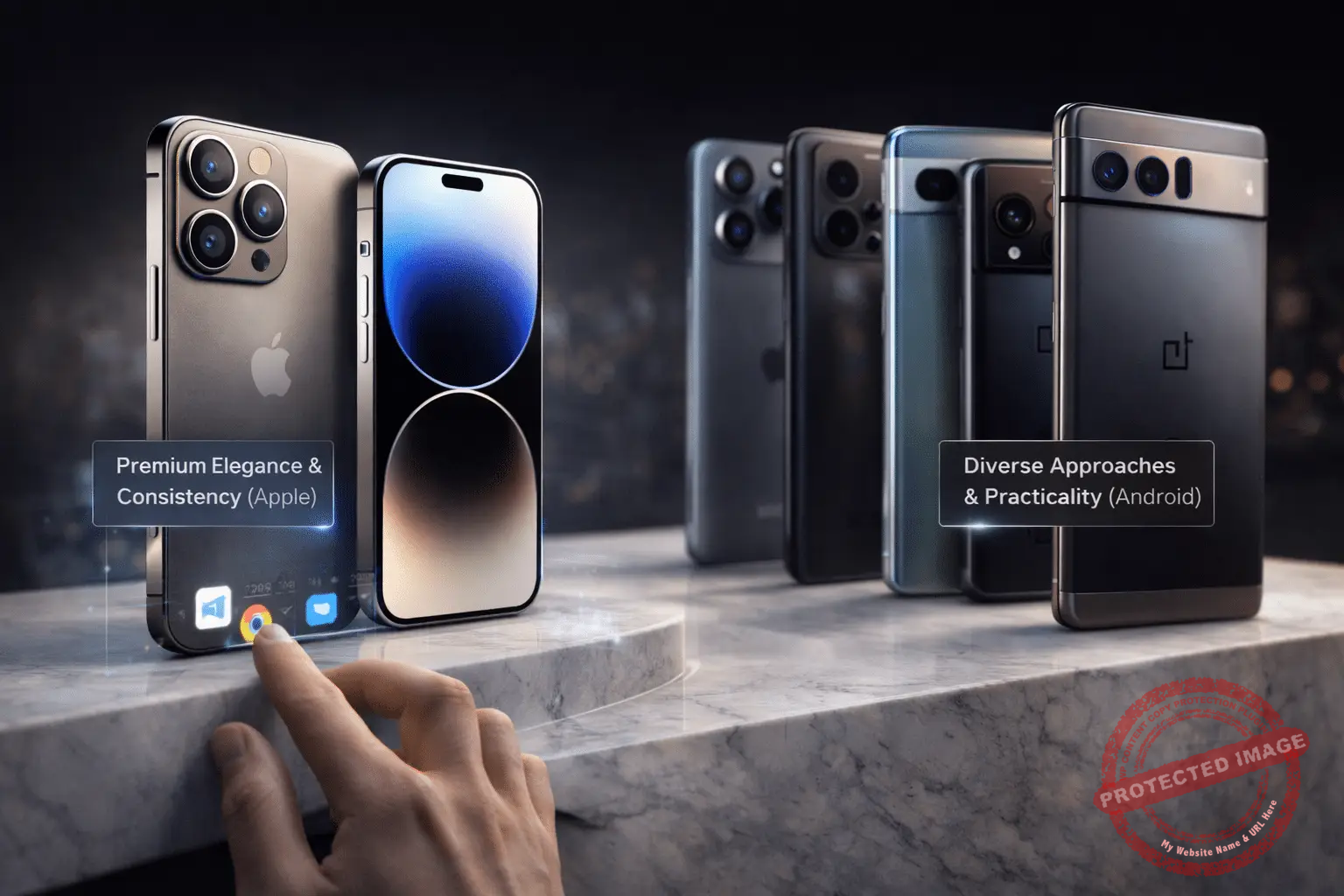
Unraveling the nuances of design and build quality in the world of smartphones.
Design and Build Quality: Apple continues to set the benchmark for sleek and sophisticated smartphone design with materials that are as durable as they are stylish. Their commitment to premium aesthetics is evident in the use of surgical-grade stainless steel and ceramic shields that offer both robustness and an elegant finish. This contrasts with many Android counterparts, where the comparison often highlights the diversity in design approaches—from plastic to aluminum bodies, reflecting a range of priorities from cost-effectiveness to high-end opulence.
Innovative Design Elements: One of the key areas where Apple excels is the seamless integration of front and back features, with edge-to-edge displays enhancing the immersive experience for users. The introduction of sleek curved edges and minimalist buttons exemplifies Apple’s dedication to ergonomic and modern design, making it a point of differentiation against various Android designs that can vary greatly depending on the manufacturer, with some focusing on practicality over elegance.
Attention to Detail: Apple’s meticulous attention to detail also extends to the tactile experience, from the click of the buttons to the smoothness of their finishes. This focus on detail has maintained their reputation as a leader in design quality. While many Android manufacturers strive to match this level of finesse, Apple’s consistency in design has set a standard that others attempt to follow, ensuring their products are not just seen as phones but as fashion statements.
Operating System and User Interface:
Apple’s iOS is renowned for its smooth and intuitive user experience, offering a cohesive interface that prioritizes user-friendliness and stability. The closed ecosystem of iOS provides seamless integration across Apple devices, ensuring that features like Handoff, AirDrop, and Continuity create a synchronized experience. This contrasts with Android’s more open and customizable operating system, where the user interface can vary significantly across different devices due to manufacturer customizations, offering greater flexibility at the expense of consistency and uniformity.
Evolution in iOS:
Over the years, Apple has enhanced iOS to include several intuitive features such as widgets, improved Siri capabilities, and app organization tools like the App Library. The emphasis on timely and consistent updates ensures that even older iPhone models receive the latest features and security patches. In contrast, the Android operating system prioritizes customization, which often results in delayed updates as manufacturers need time to adapt these updates to their specific UI skins, creating a fragmented experience when it comes to timely feature releases.
User Interface Consistency:
A hallmark of Apple’s design ethos is the consistent flow and aesthetic across its hardware and software offerings. This has enabled Apple to craft an ecosystem where the transition from one task to another is intuitive. Android manufacturers, while offering extensive customizability, sometimes face challenges in providing a unified user interface across their varying models, which can lead to a disjointed user experience. The comparison between Apple and Android often highlights these differences, where Apple users appreciate the predictability and design uniformity that the company delivers.
App Ecosystem and Compatibility:
A significant strength of Apple phones lies in their tightly curated app ecosystem, which offers unparalleled integration and reliability across devices. The Apple App Store is known for its stringent quality standards and rigorous review process, which ensures that users have access to high-quality apps that complement the iOS environment. This level of oversight provides a layer of security and performance consistency not always guaranteed in the more open Android ecosystem.
Developer Support and Optimization:
With Apple’s singular focus on iOS, developers often prioritize optimizing their applications for the iPhone, resulting in refined and streamlined user experiences. This optimization translates to quicker updates and enhanced functionalities that leverage Apple’s hardware capabilities effectively. In contrast, the Android platform, while encouraging a broader range of app options thanks to its openness, faces challenges with fragmentation, as apps must be tailored to countless device configurations across various manufacturers.
Cross-Platform Integration:
Apple’s ecosystem promotes seamless interoperability among its diverse array of products, allowing users to start a task on one device and complete it on another without any friction. This is particularly evident in universal apps that work across iOS, macOS, and watchOS, underscoring Apple’s strategic advantage in fostering a cohesive digital experience. Android, while offering strong capabilities for cross-device interactions within certain brands, such as Samsung’s ecosystem, cannot match the uniformity and scope of integration Apple users enjoy across the board.
Comparative User Experience:
When it comes to application compatibility, the comparison between Apple and Android highlights distinct user experiences. Apple users benefit from an ecosystem where apps are designed to run seamlessly due to close hardware-software synergy. Android, however, provides more freedom and choice, which appeals to users who prefer customization and variety. Despite the appeal of Android’s flexibility, many users still prefer the consistency found in the Apple ecosystem, where predictability and quality are prioritized.
Contributing Editors:
Benoit Leduc, Co-Editor, Montreal, Quebec.
Peter Jonathan Wilcheck, Co-Editor, Miami, Florida.
#Apple, #iPhone, #AppleWatch, #MacBook, #iOS, #AppleStore, #AppleEvent, #AppleMusic, #AppleTV, #AppleCare, #AirPods, #iPhonePro, #AppleEcosystem, #AppleNews, #AppleTechnology
Post Disclaimer
The information provided in our posts or blogs are for educational and informative purposes only. We do not guarantee the accuracy, completeness or suitability of the information. We do not provide financial or investment advice. Readers should always seek professional advice before making any financial or investment decisions based on the information provided in our content. We will not be held responsible for any losses, damages or consequences that may arise from relying on the information provided in our content.

 AAPL
AAPL MSFT
MSFT GOOG
GOOG TSLA
TSLA AMD
AMD IBM
IBM TMC
TMC IE
IE INTC
INTC MSI
MSI NOK
NOK DELL
DELL ECDH26.CME