


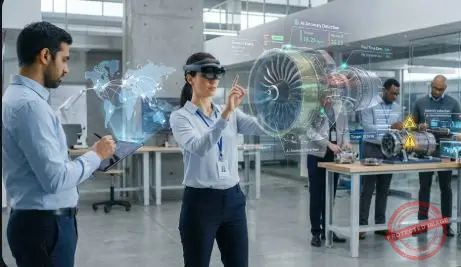
For years, digital transformation unfolded mostly on flat screens: laptops, phones and dashboards. By 2026, a new wave of spatial computing is pushing transformation into three dimensions. Enterprises are using augmented, virtual, and mixed reality to visualize data in physical context, train workers in immersive environments, and blend digital workflows into factories, stores, and field operations.
Spatial computing, once considered a niche for gaming and entertainment, is rapidly becoming a strategic capability for organizations that want to connect digital intelligence with the real world.
What spatial computing really means for business
Analysts describe spatial computing as an evolving, three-dimensional form of computing that uses sensors, computer vision, AR, VR and MR to fuse digital content with physical space. Forbes Deloitte notes that spatial computing provides new ways to contextualize business data, engage workers and interact with systems, from 3D visualizations of supply chains to location-aware guidance on the factory floor. Deloitte
NTT DATA outlines spatial computing’s fundamentals as a stack that includes sensing devices, 3D content creation tools, real-time rendering engines and integration layers connecting to enterprise systems. NTT DATA The key shift is interaction: users do not simply click or tap; they move, gesture, look and speak, with the system understanding position, orientation and environment.
For digital transformation leaders, this means every process that involves people in physical locations—maintenance, logistics, retail, healthcare, construction—can be reimagined with immersive interfaces.
Spatial computing use cases powering transformation
Across industries, practical spatial computing applications are moving from pilot to production. RedStream Technology highlights how spatial computing is transforming operations by enabling immersive training, digital twins of facilities and real-time situational awareness for distributed teams. RedStream Technology
In manufacturing, technicians can wear AR headsets that overlay assembly instructions, safety warnings, and sensor readings directly onto machines. They can see exploded 3D views of components, track torque values, and confirm steps hands-free, reducing errors and training time.
In field service, spatial computing allows remote experts to “see what the technician sees” and annotate real-world objects, guiding repairs without travel. This directly supports cost optimization and sustainability targets in transformation programs.
In retail, spatial computing powers immersive product visualization, virtual try-ons and interactive store layouts. Customers can see how furniture would look in their home or explore digital information attached to shelves and products.
In the office and knowledge-work environments, spatial computing enables 3D data rooms where teams explore models of supply chains, buildings or networks, walking around and manipulating visualizations with natural gestures. These experiences help bridge communication gaps between technical experts and business stakeholders.
Integrating spatial computing with AI and platform engineering
Spatial computing is most potent when combined with AI-native platforms and strong platform engineering. For example, AI models can interpret gestures and voice commands, detect anomalies in video feeds, and generate context-aware prompts for workers. Platform engineering provides the APIs, identity controls, and deployment pipelines that connect spatial front-ends to backend systems.
Deloitte’s technology trends work suggests that spatial interfaces, AI and digital twins will increasingly interlock: AI systems will simulate outcomes inside digital twins, and spatial computing will present those simulations in human-friendly ways. Deloitte. The result is a closed loop in which field data informs models, models power predictions, and spatial interfaces deliver real-time insight back to the field.
To support such scenarios, organizations need platforms that can stream telemetry from IoT sensors, process it with AI, store high-fidelity 3D models and deliver low-latency content to headsets and devices. This raises the bar for network performance, edge computing and security policies.
Talent, tooling, and content challenges
While the technology stack for spatial computing is maturing, talent and content remain bottlenecks. LineZero notes that spatial computing projects require specialized roles such as 3D designers, real-time rendering developers, and UX specialists who understand AR and MR interaction patterns. linezero.com RedStream Technology emphasizes the need for strategic assessments of applications, infrastructur,e and talent before scaling AR/VR programs. RedStream Technology
Enterprises must make decisions about tools and standards early. They need pipelines to capture CAD and BIM data, convert it to real-time 3D formats, and sync it with operational data sources. They must align on device choices—head-mounted displays, tablets, phones—and on platforms for content distribution and access control.
Training is essential. Workers unfamiliar with AR or VR may initially find headsets distracting or uncomfortable. Programs must be co-designed with frontline employees, focusing on clear benefits such as fewer errors, safer operations or shorter ramp-up times.
Finally, content maintenance is a significant ongoing cost. As facilities, products or procedures change, 3D content must be updated. Organizations that treat spatial experiences as static “projects” will quickly accumulate digital debt; those that build content pipelines and governance frameworks will sustain long-term value.
Security, privacy, and ethics in immersive environments
Spatial computing introduces new security and privacy questions. Devices capture detailed information about physical environments, including layouts, equipment, documents, and even bystanders. That data may be sensitive from both security and privacy perspectives.
Digital transformation leaders must therefore extend their security frameworks to cover spatial devices and data. This includes controlling where 3D scans and video streams are stored, encrypting data in transit and at rest, and applying access control and anonymization where appropriate.
Ethical considerations also arise when spatial computing is used for monitoring worker performance. While analytics on movement and task completion can improve safety and training, they can also feel intrusive if used to micromanage. Transparent communication, consent, and clear policies are critical.
Closing thoughts and looking forward
Spatial computing is turning digital transformation into something you can walk through, touch, and see from multiple angles. By 2026, organizations that treat it as a strategic capability—rather than a novelty—will gain advantages in training, safety, collaboration and customer engagement.
Looking ahead, spatial computing is likely to fuse with other transformation pillars. AI-native agents will inhabit spatial environments as virtual collaborators, pointing out anomalies, simulating scenario,s and answering questions in context. Platform engineering will provide the consistent backplane for deploying spatial applications across devices and locations. Hyperautomation will connect spatial workflows with back-office processes, while confidential computing and preemptive cybersecurity will protect immersive data streams against new threat categories.
For digital leaders, the next step is clear: identify the processes where physical context matters most, build a small portfolio of high-value spatial use cases and connect them to a broader AI-native, platform-engineering-driven transformation roadmap.
References
-
“What Is Spatial Computing?” – Forbes – https://www.forbes.com/sites/cathyhackl/2024/01/06/what-is-spatial-computing/
-
“Spatial Computing Takes Center Stage” – Deloitte Tech Trends – https://www.deloitte.com/us/en/insights/focus/tech-trends/2025/tech-trends-future-of-spatial-computing.html
-
“Navigating the Spatial Computing Revolution” – NTT DATA – https://www.nttdata.com/global/en/insights/focus/2024/navigating-the-spatial-computing-revolution
-
“The Future of Spatial Computing: Shaping the Work and Office of Tomorrow” – LineZero – https://www.linezero.com/blog/the-future-of-spatial-computing
-
“The Rise of Spatial Computing: What IT Leaders Need to Know” – RedStream Technology – https://www.redstreamtechnology.com/insights/2025/8/12/the-rise-of-spatial-computing-what-it-leaders-need-to-know/
Phil Giroux, Co-Editor, Digital Transformation, Montreal, Quebec.
Peter Jonathan Wilcheck, Co-Editor, Miami, Florida.
#SpatialComputing #DigitalTransformation #AugmentedReality #VirtualReality #MixedReality #DigitalTwins #ImmersiveTraining #EnterpriseAR #FutureOfWork #3DData
Post Disclaimer
The information provided in our posts or blogs are for educational and informative purposes only. We do not guarantee the accuracy, completeness or suitability of the information. We do not provide financial or investment advice. Readers should always seek professional advice before making any financial or investment decisions based on the information provided in our content. We will not be held responsible for any losses, damages or consequences that may arise from relying on the information provided in our content.

 AAPL
AAPL MSFT
MSFT GOOG
GOOG TSLA
TSLA AMD
AMD IBM
IBM TMC
TMC IE
IE INTC
INTC MSI
MSI NOK
NOK DELL
DELL ECDH26.CME