


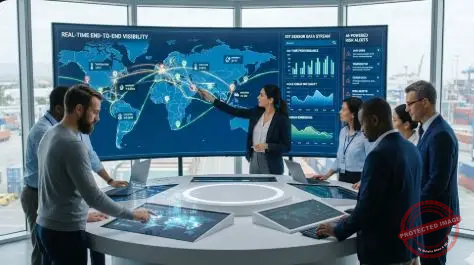
From blind spots to real-time, sensor-driven transparency in 2026
Supply chain leaders have spent years talking about “from source to shelf” visibility, but reality has often lagged the rhetoric. Data silos, manual updates, and fragmented tracking systems left teams guessing about the true location and condition of goods. By 2026, the convergence of IoT sensors, cellular and satellite connectivity, and AI analytics is finally closing those gaps. End-to-end visibility is becoming a day-to-day operational asset rather than an aspirational slide in strategy decks.
Real-time tracking from first mile to last
Modern visibility platforms combine device-agnostic sensors, GPS, cellular or LPWAN connectivity, and cloud software to track shipments from factories and farms through ports, warehouses, and the last mile. Adoption of IoT-based shipment tracking has risen steadily in recent years, with some reports showing meaningful year-on-year increases as organizations move away from manual status updates.tive.com+1
Sensors embedded in pallets, containers, and even individual packages stream data on location, temperature, humidity, shock, and dwell time. This is invaluable for sensitive goods like pharmaceuticals, food, and high-value electronics. If a trailer door is opened unexpectedly or a cold-chain shipment warms beyond its threshold, alerts are triggered and corrective actions can be taken before product is lost.Journal of Marketing & Social Research
Walmart’s rollout of Bluetooth-enabled sensor labels on grocery pallets in the United States is one high-profile example. These tags allow the retailer to monitor conditions across thousands of stores and distribution centers, reducing manual checks and feeding AI systems that optimize replenishment. Financial Times
Unified visibility platforms and control towers
IoT data is only useful when it is integrated and contextualized. Leading organizations are deploying visibility platforms that ingest data from carriers, telematics, warehouse systems, and sensors into a single pane of glass. These platforms support global control towers where cross-functional teams monitor flows, exceptions, and risks.Trackonomy
AI models layered on top of these platforms can detect anomalies, predict delays, and recommend mitigation steps. A late vessel arrival might trigger automatic rebooking of inland transportation, reallocation of inventory to alternate DCs, or dynamic reprioritization of orders. Instead of reacting to angry customer calls, teams use predictive alerts to address issues while there is still time to maneuver.SSRN
Visibility as a sustainability and ESG enabler
End-to-end visibility is also becoming a foundational capability for sustainability and ESG reporting. Companies are under growing pressure from regulators, investors, and customers to quantify emissions, trace materials, and ensure ethical sourcing across their supply chains.National Law Review
IoT and real-time tracking give organizations more precise data on route choices, idle times, temperature excursions, and rework, all of which affect carbon footprints and waste. Combined with routing and optimization algorithms, visibility tools help reduce emissions by consolidating loads, avoiding congestion, and minimizing empty miles.StockIQ Technologies
Extending visibility to multi-tier suppliers
One of the toughest challenges remains visibility beyond tier-one suppliers. Many disruptions originate upstream—from raw material shortages to component delays. By 2026, more enterprises are pushing visibility solutions deeper into their networks, inviting suppliers to share shipment and production data via APIs, web portals, or inexpensive IoT devices.
Some industries are experimenting with shared visibility networks where multiple companies contribute data in exchange for broader insights into lanes, nodes, and risks. This collaborative approach raises questions about data ownership and competition, but it also offers powerful network effects: the more participants contribute, the more accurate predictions and benchmarks become.Inbound Logistic
Data overload, privacy, and cybersecurity
With every pallet, trailer, and container potentially streaming data, the risk of information overload is real. Teams can quickly be overwhelmed by low-value alerts or dashboards that are too complex to interpret. To avoid this, organizations are refining alert thresholds, using AI to filter signals from noise, and focusing on exceptions that truly require intervention.Journal of Marketing & Social Research
Visibility also introduces privacy and security concerns. Location data can reveal sensitive information about production volumes, customer bases, or strategic shifts. IoT devices and connectivity points may expand the cyber-attack surface if not properly secured. Companies are responding with encryption, device authentication, network segmentation, and clear policies on how data is shared with partners.Journal of Marketing & Social Research
Closing thoughts and looking forward
End-to-end visibility powered by IoT is steadily turning supply chains into living data streams that can be monitored, analyzed, and optimized in near real time. By 2026, the conversation will move beyond “Can we see it?” to “Are we acting on what we see in time?”
Organizations that treat visibility as a strategic capability—closely tied to customer experience, risk management, and sustainability—will be better prepared for the next wave of disruptions. As sensor costs fall and connectivity improves, the frontier will shift toward predictive and prescriptive insights: not just knowing where things are, but automatically adjusting flows, contracts, and capacity based on what the data indicates will happen next.
References
From First Mile to Last: Achieving End-to-End Supply Chain Visibility – Tive – https://www.tive.com/blog/from-first-mile-to-last-achieving-end-to-end-supply-chain-visibility tive.com
Importance of End-to-End Supply Chain Visibility – Trackonomy – https://trackonomy.ai/blog/end-to-end-supply-chain-visibility/ Trackonomy
The Role of IoT in Real-Time Supply Chain Visibility and Risk Management – Journal of Management and Strategy Research – https://jmsr-online.com/article/the-role-of-iot-in-real-time-supply-chain-visibility-and-risk-management-390/ Journal of Marketing & Social Research
End-to-End Visibility: The See-Through Supply Chain – Inbound Logistics – https://www.inboundlogistics.com/articles/end-to-end-visibility-the-see-through-supply-chain/ Inbound Logistics
AI-Enabled Real-Time Supply Chain Visibility and Monitoring – SSRN – https://papers.ssrn.com/sol3/papers.cfm?abstract_id=5199933 SSRN
Dan Ray, Supply Chain Management, Montreal, Quebec.
Peter Jonathan Wilcheck, Co-Editor, Miami, Florida.
#EndToEndVisibility #IoTSupplyChain #RealTimeTracking #ControlTower #ColdChainLogistics #RiskManagement #ESGReporting #DataDrivenLogistics #ConnectedSupplyChain #SensorAnalytics
Post Disclaimer
The information provided in our posts or blogs are for educational and informative purposes only. We do not guarantee the accuracy, completeness or suitability of the information. We do not provide financial or investment advice. Readers should always seek professional advice before making any financial or investment decisions based on the information provided in our content. We will not be held responsible for any losses, damages or consequences that may arise from relying on the information provided in our content.
 AAPL
AAPL AMD
AMD CIS.HA
 DELL
DELL IBM
IBM INTC
INTC MSFT
MSFT GOOG
GOOG HPE
HPE NVDA
NVDA TSLA
TSLA TMC
TMC MSI
MSI NOK
NOK OPEAZZX