


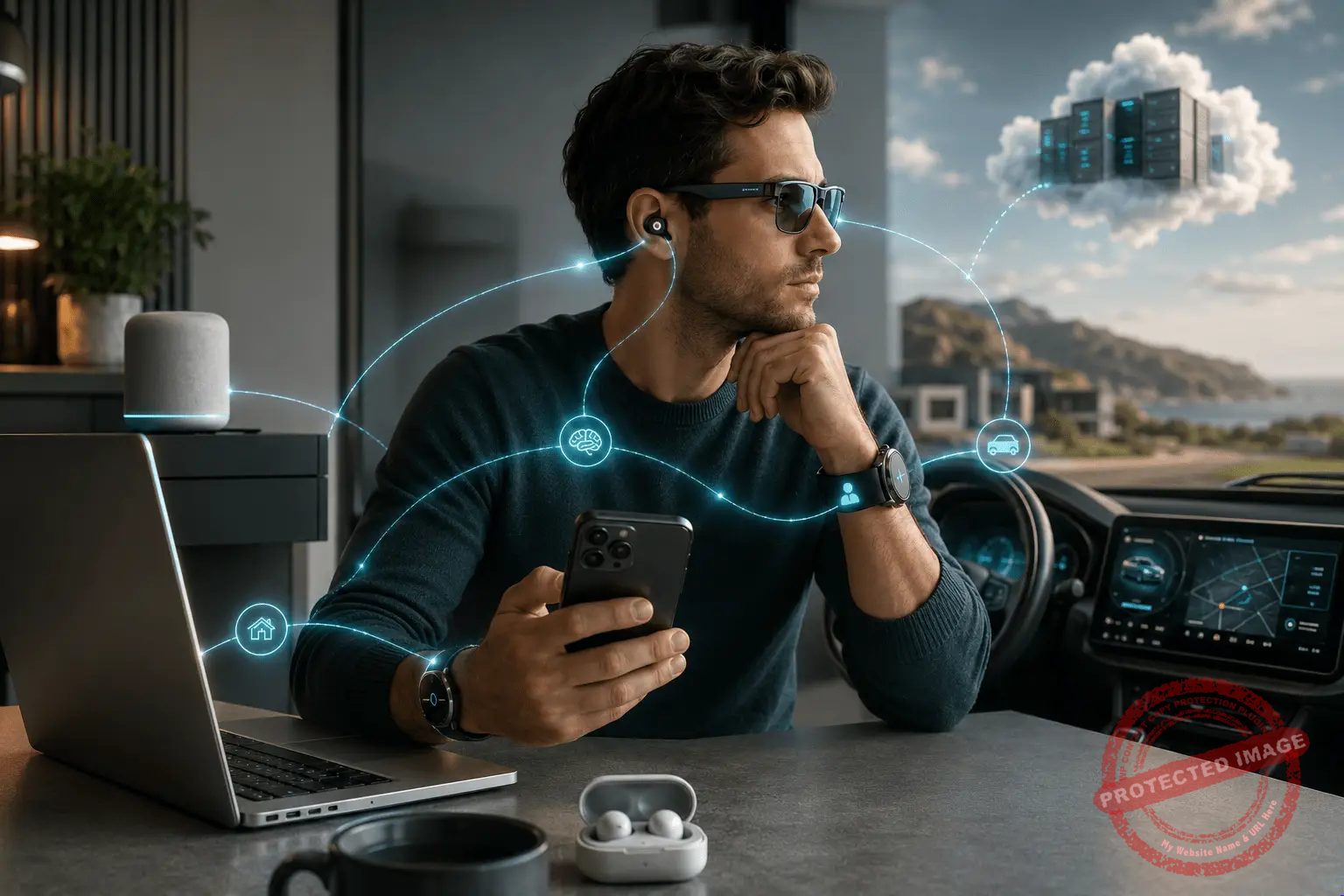
Most AI personalization today is still cloud-centered. An app collects signals about what you click, type, watch, buy, skip, or ask for. That data is processed somewhere else. Then the system sends back a recommendation, prediction, summary, or automated action.
Hyper-personalized Edge AI changes that model.
Instead of treating personalization as something that happens in a remote data center, it moves more intelligence onto the devices closest to you: your phone, laptop, smartwatch, earbuds, car, smart glasses, home devices, workplace tools, or industrial equipment. These devices do not just display AI results. They can run AI locally, interpret your context in real time, and adapt to your preferences while keeping more of your personal data under local control.
That is the core idea: hyper-personalized Edge AI is AI that learns from your immediate context, runs close to where your data is created, and adapts experiences around you without requiring every sensitive detail to leave the device.
What Makes It “Edge AI”?
Edge AI means AI processing happens near the source of the data instead of depending entirely on the cloud.
The “edge” might be a smartphone, wearable, vehicle, camera, factory sensor, medical device, retail terminal, or AR headset. These devices sit at the edge of the network, where real-world data is generated.
That matters because many personalized experiences depend on signals that are immediate, private, or bandwidth-heavy:
- Your voice
- Your location
- Your routines
- Your typing style
- Your biometric patterns
- Your recent messages or notes
- Your physical environment
- Your device usage habits
- Your preferred tone, timing, and interface settings
If every one of those signals must be uploaded, processed, and returned before the system can act, personalization becomes slower, more expensive, more fragile, and more privacy-sensitive.
Edge AI reduces that dependency. It lets the device perform inference locally: recognizing intent, detecting patterns, summarizing context, recommending an action, or adapting the interface without needing a cloud round trip for every decision.
What Makes It “Hyper-Personalized”?
Basic personalization says: “People like you may want this.”
Hyper-personalization says: “Given your current context, your habits, your preferences, your device, your environment, and what you are trying to do right now, this is probably the most useful next step.”
That difference is important.
A normal recommendation engine might suggest a playlist because users with similar listening histories enjoyed it. A hyper-personalized Edge AI system might notice that you are walking, your heart rate is elevated, it is early morning, you usually prefer spoken summaries during this routine, and you have a calendar event in 30 minutes. It might offer a short audio briefing instead of a long article.
The experience becomes more situational. Less “AI for an average user” and more “AI tuned to this person, on this device, in this moment.”
Why the Edge Is the Right Place for Personalization
Hyper-personalization needs context. The richest context often lives on personal devices.
Your phone knows which apps you use, which notifications you ignore, where you tend to go, and how you communicate. Your smartwatch sees motion and biometric signals. Your earbuds capture voice interaction. Your car understands driving context. Your laptop contains work patterns, documents, and local workflows.
That information can make AI much more useful, but it is also exactly the kind of data people may not want continuously uploaded to external servers.
This is where Edge AI becomes more than a performance choice. It becomes a trust architecture.
By running more AI locally, a system can personalize based on sensitive data while reducing how much raw data leaves the device. The cloud can still help when needed, especially for large-scale reasoning, fresh information, or heavier model workloads. But the edge can handle the intimate, fast, repetitive, context-aware decisions that make personalization feel natural.
A Simple Example: The Personal Assistant That Actually Knows Your Context
Imagine a personal AI assistant on your phone.
A cloud-only assistant may answer questions well, but it depends heavily on what you explicitly tell it or what you allow it to upload. A hyper-personalized Edge AI assistant could do more of the everyday interpretation locally.
It might understand:
- You usually decline meetings before 9 a.m.
- You prefer short replies during work hours
- You often ask for driving directions after certain calendar events
- You rewrite formal messages into a warmer tone before sending
- You silence notifications when your wearable detects a workout
- You ask for summaries instead of full documents when commuting
None of these behaviors requires the world’s largest model. They require local context, fast inference, and careful boundaries.
That is why on-device small language models are so relevant. A compact language model running on the phone can summarize, classify, rewrite, extract tasks, or interpret intent without sending every message or note to the cloud. It becomes one building block for hyper-personalized Edge AI.
The Role of On-Device Small Language Models
Small language models, or SLMs, are compact AI models designed to perform useful language tasks with lower memory, compute, and power requirements than massive cloud models.
In hyper-personalized Edge AI, they can help devices understand and adapt to a person’s language patterns.
For example, an on-device SLM might:
- Suggest replies that match your usual tone
- Summarize private notes locally
- Extract tasks from a meeting transcript
- Rewrite a message for clarity
- Understand offline voice commands
- Adapt an app interface based on what you usually do next
This is not about replacing frontier cloud AI. It is about putting the right-sized intelligence close to the user.
The cloud may still be better for deep research, long-context reasoning, complex coding, or information that requires current external knowledge. The edge is better for fast, private, personal, context-rich decisions.
The Real Benefits
The first benefit is privacy. Hyper-personalized systems need personal data. Edge AI can reduce the amount of raw personal data sent away for processing.
The second is latency. Local inference can respond quickly because it does not always wait on the network. That matters for voice, accessibility, AR, driving, wearables, and other real-time experiences.
The third is reliability. Edge AI can keep working when connectivity is weak, expensive, or unavailable.
The fourth is cost control. Running every small personalization request through cloud infrastructure can become expensive at scale. Local inference can reduce repeated cloud calls.
The fifth is contextual relevance. Devices can adapt based on local signals that would be too sensitive, too noisy, or too frequent to continuously transmit.
The Tradeoffs
Hyper-personalized Edge AI also has constraints.
Edge devices have limited battery, memory, thermal headroom, and compute capacity. A model that runs well on a high-end phone may not work on a low-power wearable. A system that feels instant in one environment may slow down in another.
There is also the risk of over-personalization. If AI adapts too aggressively, it can feel invasive or unpredictable. Users need visibility and control: what the system is learning, what it can access, what it can change, and how to reset or disable personalization.
Security matters too. Keeping data local does not automatically make a system safe. Local data still needs protection, permissions, encryption, and clear boundaries between apps, models, and user profiles.
The best hyper-personalized Edge AI systems will be restrained. They will act where local intelligence clearly improves the experience, and they will ask for cloud help only when the task genuinely needs it.
Where This Is Heading
Hyper-personalized Edge AI points toward a different kind of digital experience.
Instead of one-size-fits-all apps, devices can become more adaptive. Instead of uploading every signal for remote analysis, more interpretation can happen locally. Instead of assistants that wait for explicit commands, systems can become more proactive while still respecting user control.
The strongest near-term use cases are likely to appear in:
- Smartphones and personal productivity apps
- Wearables and health-adjacent coaching
- Smart earbuds and voice interfaces
- AR glasses and contextual overlays
- Vehicles and driver assistance experiences
- Enterprise field tools
- Industrial and retail edge devices
- Smart home systems
Across all of these, the same pattern applies: personal context is valuable, but sensitive. Edge AI gives developers a way to use that context more responsibly.
The Takeaway
Hyper-personalized Edge AI is not just “AI on a device.” It is a shift in where personalization happens and who controls the context behind it.
Cloud AI is still essential. But for AI that adapts to your habits, your environment, your body, your language, your routines, and your moment-to-moment needs, the edge is often the better place to start.
The future of personalization will not be defined only by bigger models. It will be defined by smarter placement: the right model, on the right device, using the right context, with the right level of user control.
- IBM: What Is Edge AI?
https://www.ibm.com/think/topics/edge-ai
Supports the definition of Edge AI as AI processing on local edge devices, with emphasis on real-time processing and reduced reliance on cloud infrastructure. - NVIDIA: What Is Edge AI?
https://blogs.nvidia.com/blog/what-is-edge-ai/
Supports the idea that Edge AI performs computation near the user and close to where data is generated. - Apple Developer: Foundation Models Framework
https://developer.apple.com/documentation/foundationmodels
Supports the article’s point about on-device language models being made available through modern developer platforms. - Android Developers: Gemini Nano
https://developer.android.com/ai/gemini-nano
Supports the discussion of on-device generative AI, local inference, device hardware acceleration, and lower latency. - Qualcomm AI Hub
https://aihub.qualcomm.com/
Supports the article’s claims about optimizing, validating, and deploying AI models for on-device and edge hardware.
Researched and written by: Peter Jonathan Wilcheck
Post Disclaimer
The information provided in our posts or blogs are for educational and informative purposes only. We do not guarantee the accuracy, completeness or suitability of the information. We do not provide financial or investment advice. Readers should always seek professional advice before making any financial or investment decisions based on the information provided in our content. We will not be held responsible for any losses, damages or consequences that may arise from relying on the information provided in our content.
 AAPL
AAPL AMD
AMD CIS.HA
 DELL
DELL IBM
IBM INTC
INTC MSFT
MSFT GOOG
GOOG HPE
HPE NVDA
NVDA TSLA
TSLA TMC
TMC MSI
MSI NOK
NOK ECDH26.CME
 OPEAZZX