


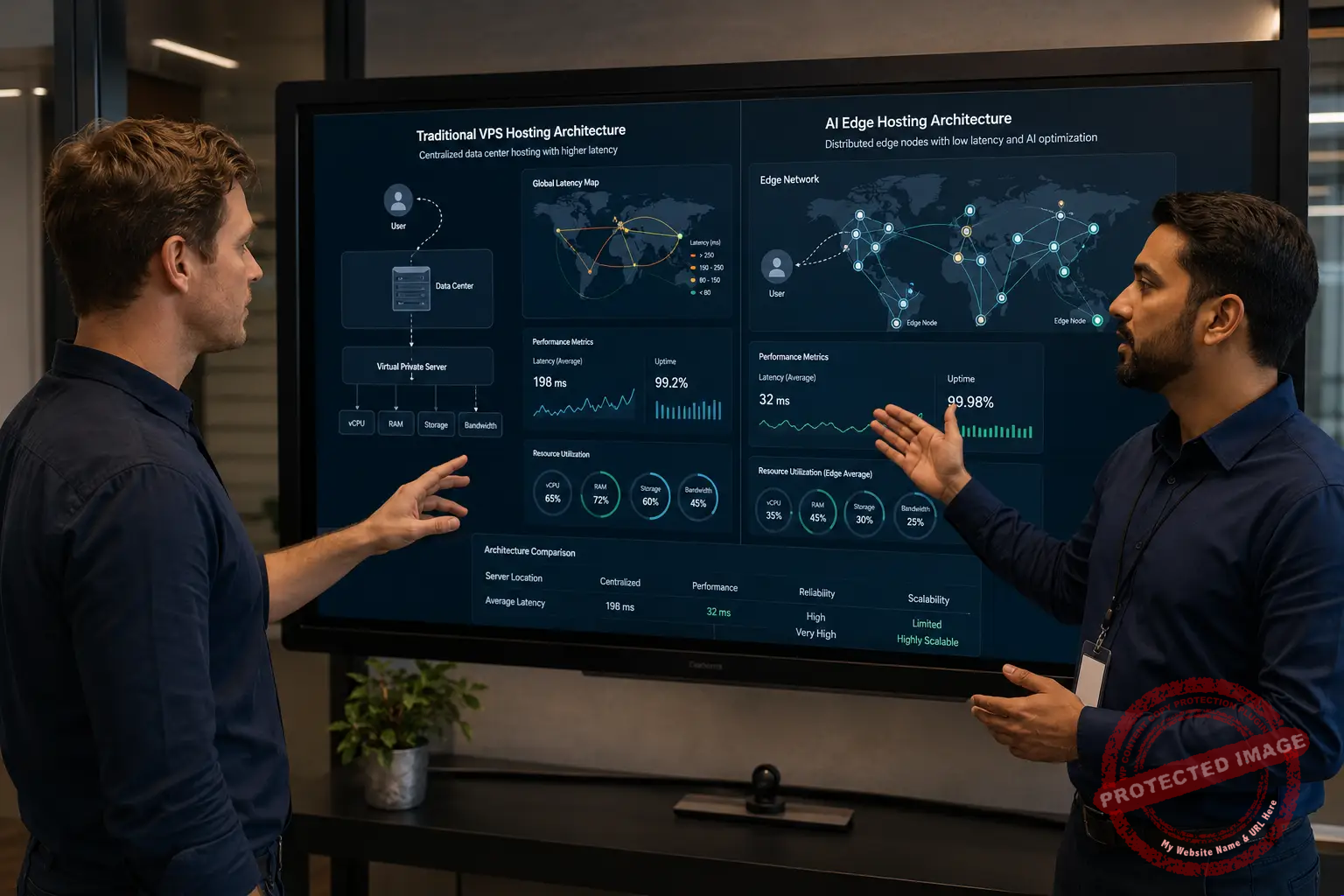
Web hosting is no longer just about renting space on a server. The strongest new direction is AI edge hosting, where websites, applications, and AI-powered features run closer to visitors through global edge networks, serverless functions, AI gateways, and CDN-connected compute.
For businesses, this matters because speed, personalization, security, and uptime are now tied together. A modern hosting platform is expected to load pages quickly, handle traffic spikes, protect applications from attacks, and support AI-driven features without forcing teams to manage complex server infrastructure.

What Is AI Edge Hosting?
AI edge hosting combines three major hosting ideas: edge computing, serverless infrastructure, and AI model access.
Edge computing means code runs closer to the visitor instead of only from one central data center. Serverless means developers deploy functions or applications without managing the underlying servers. AI gateways and AI inference platforms make it easier to connect websites to language models, image models, chatbots, search tools, recommendations, and automation features.
Cloudflare’s AI platform, for example, supports AI workloads through Workers AI and AI Gateway on its global network. Vercel’s Fluid compute is designed for dynamic workloads like APIs, streaming, and AI. Netlify’s AI Gateway simplifies model access inside functions and edge functions. AWS Lambda@Edge continues to support code execution closer to users through CloudFront. Deno Deploy has also moved deeper into globally distributed application hosting with modern deployment workflows.
The practical result is simple: more web applications can now run globally without every business needing a large DevOps team.
Why This Topic Matters Now
Traditional shared hosting and VPS hosting still have a place, especially for small business websites, blogs, and standard WordPress sites. But the demands placed on websites have changed.
Visitors expect pages to feel instant. Store owners want personalized product recommendations. SaaS teams need fast APIs. Publishers want dynamic content that does not slow down Core Web Vitals. Support teams want AI chat built into the website. Marketing teams want safe experimentation and fast rollbacks.
AI edge hosting addresses these needs by placing more intelligence into the delivery layer. Instead of sending every request back to one origin server, the platform can cache content, transform responses, route traffic, run authentication checks, call AI models, or personalize a page closer to the visitor.
This does not make traditional hosting obsolete. It changes where the “smart” parts of hosting live.
The Main Benefits for Website Owners
The first benefit is performance. When code and content are delivered from locations near the visitor, latency drops. For global audiences, this can make a major difference. A visitor in Singapore, London, Toronto, or Johannesburg should not always have to wait on a server located in one distant region.
The second benefit is scaling. Serverless and edge platforms can absorb sudden traffic increases more gracefully than a single small VPS. This is useful for product launches, viral content, seasonal ecommerce campaigns, ticket sales, and event-driven traffic spikes.
The third benefit is easier AI adoption. AI features often require model routing, API keys, rate limits, retries, caching, observability, and cost controls. AI gateways are emerging because teams do not want to wire all of that together manually for every project.
The fourth benefit is operational simplicity. Businesses can deploy code, preview changes, roll back releases, and connect services without directly managing operating system patches, web server tuning, or capacity planning.

Where AI Edge Hosting Fits Best
AI edge hosting is a strong fit for modern web applications that need speed and dynamic behavior. Examples include SaaS dashboards, ecommerce storefronts, booking platforms, media sites, membership portals, documentation platforms, and AI-assisted customer support tools.
It also works well for headless and Jamstack websites, where the frontend is separated from the backend. The static parts of the site can be cached globally, while dynamic functions handle checkout logic, search, personalization, authentication, form processing, or AI responses.
For WordPress, the picture is more mixed. A standard WordPress site can still perform very well on managed WordPress hosting with proper caching, a CDN, optimized PHP, and good database management. But headless WordPress, WooCommerce personalization, or AI-powered search may benefit from edge functions and AI gateways layered around the core CMS.
The Tradeoffs to Understand
AI edge hosting is powerful, but it’s not magic.
The first tradeoff is complexity. A simple brochure website does not need a global AI gateway. Adding edge functions, model routing, and serverless architecture can create unnecessary moving parts if the business only needs stable pages, email forms, and basic SEO.
The second tradeoff is debugging. Distributed systems can be harder to troubleshoot than a single server. A problem may involve the origin server, edge cache, function runtime, DNS, SSL, API provider, AI model, rate limit, or firewall rule.
The third tradeoff is cost predictability. Serverless pricing can be efficient because you do not pay for idle capacity, but traffic spikes, AI inference, high request volume, or long-running tasks can increase bills quickly. Teams should use budgets, logs, alerts, and usage limits.
The fourth tradeoff is vendor dependence. Once an application is deeply integrated into a platform’s functions, storage, AI gateway, and routing system, moving away may require planning. This is not automatically bad, but it should be understood before committing.
What Hosting Providers Should Offer in 2026
A competitive hosting provider should now think beyond disk space, bandwidth, and control panels. Buyers increasingly need a full delivery and application platform.
Strong offerings should include global CDN integration, managed SSL, DDoS protection, web application firewall options, automated backups, staging environments, observability, serverless or edge function support, simple rollback tools, and clear AI integration paths.
For developers, documentation and deployment workflow matter. Git-based deployment, preview environments, environment variables, logs, and local development support can be more valuable than a slightly cheaper monthly plan.
For business owners, the priority is different. They need plain-language pricing, uptime clarity, support quality, migration help, backup confidence, and a realistic upgrade path from simple hosting to more advanced architecture.
Is AI Edge Hosting Right for Every Website?
No. A local bakery, small portfolio, church website, or simple service business may be better served by reliable shared hosting or managed WordPress hosting. The best hosting choice is the one that fits the workload.
AI edge hosting becomes more compelling when the website has global users, unpredictable traffic, dynamic personalization, AI features, real-time APIs, high conversion value, or a team that needs fast deployment without managing servers.
A practical rule is this: if slow pages, scaling limits, AI integration, or deployment friction are already costing money or time, AI edge hosting is worth evaluating. If the site is small, stable, and mostly informational, start with simpler hosting and add CDN, caching, and security first.

The Future Direction
The next stage of hosting will likely blend traditional infrastructure with intelligent delivery networks. VPS and dedicated servers will still matter for control-heavy workloads. Managed WordPress will still matter for content teams. Cloud hosting will still matter for complex applications.
But the fastest-growing layer is the edge: CDN-connected compute, AI inference, smart routing, security filtering, and serverless execution placed closer to users.
In last remained portion of 2026, the question is not “Do I need a server?” The better question is “Which parts of my website should run at the origin, which parts should run at the edge, and which parts should be handled by managed AI services?”
That is the hosting shift businesses should understand now.
Reference Sites:
- Cloudflare AI Docs – https://developers.cloudflare.com/ai/
- Cloudflare Workers AI Docs – https://developers.cloudflare.com/workers-ai/
- AWS Lambda@Edge – https://aws.amazon.com/lambda/edge/
- Vercel Fluid Compute Docs – https://vercel.com/docs/fluid-compute
- Netlify AI Gateway Docs – https://docs.netlify.com/build/ai-gateway/overview/
Researched and written by: Peter Jonathan Wilcheck
Post Disclaimer
The information provided in our posts or blogs are for educational and informative purposes only. We do not guarantee the accuracy, completeness or suitability of the information. We do not provide financial or investment advice. Readers should always seek professional advice before making any financial or investment decisions based on the information provided in our content. We will not be held responsible for any losses, damages or consequences that may arise from relying on the information provided in our content.
 AAPL
AAPL AMD
AMD CIS.HA
 DELL
DELL IBM
IBM INTC
INTC MSFT
MSFT GOOG
GOOG HPE
HPE NVDA
NVDA TSLA
TSLA TMC
TMC MSI
MSI NOK
NOK OPEAZZX