


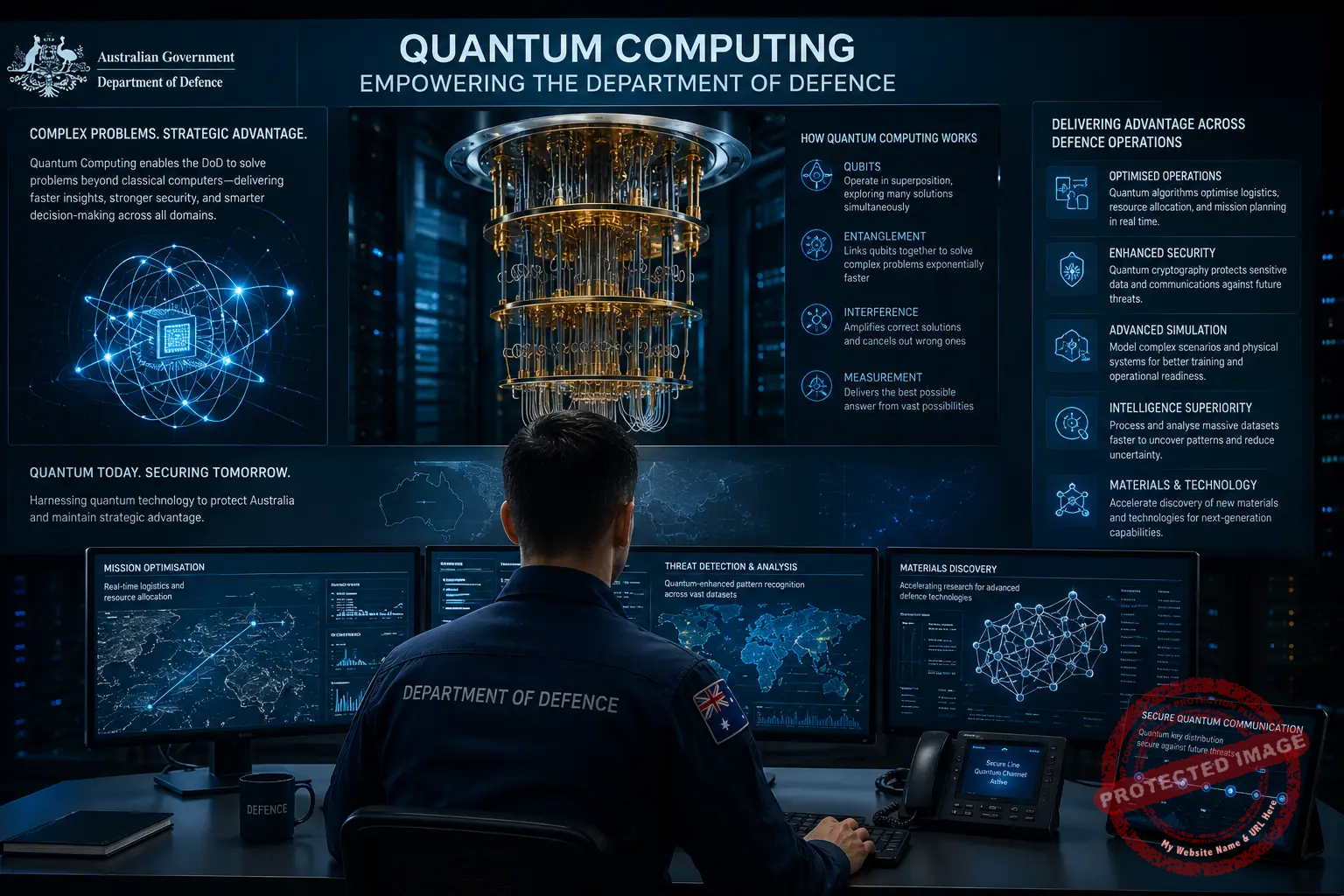
The Federal Government Is Preparing for the Quantum Era
President Trump’s June 2026 quantum announcement should be viewed less as a declaration that Washington has suddenly discovered quantum computing and more as a decision to move it from the research shelf into the government’s operational plans.
The two executive orders signed on June 22 establish a dual-track strategy:
- Expand American leadership in quantum computing, sensing, and networking.
- Accelerate migration to post-quantum cryptography (PQC) before future quantum systems can break today’s encryption standards.
This represents one of the most significant technology modernization efforts undertaken by the federal government in decades.
Quantum Computing Already Exists — So Why the Announcement Now?
Quantum computing is not a future concept.
It already exists today in laboratories, cloud platforms, and research facilities across the world. However, current systems remain relatively small, specialized, and error-prone.
Today’s quantum computers can:
- Run scientific experiments
- Test advanced algorithms
- Simulate quantum systems
- Train researchers and developers
What they cannot yet do is replace traditional data centers or supercomputers.
The government’s objective is therefore not to replace every server with a quantum processor. Instead, it is to identify specific problems where quantum systems may eventually outperform classical computing and begin building the infrastructure necessary to take advantage of those capabilities.
What Trump’s Executive Orders Mean for Federal Agencies
A New National Quantum Strategy
The executive order titled “Ushering in the Next Frontier of Quantum Innovation” directs the federal government to update its National Quantum Strategy within 180 days.
One of the most significant initiatives created by the order is:
QC-ADDS Program
Quantum Computer for Application Development and Discovery Science (QC-ADDS)
The program aims to:
- Deploy at least one science-focused quantum computer at a Department of Energy facility
- Make the system available to researchers
- Accelerate scientific discovery
- Establish performance benchmarks
The Department of Energy (DOE) will serve as the government’s primary evaluation and deployment center for quantum technologies.
Federal Collaboration
The DOE will coordinate efforts with:
- NASA
- National Science Foundation (NSF)
- National Institute of Standards and Technology (NIST)
- Department of Defense (DoD)
- National Quantum Coordination Office
This collaborative structure is intended to eliminate duplication and accelerate adoption across federal agencies.
Cybersecurity Becomes the First Major Quantum Use Case
Why Encryption Is Now a National Security Issue
The second executive order focuses on protecting America from future quantum-enabled cyberattacks.
A growing concern among security experts is known as:
“Harvest Now, Decrypt Later”
Adversaries can steal encrypted data today and store it until powerful quantum computers become available.
Once that happens, sensitive information protected by current encryption standards could potentially be exposed.
To address this threat, agencies must:
- Inventory critical systems
- Designate migration leaders
- Upgrade encryption infrastructure
- Implement NIST-approved post-quantum cryptography
Key deadlines include:
| Milestone | Deadline |
|---|---|
| NIST PQC Pilot Program | December 31, 2027 |
| Key Establishment Migration | December 31, 2030 |
| Digital Signature Migration | December 31, 2031 |
Because encryption touches nearly every federal system, cybersecurity may become the government’s first large-scale quantum implementation effort.
What Agencies Need to Do Right Now
Federal agencies cannot wait until 2030. Experts recommend immediate action:
Priority Steps
- Establish dedicated quantum migration teams.
- Inventory all cryptographic assets.
- Identify vulnerable systems.
- Create testing environments.
- Train cybersecurity personnel.
- Coordinate with NIST and federal working groups.
Organizations that begin early will likely experience lower migration costs and reduced security risk.
Who Are the Major Quantum Computing Providers?
The United States already has a vibrant quantum ecosystem.
Enterprise Leaders
IBM
IBM remains one of the most advanced quantum providers.
Key strengths include:
- Superconducting quantum processors
- IBM Quantum cloud platform
- Extensive developer ecosystem
- Planned fault-tolerant “Starling” system targeted for 2029
Google Quantum AI
Google continues to lead fundamental quantum research.
Recent breakthroughs include:
- Willow quantum processor
- Significant progress in error correction
- Quantum algorithm development
Microsoft
Through Azure Quantum, Microsoft provides:
- Access to multiple hardware vendors
- Quantum software tools
- Hybrid cloud integration
Amazon Web Services
AWS offers:
- Amazon Braket
- Cloud-based quantum experimentation
- Access to multiple hardware architectures
Specialized Quantum Companies
IonQ
Leader in trapped-ion quantum systems.
Quantinuum
A major player in enterprise quantum solutions and quantum software.
Rigetti Computing
Focused on superconducting quantum processors.
D-Wave
Known for:
- Quantum annealing
- Optimization applications
- Hybrid computing models
Atom Computing
Leader in neutral-atom quantum architectures.
Infleqtion
Focuses on quantum sensing and quantum networking technologies.
PsiQuantum
Developing large-scale photonic quantum computers.
Diraq
Advancing silicon-spin quantum processors.
GlobalFoundries
Supporting domestic manufacturing of quantum hardware components.
When Will the U.S. Government Actually Use Quantum Computing?
The Short Answer: It Already Does
Federal agencies have been experimenting with quantum technologies for years.
Participants include:
- NASA
- DOE National Laboratories
- NIST
- Defense Advanced Research Projects Agency (DARPA)
- Intelligence Community partners
- Federal contractors
The difference today is that quantum initiatives are moving from experimentation toward deployment planning.
Expected Government Adoption Timeline
2026–2027
- Strategy updates
- Procurement planning
- Pilot projects
- PQC migration programs
2028
- Quantum sensing priorities established
- Potential deployment of DOE quantum systems
- Expanded agency experimentation
2030–2031
- Broad implementation of post-quantum cryptography
- Increased operational use of quantum-enhanced technologies
While fully fault-tolerant quantum computing remains several years away, federal adoption has clearly begun.
How Different Government Departments May Use Quantum Computing
Department of Energy (DOE)
The DOE is expected to become the federal government’s primary quantum research hub.
Potential applications include:
- Battery research
- Materials science
- Catalyst discovery
- Clean energy development
- Nuclear simulations
Quantum systems are particularly well suited for modeling molecular interactions that overwhelm traditional computers.
Department of Defense (DoD)
Defense applications could include:
- Logistics optimization
- Mission planning
- Advanced materials
- Secure communications research
- Signal processing
Quantum sensors may provide operational benefits even sooner than quantum computers themselves.
Potential sensor uses include:
- GPS-independent navigation
- Magnetic anomaly detection
- Precision timing
- Battlefield sensing
Intelligence Community
Intelligence agencies are evaluating both offensive and defensive implications.
Focus areas include:
- Encryption security
- Foreign technology monitoring
- Advanced analytics
- Counterintelligence protection
Federal officials recognize that America’s competitors are investing heavily in similar capabilities.
NASA
NASA is exploring several quantum-related initiatives.
Potential applications include:
- Deep-space navigation
- Space-based sensing
- Earth observation
- Planetary science
- Quantum networking experiments
Quantum sensors may significantly improve measurement accuracy for future missions.
Department of Commerce and NIST
NIST remains the cornerstone of federal quantum standards.
Responsibilities include:
- Cryptographic standards
- Technology certification
- Industry guidance
- Security frameworks
NIST’s post-quantum cryptography standards will form the foundation for future federal cybersecurity systems.
Health and Human Services (HHS)
Healthcare agencies could eventually leverage quantum simulation for:
- Drug discovery
- Molecular analysis
- Protein modeling
- Medical materials research
These applications remain primarily in the research phase but represent substantial long-term opportunities.
Department of Agriculture (USDA)
Potential future uses include:
- Crop optimization
- Fertilizer chemistry
- Supply chain analysis
- Climate modeling
- Resource management
While still speculative, agriculture may ultimately benefit from quantum-enhanced optimization and simulation capabilities.
The Workforce Challenge
Technology alone will not determine success.
The federal government must also build a skilled workforce capable of:
- Operating quantum systems
- Developing quantum algorithms
- Managing quantum security
- Evaluating vendor capabilities
Current plans include:
- University partnerships
- Fellowship programs
- Technical training initiatives
- Federal workforce development programs
Without sufficient talent, even the best technology investments may fail to deliver meaningful results.
The Bottom Line
Quantum computing is no longer just a laboratory experiment.
President Trump’s announcement signals that quantum technologies have become a matter of national infrastructure, economic competitiveness, and national security. The federal government’s first major success will likely come through post-quantum cybersecurity initiatives, followed by scientific research, sensing technologies, and eventually mission-critical applications across multiple agencies.
The road ahead will require patience, investment, and realistic expectations. Quantum computing will not replace classical computing overnight. However, agencies that begin preparing now will be positioned to capitalize on one of the most transformative technological shifts of the 21st century.
As the United States moves deeper into the quantum era, the question is no longer whether government will use quantum technologies—but how quickly it can build the expertise, infrastructure, and security framework necessary to use them effectively.
Researched and Written by Peter Jonathan Wilcheck
Reference Sites:
- White House: Ushering in the Next Frontier of Quantum Innovation
- White House: Securing the Nation Against Advanced Cryptographic Attacks
- NIST: Department of Commerce Announces Letters of Intent With 9 Companies for $2 Billion
- NIST: First Post-Quantum Encryption Standards
- Nextgov/FCW: Trump Signs 2 Orders to Prepare the US for a Quantum Future
Post Disclaimer
The information provided in our posts or blogs are for educational and informative purposes only. We do not guarantee the accuracy, completeness or suitability of the information. We do not provide financial or investment advice. Readers should always seek professional advice before making any financial or investment decisions based on the information provided in our content. We will not be held responsible for any losses, damages or consequences that may arise from relying on the information provided in our content.

 AAPL
AAPL AMD
AMD CIS.HA
 DELL
DELL IBM
IBM INTC
INTC MSFT
MSFT GOOG
GOOG HPE
HPE NVDA
NVDA TSLA
TSLA TMC
TMC MSI
MSI NOK
NOK OPEAZZX