



Quantum AI supply chains are not a distant fantasy in which a mysterious machine instantly fixes global trade. They are an emerging operating model: artificial intelligence interprets fast-moving data, operations-research software turns business rules into mathematical problems, and quantum or quantum-inspired optimizers are tested on the hardest combinations. Used carefully, this stack can help companies forecast demand, position inventory, choose routes, and respond to disruption. The near-term value comes mostly from AI and advanced classical computing. Quantum computing adds a promising experimental tool for selected optimization problems, not a universal replacement for established systems.
Why Global Supply Chains Are So Difficult
A supply chain is a network of interdependent decisions. A retailer deciding where to hold one product must consider expected sales, supplier lead times, port congestion, warehouse capacity, labor, transport cost, service commitments, tariffs, weather, and the risk of obsolescence. Multiply that decision by thousands of products, locations, vehicles, and time periods, and the number of possible plans can grow explosively.
This is why optimization matters. Many logistics tasks belong to a family of combinatorial problems: adding choices creates far more possible combinations than a planner can examine one by one. Classical solvers already handle large industrial models extremely well, particularly when the model is well designed. The opportunity is not to discard them. It is to improve the data entering the model, update it faster, and explore whether new computing methods can produce better feasible answers within the time available.
AI Creates a Live Picture of Demand and Risk
AI is the most mature part of the partnership. Machine-learning models can combine sales histories with promotions, seasonality, prices, weather, local events, search behavior, and economic indicators. Instead of relying on a single monthly forecast, planners can use continuously refreshed demand signals and probability ranges. That helps them distinguish a durable shift from a temporary spike and decide where safety stock is worth its carrying cost.

AI can also watch for weak signals of trouble. Natural-language systems can review supplier notices, news, regulatory updates, and shipment messages. Computer-vision systems can support inspection in factories and warehouses. Anomaly-detection models can flag unusual lead times, quality results, order changes, or transport patterns. These tools do not predict every disruption, but they can shorten the time between a warning sign and a human response.
AI turns signals into decisions.
Automation completes the practical picture. AI agents and rules-based systems can classify purchase requests, reconcile routine documents, recommend replenishment orders, or direct warehouse tasks. The best deployments preserve approval thresholds and audit trails. Procurement and logistics decisions affect cash, customers, safety, and supplier relationships; a confident-looking model output is not the same as a justified decision.
Where Quantum Computing Could Contribute
Quantum computing approaches problems differently from ordinary processors. Gate-model quantum computers manipulate quantum states through circuits, while quantum annealers are specialized systems designed to search energy landscapes associated with optimization problems. They are not interchangeable, and both face important limitations. Current hardware is noisy, constrained in size and connectivity, and expensive to integrate. Error-corrected, fault-tolerant machines capable of reliably running very deep algorithms remain a development goal.

Nevertheless, logistics offers relevant research questions. Vehicle routing, container assignment, production scheduling, supplier selection, and warehouse-network design can often be expressed as optimization models with binary choices and constraints. Researchers can map parts of these models to forms suitable for annealing or algorithms such as the Quantum Approximate Optimization Algorithm. A classical computer still prepares the data, decomposes the problem, tunes parameters, checks constraints, and validates the answer. The realistic architecture is hybrid.
Hybrid optimization keeps people involved.
One concrete research example comes from IBM and ExxonMobil researchers, who studied formulations for maritime inventory routing, a problem that combines vessel movements with product supply and demand. Their work is valuable because it exposes the engineering challenge: a useful business problem must be translated into a quantum-compatible mathematical form without losing the constraints that make the plan operational. It does not prove a broad quantum advantage over the best classical solvers.
Quantum annealing has also reached limited commercial pilots. D-Wave reports that Pattison Food Group used a hybrid quantum application to optimize aspects of e-commerce delivery scheduling and reduced a planning task from hours to minutes. That is an instructive case, but the result is vendor-reported and uses a hybrid service. It should be read as evidence that experimentation can solve a defined workflow, not as proof that quantum machines now dominate global logistics.
Quantum-Inspired Methods Matter Today
Companies do not need to wait for fault-tolerant hardware to learn from quantum research. Quantum-inspired algorithms run on classical computers but borrow ideas from annealing, tensor networks, or other mathematical techniques associated with quantum information. They may generate useful candidate solutions without using qubits at all. The label must be handled honestly: “quantum-inspired” is not “quantum-powered.” Its business value should be measured against strong classical baselines on cost, solution quality, speed, reliability, and energy use.
This benchmarking discipline is essential. A new optimizer can look impressive when compared with a spreadsheet, a simplistic heuristic, or an outdated model. The meaningful question is whether it improves on the best practical alternative while respecting every delivery window, capacity limit, labor rule, and contractual commitment.
The Combined Decision Loop
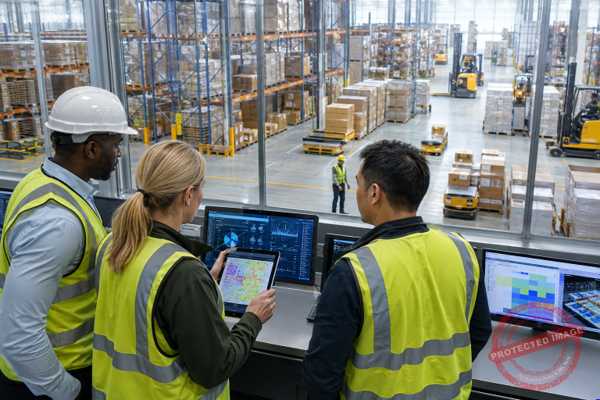
The strongest model is a decision loop, not a single algorithm. AI first estimates demand, delay probabilities, supplier risk, and travel times. A digital twin represents facilities, lanes, inventory, capacities, and policies. An optimizer then searches for a feasible plan, perhaps using classical methods alone or sending a carefully selected subproblem to a quantum, annealing, or quantum-inspired solver. Simulation stress-tests the plan against port closure, severe weather, a supplier failure, or a sudden change in trade policy. Human operators review the trade-offs, approve action, and feed outcomes back into the models.
Planning links models to operations.
That loop can support faster rerouting, better inventory placement, and more deliberate resilience. It may reveal that the lowest-cost network is too fragile, or that a small increase in stock at one regional hub sharply improves service during disruption. It can also expose conflicts among objectives. Minimizing fuel, delivery time, cost, and emissions simultaneously rarely produces one perfect answer; leaders must decide which trade-offs are acceptable.
Successful teams also separate recommendation speed from execution authority. A model may recalculate a plan continuously, while operational changes still pass through role-based approvals. That distinction protects against cascading errors and gives planners time to confirm that a mathematically feasible option is physically, commercially, and ethically workable.
“Real time” should also be used carefully. AI can process incoming events rapidly, but data may be late or wrong. Quantum solvers do not examine millions of business variables “at the same time” in the ordinary sense, nor do they guarantee an instant optimum. Encoding, queueing, repeated runs, classical coordination, and validation all take time. For many decisions, a trustworthy answer in fifteen minutes is more valuable than an opaque answer in fifteen seconds.
What Companies Should Do Now
The sensible starting point is a painful, bounded decision with measurable economics: delivery-slot assignment, dock scheduling, safety-stock placement, or rerouting after a disruption. Establish a high-quality classical baseline. Improve master data and event feeds. Define hard constraints, acceptable service levels, and the business value of a faster or better solution. Then test AI forecasts and alternative optimizers in a sandbox or digital twin before connecting them to execution systems.
Governance belongs in the design. Teams should monitor forecast error across products and regions, protect commercially sensitive data, document overrides, and test whether automated recommendations disadvantage smaller suppliers or create unsafe workloads. NIST’s AI Risk Management Framework offers a useful structure for mapping, measuring, managing, and governing AI risk, even though each company must adapt it to its operations.
Quantum experiments should have explicit exit criteria. A pilot is worthwhile when the problem has a suitable mathematical structure, the comparison is fair, integration costs are counted, and the organization gains reusable knowledge. It should stop or change direction when a classical method is clearly superior. That is not failure; it is disciplined research.
A Practical Answer
Can quantum computing and AI help global supply chains? Yes, but on different timelines and with different responsibilities. AI already improves visibility, forecasting, anomaly detection, and automation when it is supported by good data and human oversight. Quantum computing is a credible research path for selected optimization and simulation workloads, yet today it remains largely hybrid, experimental, and highly dependent on classical systems. Quantum-inspired techniques provide an additional bridge, provided their performance is judged rather than assumed.
The real opportunity is not a magical optimizer. It is a better decision system: richer signals, clearer models, faster scenario testing, stronger governance, and people who understand the operational consequences. Supply chains will remain exposed to uncertainty. Quantum and AI can help organizations navigate that uncertainty more intelligently, but resilience will still come from sound network design, trusted partnerships, prepared teams, and choices leaders are willing to explain.
Reference Sites
NIST — AI Risk Management Framework — https://www.nist.gov/itl/ai-risk-management-framework
McKinsey & Company — Succeeding in the AI supply-chain revolution — https://www.mckinsey.com/capabilities/operations/our-insights/succeeding-in-the-ai-supply-chain-revolution
IEEE Xplore — Formulating and Solving Routing Problems on Quantum Computers — https://doi.org/10.1109/TQE.2021.3049230
D-Wave — Pattison Food Group Optimizes E-Commerce Delivery with Quantum-Hybrid Solutions — https://www.dwavequantum.com/resources/application/pattison-food-group-optimizes-e-commerce-delivery-with-quantum-hybrid-solutions/
Frontiers in ICT — A Hybrid Solution Method for the Capacitated Vehicle Routing Problem Using a Quantum Annealer — https://doi.org/10.3389/fict.2019.00013
Researched and Written by Peter Jonathan Wilcheck
Questions for Readers
- Which supply-chain decision in your organization would benefit most from faster scenario testing?
- What evidence would convince you that a quantum or quantum-inspired optimizer is better than your current approach?
- Where should human approval remain mandatory as AI-driven supply chains become more autonomous?
- Please add your personal commentary and share the experience, concern, or opportunity you believe deserves more attention.
Post Disclaimer
The information provided in our posts or blogs are for educational and informative purposes only. We do not guarantee the accuracy, completeness or suitability of the information. We do not provide financial or investment advice. Readers should always seek professional advice before making any financial or investment decisions based on the information provided in our content. We will not be held responsible for any losses, damages or consequences that may arise from relying on the information provided in our content.

 AAPL
AAPL AMD
AMD CIS.HA
 DELL
DELL IBM
IBM INTC
INTC MSFT
MSFT GOOG
GOOG HPE
HPE NVDA
NVDA TSLA
TSLA TMC
TMC MSI
MSI NOK
NOK OPEAZZX