


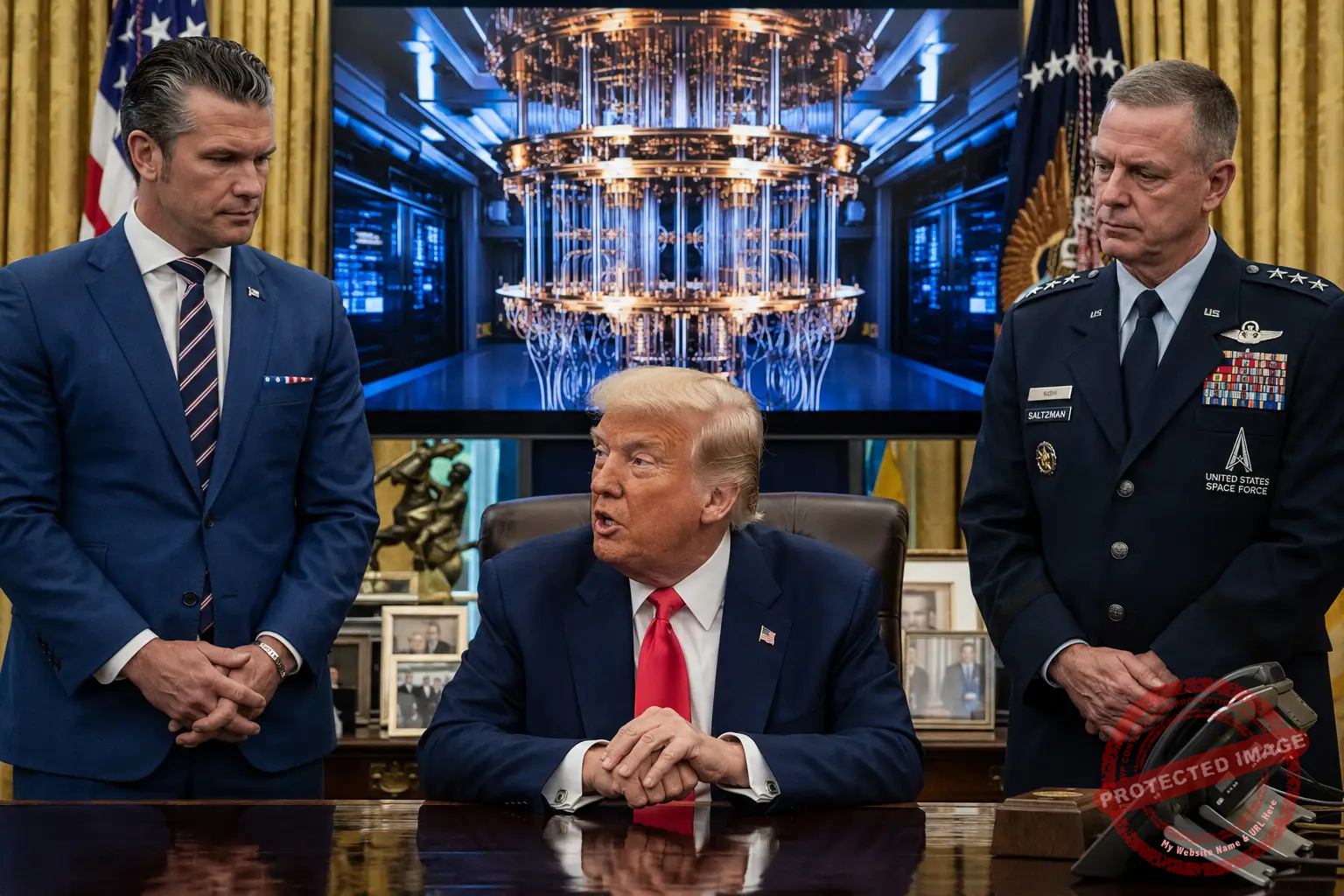
The White House’s June 2026 quantum announcements mark a clear shift in U.S. technology policy: quantum is no longer being treated mainly as a long-range research frontier. It is now being framed as strategic infrastructure, cybersecurity preparation, industrial policy, and national security capability at the same time.
That matters because quantum technology is not a single invention. It is a family of technologies that includes quantum computers, quantum sensors, quantum networks, specialized chips, cryogenic systems, control electronics, software, standards, and a workforce capable of building and operating all of it. The new federal push tries to move several of these pieces together rather than waiting for one breakthrough to arrive on its own.
On June 22, President Trump signed an executive order titled “Ushering in the Next Frontier of Quantum Innovation”. The order calls for an updated National Quantum Strategy within 180 days and establishes the Quantum Computer for Application Development and Discovery Science effort, or QC-ADDS. The stated goal is to pursue a quantum computer at a scale that can begin a new era of quantum-enabled scientific discovery, with the intent to place at least one such system at a Department of Energy facility and make it available to the scientific community where possible.
That language is important. It does not claim that general-purpose, fault-tolerant quantum computing is already here. Instead, it sets a national target and orders agencies to define the technical specifications, partnership models, evaluation tools, and manufacturing support needed to get there. The following day, the Department of Energy announced its Quantum Genesis initiative, which aims to develop and deploy scientifically relevant, fault-tolerant quantum computing capability for research and development by 2028. DOE described low hundreds of logical qubits as a target for demonstrations in its “Q Competition,” focused on scientific applications such as chemistry, materials science, plasma physics, and high-energy physics.
The phrase “logical qubits” deserves attention. Today’s physical qubits are fragile. They lose information through noise, heat, vibration, stray fields, and control errors. A logical qubit is built from many physical qubits arranged with error correction so that useful information can survive long enough to perform meaningful computations. That is why raw qubit counts alone are not a reliable measure of progress. A machine with fewer but higher-quality logical qubits could be more scientifically valuable than a larger machine made from unstable physical qubits.
This is also why the 2028 target is ambitious. Fault tolerance requires advances in hardware, error correction, fabrication, measurement, software, and system integration. The White House order acknowledges this indirectly by asking DOE to establish technical specifications and by calling for a national center to assess quantum computing system performance. In a field where claims can easily outrun reality, independent benchmarking will be essential. It will help distinguish useful progress from impressive demonstrations that do not yet solve practical problems.
The second major executive order, “Securing the Nation Against Advanced Cryptographic Attacks”, addresses the other side of the quantum coin: risk. A sufficiently powerful quantum computer could break widely used public-key cryptography, including systems that protect government communications, financial transactions, software updates, and digital identity. The danger is not only future decryption. Adversaries can collect encrypted data now and store it until quantum capabilities mature, a threat often called “harvest now, decrypt later.”
The order directs civilian federal agencies to move high-value assets and high-impact systems to post-quantum cryptography for key establishment by December 31, 2030, and for digital signatures by December 31, 2031. It also assigns NIST, CISA, NSA, OMB, and the Office of the National Cyber Director roles in guidance, oversight, implementation, and reporting. NIST’s role is especially central because it released the first three finalized post-quantum encryption standards in 2024: FIPS 203 for key encapsulation and FIPS 204 and FIPS 205 for digital signatures.
This migration will be more difficult than a software update. Cryptography is embedded in browsers, cloud services, firmware, identity systems, industrial controls, payment infrastructure, procurement rules, and old systems whose owners may not fully know where cryptographic dependencies reside. The new order’s call for cryptographic inventories and a cryptographic bill of materials reflects that reality. Before an organization can modernize its encryption, it has to know where encryption is being used.
Quantum sensors form the third pillar of the announcement. The quantum innovation order directs defense leadership to identify at least three next-generation quantum sensor projects to prioritize for fielding by September 30, 2028. It also instructs Commerce, Energy, NSF, and NASA to develop five-year plans for quantum sensing and networking. This is one of the most practical near-term areas of quantum technology. Quantum sensors can exploit atomic and photonic effects to measure time, acceleration, gravity, magnetic fields, and other physical quantities with high precision.
The defense relevance is straightforward. Modern military operations depend heavily on GPS for navigation, timing, and coordination. But GPS can be jammed, spoofed, or denied. Quantum-enabled clocks, inertial sensors, magnetometers, and gravimeters could help aircraft, ships, submarines, ground units, and space systems navigate or maintain timing when satellite signals are unreliable. These technologies are not magic replacements for GPS, and many remain difficult to ruggedize for operational environments. But they address a real vulnerability and may mature sooner than large-scale quantum computers.
The industrial policy piece is equally significant. The federal government is not only funding research; it is trying to build domestic capacity. In May, the Commerce Department announced letters of intent totaling about $2.013 billion in proposed CHIPS Act incentives for nine companies, according to coverage of the department’s announcement by The Quantum Insider. The proposed awards include support for quantum foundries and companies working across superconducting, trapped-ion, neutral-atom, photonic, silicon-spin, and other approaches. IBM and GlobalFoundries were identified for major foundry-related investments, including superconducting wafer fabrication and broader domestic manufacturing capacity.
This portfolio approach is prudent. No one yet knows which quantum architecture will dominate, or whether several will coexist for different applications. Superconducting systems may excel in one set of engineering tradeoffs, trapped ions in another, neutral atoms or photonics in another. By investing in foundries, components, and multiple modalities, the government is trying to avoid betting the national strategy on a single technical winner too early.
The workforce provisions may prove just as important as the machines. The quantum innovation order instructs the Office of Personnel Management to develop a government-wide QIST recruitment and retention strategy within 90 days. It also directs the Department of Labor and NSF to improve training pathways, define QIST-relevant occupations, track labor needs, and build National QIST Workforce Development Institutes. That reflects a simple constraint: quantum progress depends on people who understand physics, engineering, computer science, cybersecurity, fabrication, systems integration, and mission use cases. The talent pool is still thin.
Taken together, these announcements show a government trying to compress timelines. The United States wants useful quantum computers for science, quantum-safe encryption for government systems, quantum sensors for contested environments, and a domestic supply chain that is not dependent on fragile or adversarial sources. The strategy is ambitious, but it is not automatically self-fulfilling. Deadlines do not solve error correction. Executive orders do not manufacture dilution refrigerators, low-loss photonics, high-fidelity gates, or trained engineers overnight.
The most responsible way to read the announcement is neither as hype nor as routine policy. It is a serious acceleration signal. The federal government is saying that quantum technology has crossed from laboratory promise into strategic planning. The next test will be execution: measurable technical milestones, transparent benchmarking, realistic procurement, secure supply chains, and a disciplined migration to post-quantum cryptography before the threat becomes urgent.
If the United States succeeds, the payoff will not be a single “quantum moment.” It will be a new layer of national capability: better tools for science, stronger protection for data, more resilient navigation and timing, and an industrial base prepared for a technology cycle that may define the next several decades.
Researched and written by Peter Jonathan Wilcheck
Post Disclaimer
The information provided in our posts or blogs are for educational and informative purposes only. We do not guarantee the accuracy, completeness or suitability of the information. We do not provide financial or investment advice. Readers should always seek professional advice before making any financial or investment decisions based on the information provided in our content. We will not be held responsible for any losses, damages or consequences that may arise from relying on the information provided in our content.

 AAPL
AAPL AMD
AMD CIS.HA
 DELL
DELL IBM
IBM INTC
INTC MSFT
MSFT GOOG
GOOG HPE
HPE NVDA
NVDA TSLA
TSLA TMC
TMC MSI
MSI NOK
NOK OPEAZZX