


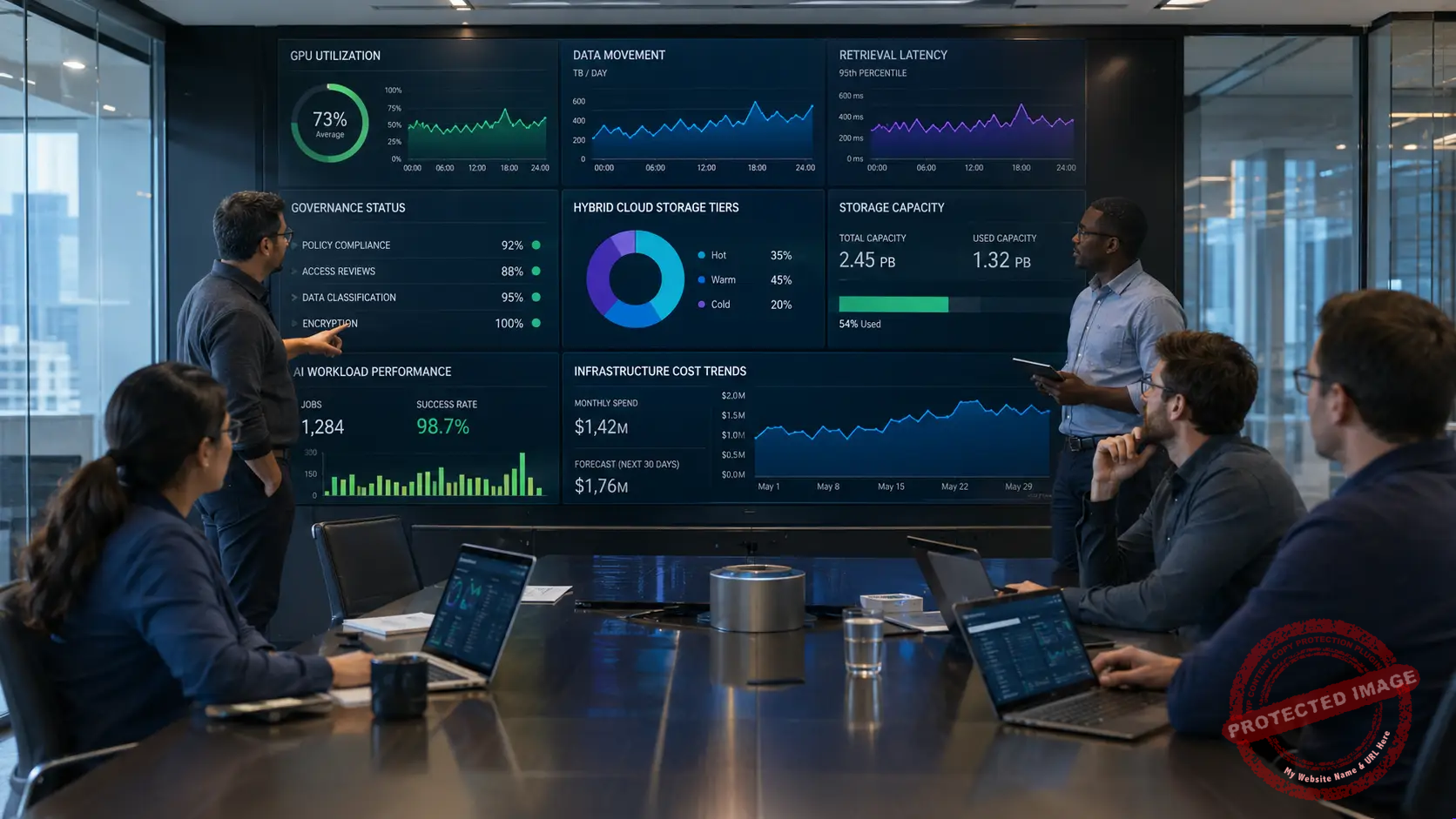
AI strategy is entering a more serious phase. The first wave was about models, experiments, and proofs of concept. The next wave is about whether enterprises can deliver reliable, governed, low-latency access to the data those models need every time they answer a question, trigger a workflow, or support a decision.
The thesis is simple: storage is no longer a passive repository in the AI stack. For enterprise AI, especially retrieval-augmented generation, agentic workflows, and multimodal analytics, storage is becoming an active performance, governance, and cost-control layer. Companies that treat storage as an afterthought will discover that better models cannot compensate for stale data, slow retrieval, fragmented metadata, or uncontrolled infrastructure spend.

Why Storage Matters Now
Generative AI has made data infrastructure visible to the boardroom. A chatbot demo can run on a small curated dataset. A production AI assistant serving sales, legal, engineering, and customer operations cannot.
Google Cloud’s 2025 AI infrastructure report highlights the importance of cost efficiency, data quality, security, and distributed workflows in AI adoption. IDC has also projected that by 2028, most enterprise AI workloads will run on fit-for-purpose hybrid infrastructure, optimized for performance, cost, and compliance. That matters because AI data rarely lives in one place. It sits across cloud object stores, on-premises file systems, SaaS platforms, data lakes, archives, and edge locations.
The business issue is not “Where do we store the data?” It is “Can the AI system find the right data, prove it is allowed to use it, retrieve it fast enough, and keep the answer current?”
That question belongs as much to storage architecture as it does to model engineering.
RAG Turns Storage Into a Real-Time System
Retrieval-augmented generation, or RAG, changes the role of enterprise storage. In traditional analytics, storage often feeds batch jobs. In production RAG, storage sits directly in the inference path. Every user question may require the system to search source documents, retrieve relevant chunks, check metadata, apply access permissions, and return context to the model in milliseconds.
This is why a RAG architecture is not just a vector database with a bucket attached. A mature RAG environment needs a durable source archive, parsed chunks, embeddings, vector indexes, keyword indexes, metadata, access controls, and retention policies. Each has a different performance and governance profile.
If those layers drift apart, business trust breaks down. The model may retrieve an old policy. A user may see information they should not access. An index rebuild may become expensive enough that teams avoid updating it. The result is not just technical debt. It is AI risk.
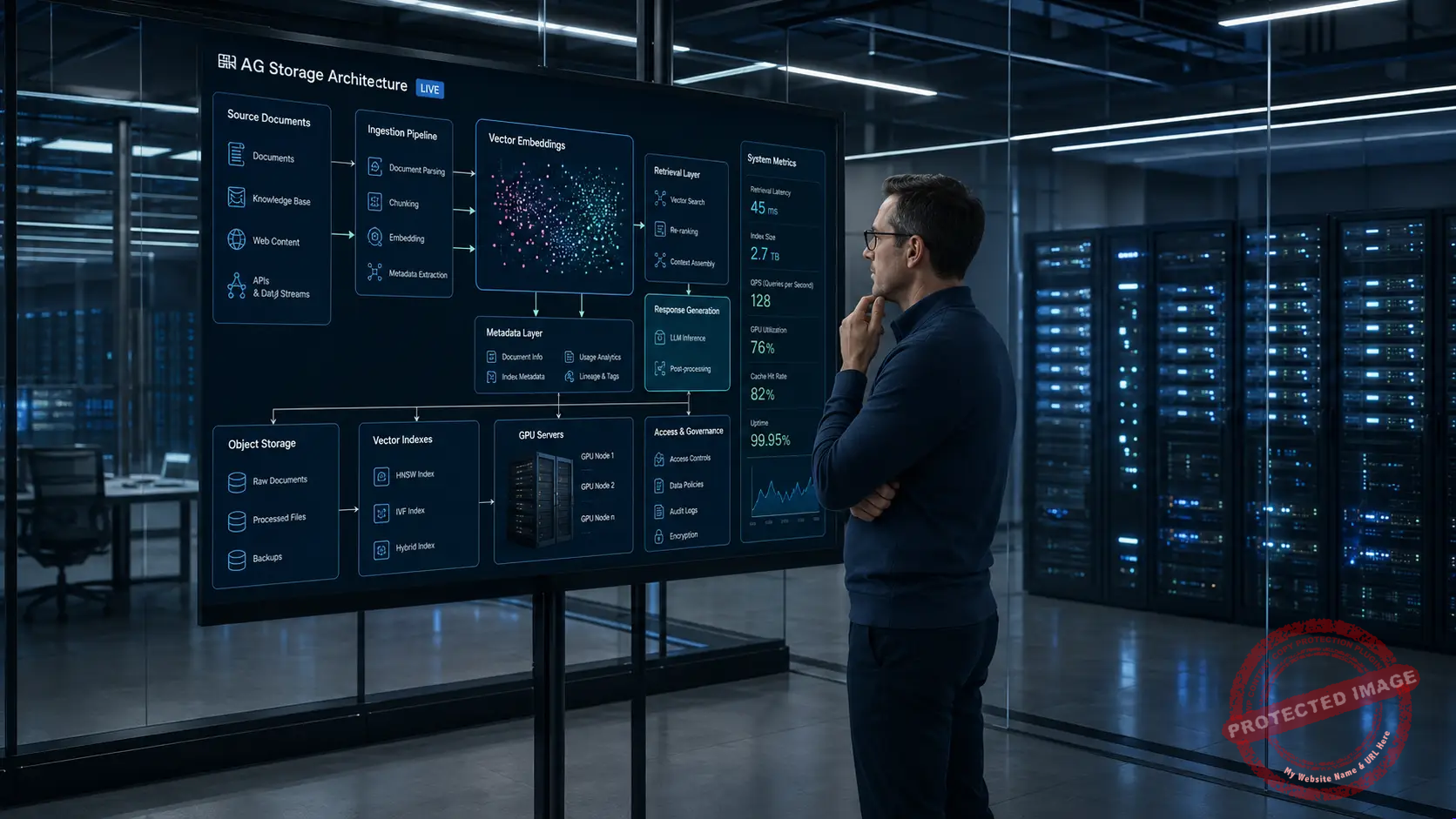
AI Storage Must Balance Speed, Scale, and Governance
The old storage tradeoff was usually performance versus capacity. AI adds a third dimension: context integrity.
Speed still matters. Flash, NVMe, parallel file systems, and low-latency networking are important for training pipelines, embedding generation, and hot retrieval indexes. Scale also matters because unstructured enterprise data grows quickly: documents, transcripts, images, logs, contracts, design files, and operational records all become possible AI context.
But governance is what separates enterprise AI from a clever prototype. AI-ready storage must preserve lineage, permissions, retention status, version history, and metadata. Without that, organizations cannot confidently answer basic questions: Which source did this answer come from? Was the data current? Was the user authorized? Can we delete or retain the underlying record according to policy?
NVIDIA’s AI Data Platform direction reflects this shift: storage is being connected more closely with accelerated computing so enterprises can prepare, index, secure, and retrieve data where it lives. The deeper point is architectural. AI systems need storage platforms that can participate in intelligence, not merely hold files.
The Cost Problem Is Really a Data Movement Problem
AI infrastructure cost is often discussed in terms of GPUs. That is understandable, but incomplete. The hidden cost is moving, duplicating, reprocessing, and re-indexing data because the storage architecture was not designed for AI workflows.
Every unnecessary copy adds expense. Every full re-embedding cycle consumes compute. Every cross-cloud retrieval pattern can introduce latency, egress fees, and operational complexity. Every disconnected metadata system makes governance more manual.
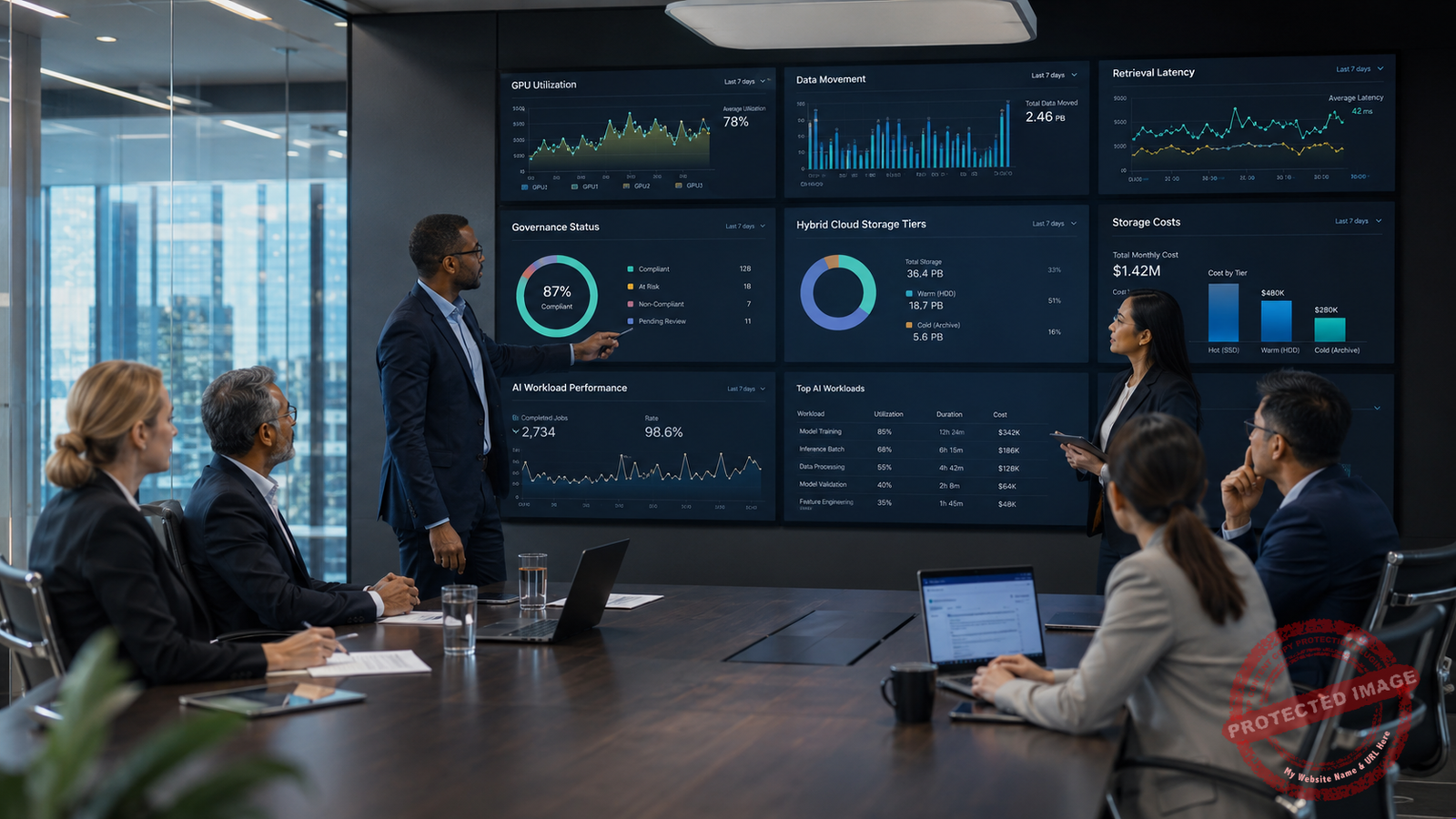
This is where hybrid architecture becomes practical, not ideological. Some data belongs close to GPUs. Some belongs in scalable object storage. Some must remain on-premises for sovereignty or latency reasons. Some can live in colder tiers until needed. The winning pattern is not “all cloud” or “all on-prem.” It is placing data according to its access pattern, risk profile, and business value.
For business leaders, this reframes the storage conversation. The goal is not simply cheaper capacity. The goal is a lower cost per trusted AI answer.
What Leaders Should Ask Before Scaling AI
The most useful question for the reader to ask is: “Is our storage architecture designed for production AI behavior, or only for storing AI data?”
That question exposes the gap quickly. If the organization cannot explain how data is indexed, refreshed, secured, versioned, and retrieved under load, it is not ready to scale AI confidently.
A practical AI storage strategy should answer five questions:
- Which data is hot, warm, cold, regulated, or business-critical?
- Where do embeddings, source documents, metadata, and access controls live?
- How quickly must retrieval happen for each AI use case?
- How will indexes stay fresh as enterprise data changes?
- What is the cost of moving, copying, reprocessing, and governing the data?
These questions create a bridge between technical and executive teams. Engineers can map the workload. Finance can see cost drivers. Risk leaders can inspect controls. Business owners can connect infrastructure decisions to AI outcomes.
Looking forward: AI Will Reward the Best Data Foundations
The next phase of AI will not be won only by choosing the largest model or the most powerful GPU cluster. It will be won by organizations that make trusted enterprise data available to AI systems with speed, control, and economic discipline.
Storage for AI is now a strategic layer. It determines how current the answer is, how fast the system responds, how much the workflow costs, and whether the business can trust the result. The practical takeaway is clear: before scaling AI, modernize the data foundation beneath it. Models create the interface, but storage determines whether the intelligence is usable.
What is your opinion: are most enterprises investing enough in the storage and data infrastructure behind AI, or are they still over-focused on models?
Add your personal commentary, especially if you have seen AI projects succeed or struggle because of data access, latency, governance, or cost.
Reference Sites:
- NVIDIA AI Data Platform for Enterprise: https://www.nvidia.com/en-us/data-center/ai-data-platform/
- Google Cloud 2025 State of AI Infrastructure Report: https://cloud.google.com/resources/content/state-of-ai-infrastructure
- IDC / Intel AI Infrastructure in 2025: https://www.intel.com/content/dam/www/central-libraries/us/en/documents/2025-02/idc-ai-infrastructure-balancing-dc-and-cloud-investments-brief.pdf
- Scality RAG Data Storage Design Guide: https://www.solved.scality.com/rag-data-storage-for-enterprise-ai/
- IDC AI Infrastructure Spending Forecast: https://my.idc.com/getdoc.jsp?containerId=prUS53894425
Researched and written by: Peter Jonathan Wilcheck
Post Disclaimer
The information provided in our posts or blogs are for educational and informative purposes only. We do not guarantee the accuracy, completeness or suitability of the information. We do not provide financial or investment advice. Readers should always seek professional advice before making any financial or investment decisions based on the information provided in our content. We will not be held responsible for any losses, damages or consequences that may arise from relying on the information provided in our content.

 AAPL
AAPL AMD
AMD CIS.HA
 DELL
DELL IBM
IBM INTC
INTC MSFT
MSFT GOOG
GOOG HPE
HPE NVDA
NVDA TSLA
TSLA TMC
TMC MSI
MSI NOK
NOK ECDH26.CME
 OPEAZZX