


AI infrastructure has moved from experimental GPU boxes to production-grade platforms where every design choice affects latency, reliability, and cost per token. The hard part is no longer simply “getting GPUs.” The harder question is how to turn expensive accelerator capacity into predictable, high-utilization inference service without making the platform brittle.
For teams serving large language models, multimodal models, embedding pipelines, or real-time AI features, GPU infrastructure now sits at the center of product performance. A good stack must schedule GPUs intelligently, isolate workloads, batch requests efficiently, monitor hardware deeply, and scale without wasting idle capacity.
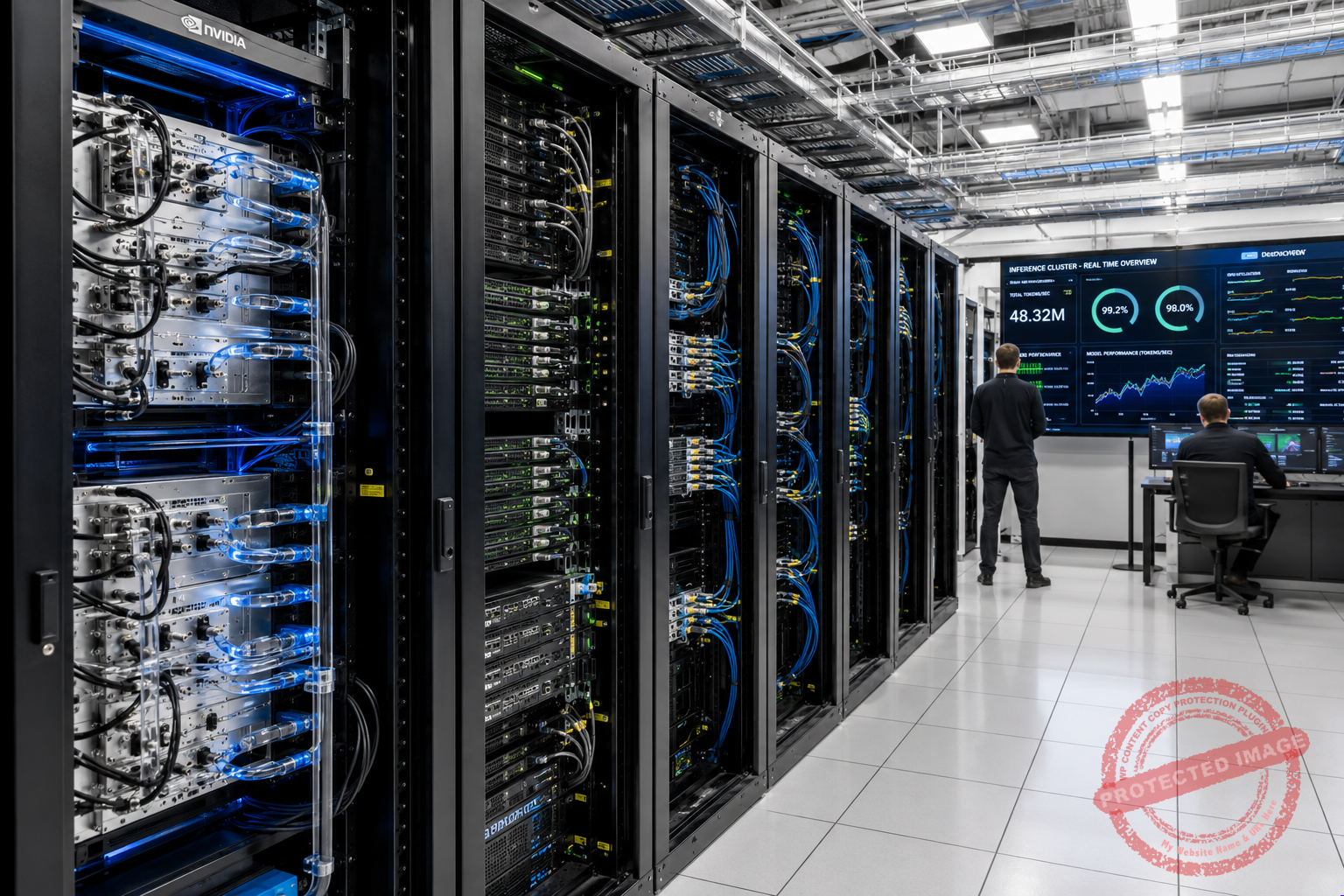
Why GPU Inference Infrastructure Is Different
Training infrastructure is usually optimized for long-running jobs, high-bandwidth interconnects, checkpointing, and distributed compute efficiency. Inference infrastructure has a different pressure profile. It must handle variable request traffic, user-facing latency targets, model versioning, rolling deployments, and cost-sensitive throughput.
A production inference platform has to answer practical questions:
- Which workloads need full GPUs, and which can share?
- How do we avoid underutilized accelerators during low traffic?
- How do we protect latency-sensitive services from noisy neighbors?
- How do we monitor GPU memory, thermals, errors, and utilization?
- How do we scale without turning every deployment into custom platform work?
The right answer is rarely one tool. It is usually a layered architecture.
Layer 1: GPU Access and Scheduling
Kubernetes remains a common control plane for AI infrastructure because it gives teams a consistent way to package, deploy, observe, and scale services. But GPUs are not ordinary CPU or memory resources. They require drivers, runtime configuration, health tracking, and device-aware scheduling.
The NVIDIA Kubernetes device plugin exposes GPUs to Kubernetes workloads and helps the cluster track available GPU devices. This is the foundation for running GPU-enabled containers in Kubernetes without manually wiring every node.
Dynamic Resource Allocation, or DRA, is becoming important because it gives Kubernetes a more flexible model for requesting and assigning specialized hardware such as GPUs. Instead of treating accelerators as simple count-based resources, DRA supports richer resource claims and device classes. That matters as clusters become more heterogeneous and as workloads require specific GPU features, memory sizes, or sharing modes.
Layer 2: Workload Isolation with MIG
Not every inference workload needs an entire high-end GPU. Embedding services, small models, batch classifiers, internal copilots, and lower-throughput endpoints may perform well on a slice of a GPU.
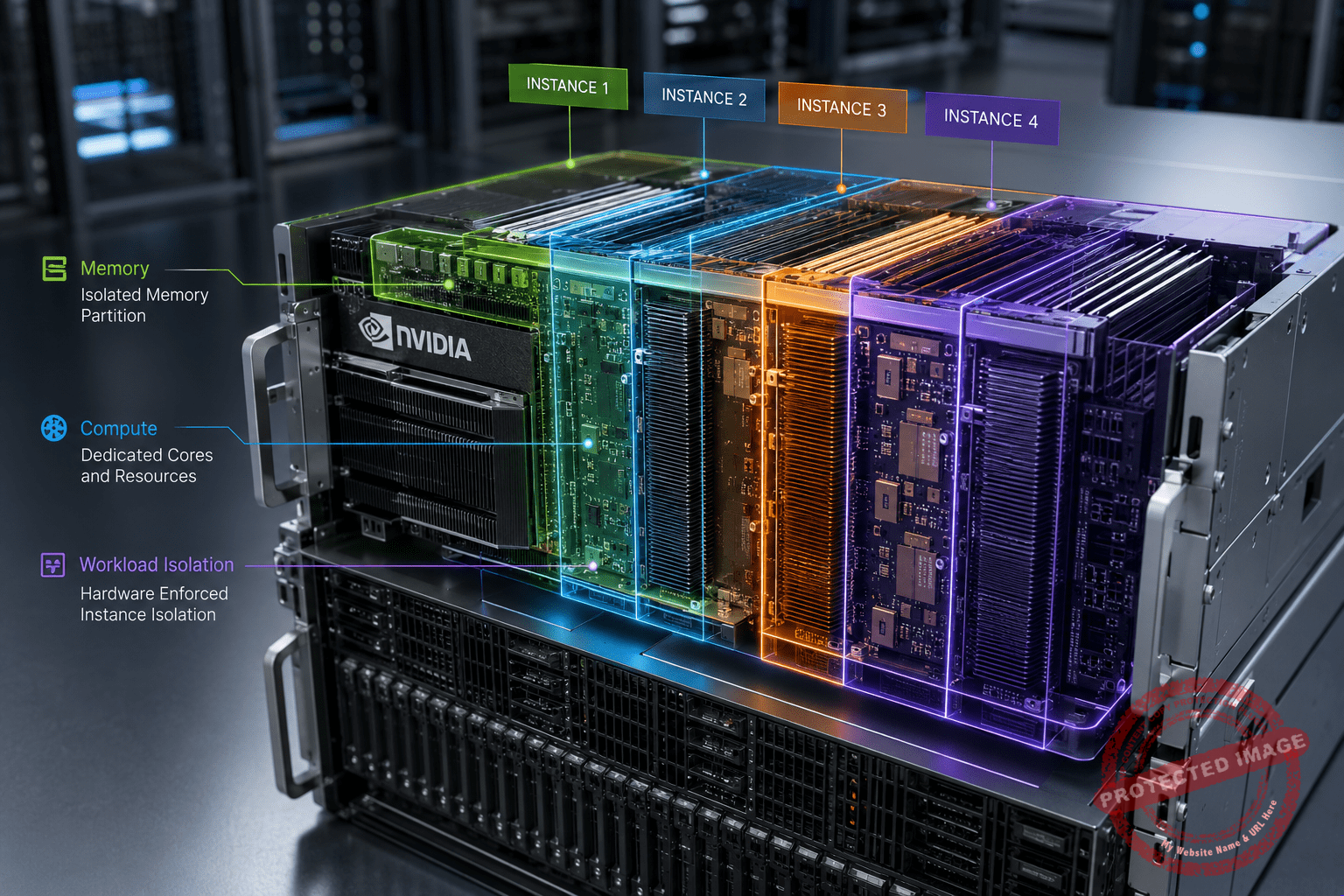
NVIDIA Multi-Instance GPU, commonly called MIG, allows supported GPUs to be partitioned into isolated GPU instances with dedicated compute and memory resources. NVIDIA documents that MIG can partition supported GPUs into as many as seven instances, depending on the GPU and configuration.
This is useful when a platform team wants better density without giving every team a full accelerator. It also helps separate workloads so one service does not consume all GPU memory or compute capacity on a shared card.
Layer 3: Serving Engines That Keep GPUs Busy
Raw GPU allocation is only part of the story. The serving engine determines how efficiently requests become GPU work.
For traditional ML models and many deep learning workloads, NVIDIA Triton Inference Server provides production serving capabilities such as concurrent model execution and dynamic batching. Dynamic batching combines inference requests into batches at serving time, improving throughput when the model and latency budget support it.
For LLMs, vLLM has become influential because it is designed specifically for high-throughput language model serving. Its documentation describes it as a fast and easy-to-use library for LLM inference and serving. The broader vLLM ecosystem focuses on techniques such as efficient KV cache handling, continuous batching, and multi-GPU serving patterns.
The key principle is simple: GPUs are most cost-effective when they stay saturated. Poor batching, fragmented memory, or naive request handling can leave expensive hardware waiting while users still experience latency.
Layer 4: Kubernetes-Native Model Serving
Once a team has GPU nodes and serving runtimes, the next challenge is operational consistency. Model services need routing, autoscaling, rollout controls, health checks, observability, and framework flexibility.
KServe provides Kubernetes custom resources for serving ML models and abstracts much of the complexity around autoscaling, networking, health checks, and server configuration. This kind of abstraction matters because platform teams should not need to reinvent deployment plumbing for every model.
A practical pattern is:
- Use Kubernetes as the orchestration layer.
- Use the NVIDIA device plugin or DRA for GPU resource exposure and allocation.
- Use MIG where workload isolation and GPU sharing make sense.
- Use vLLM for LLM serving or Triton for broader inference serving.
- Use KServe or a similar model-serving layer for deployment consistency.
Layer 5: Observability Beyond Basic Utilization
GPU infrastructure cannot be managed well with CPU-style metrics alone. Platform teams need visibility into GPU memory, utilization, temperature, power, errors, and workload behavior.
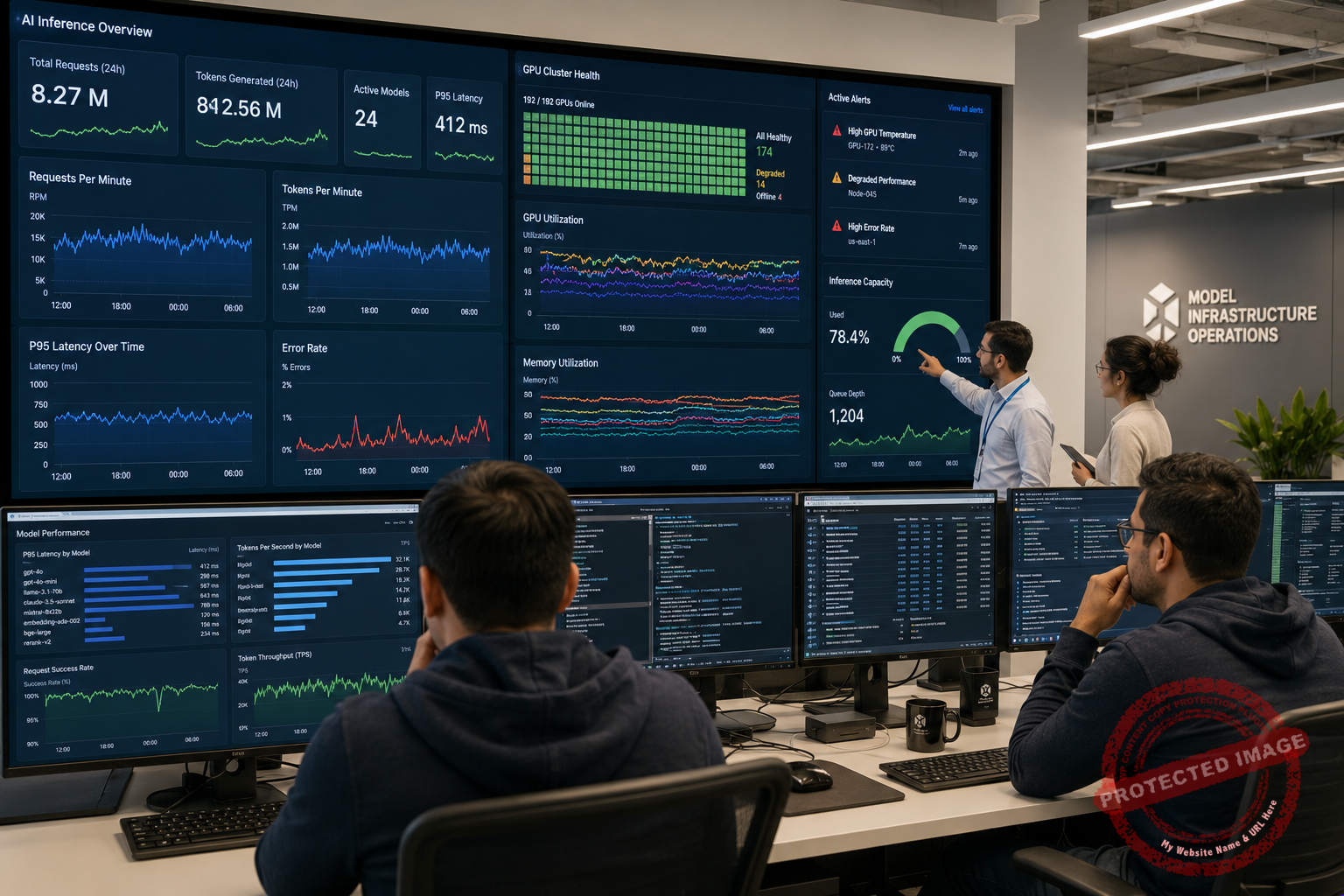
NVIDIA DCGM-Exporter exposes GPU metrics through an HTTP endpoint for monitoring systems such as Prometheus. This enables infrastructure teams to build dashboards and alerts around accelerator health and efficiency.
The most useful GPU dashboards typically include:
- GPU utilization by workload
- GPU memory used and available
- Power draw and thermal behavior
- Error conditions and health status
- Request latency and queue depth
- Tokens per second or predictions per second
- Cost per request or cost per million tokens
Cloud, Bare Metal, or Hybrid?
The best hosting model depends on workload maturity.
Cloud GPUs are attractive when demand is uncertain, time-to-market is critical, or teams need fast access to multiple accelerator types. They also reduce the burden of hardware operations. The tradeoff is that long-running high-utilization workloads may become expensive, and capacity availability can vary.
Bare metal GPU hosting can be compelling when workloads are stable, utilization is high, and teams need predictable performance or more direct control over hardware, networking, and storage. The tradeoff is operational responsibility: firmware, drivers, replacement planning, cooling, monitoring, and capacity forecasting all become part of the platform.
Hybrid models are increasingly practical. Teams may run steady inference workloads on owned or dedicated infrastructure while bursting experiments, training jobs, or temporary campaigns into cloud capacity.
Practical Best Practices
Start with workload profiling before choosing hardware. Measure model size, KV cache growth, request length, batch behavior, latency targets, and traffic variability.
Separate training and inference clusters unless there is a strong reason to combine them. Their scheduling patterns and reliability expectations differ.
Use MIG for density, but do not assume every workload benefits from slicing. Some models need full GPU memory bandwidth, larger VRAM, or predictable whole-device performance.
Treat batching as a product decision, not only an infrastructure setting. Higher batching can reduce cost, but too much waiting can harm user-facing latency.
Build observability early. GPU clusters become expensive mysteries when teams only look at application logs and CPU metrics.
Design for model lifecycle management. Production systems need canary deployments, rollback paths, model versioning, and compatibility checks.
Looking Forward
Production GPU inference infrastructure is not defined by one accelerator, one framework, or one hosting model. It is defined by how well the layers work together: GPU scheduling, workload isolation, serving efficiency, Kubernetes-native deployment, and deep observability.
The teams that win on AI infrastructure will not simply buy more GPUs. They will build platforms that turn GPU capacity into reliable, measurable, and cost-efficient model performance.
Reference Sites
- NVIDIA Kubernetes Device Plugin: https://github.com/NVIDIA/k8s-device-plugin
- Kubernetes Dynamic Resource Allocation: https://kubernetes.io/docs/concepts/scheduling-eviction/dynamic-resource-allocation/
- NVIDIA Multi-Instance GPU User Guide: https://docs.nvidia.com/datacenter/tesla/mig-user-guide/latest/
- NVIDIA Triton Inference Server Documentation: https://docs.nvidia.com/deeplearning/triton-inference-server/user-guide/docs/
- NVIDIA DCGM-Exporter Documentation: https://docs.nvidia.com/datacenter/dcgm/latest/gpu-telemetry/dcgm-exporter.html
Researched and written by: Peter Jonathan Wilcheck
Post Disclaimer
The information provided in our posts or blogs are for educational and informative purposes only. We do not guarantee the accuracy, completeness or suitability of the information. We do not provide financial or investment advice. Readers should always seek professional advice before making any financial or investment decisions based on the information provided in our content. We will not be held responsible for any losses, damages or consequences that may arise from relying on the information provided in our content.

 AAPL
AAPL AMD
AMD CIS.HA
 DELL
DELL IBM
IBM INTC
INTC MSFT
MSFT GOOG
GOOG HPE
HPE NVDA
NVDA TSLA
TSLA TMC
TMC MSI
MSI NOK
NOK OPEAZZX