


November’s grid-sensing debate puts connected meters, feeder measurements, transformer health, and verified demand flexibility at the center of a growing industrial challenge.
A modern data center depends on much more than the equipment inside its server halls. Electricity must cross transmission lines, pass through substations and transformers, and arrive within operating limits that also protect neighboring customers. Understanding that physical path is becoming an increasingly consequential application of the Internet of Things.
A November 4 analysis from grid-monitoring supplier EGM highlights a specific gap: smart meters describe conditions at customer connections, but utilities also need measurements along the network supplying them. Combined with government research on data-center oscillations and industry flexibility demonstrations, the discussion points toward a practical priority: make large electrical loads observable before assuming they can be managed safely or efficiently. 123
This is not a claim that sensors create unlimited power. It is a case for better evidence about the infrastructure already carrying it, the loads requesting access, and the responses available when conditions change.
The missing view between substation and meter
Advanced metering infrastructure helps utilities understand consumption at the edge of their networks. But a meter’s record does not describe every conductor, connection, or transformer between a customer and the substation. EGM’s November commentary argues that feeder measurements complement meter data rather than replacing it. 1
The supplier describes measuring electrical quantities such as current and voltage alongside conductor temperature and environmental conditions. Its underlying proposition is straightforward: consumption records and asset-condition measurements answer related but different questions. Knowing how much electricity a customer used is not identical to knowing how the supplying circuit behaved. 1
For a utility evaluating a data-center connection, that distinction matters. Historical demand, anticipated growth, equipment ratings, protection settings, and local conditions must all inform the assessment. Measurements may help refine those judgments, but they cannot eliminate transmission constraints, permitting requirements, or the need to reinforce equipment.
EGM also identifies a less visible challenge: correctly mapping meters to transformers, laterals, and feeders. If that connectivity map is wrong, an apparently precise analysis can assign demand or a voltage event to the wrong part of the network. Better instrumentation needs dependable asset records as well as communications. 1
A data center is not always a steady load
The Department of Energy’s Office of Electricity described another measurement problem in May: synchronized activity in AI training systems can produce repetitive fluctuations in electrical demand. Some oscillations may interact adversely with equipment elsewhere on the grid. That makes the timing of observations important, not merely the average amount of electricity consumed. 2
DOE’s account explains that phasor measurement units monitor quantities including voltage, current, and frequency, and are useful for low-frequency oscillations. But the filtering involved in estimating phasors can miss or misrepresent faster behavior. Simply increasing the reporting rate does not remove every measurement limitation. 2
Point-on-wave recordings preserve higher-resolution waveform information and can capture faster dynamics. The tradeoff is data volume: continuous waveform streams create storage and communications burdens. DOE summarizes a hybrid approach combining phasor and waveform measurements as a practical path for monitoring large-load oscillations. 2
For operators, the lesson is accessible. A monthly bill, an interval meter reading, and a high-speed waveform recorder are not interchangeable descriptions of the same phenomenon. The instrument and sampling approach must match the operational question being asked.
Transformer health belongs in the picture
A substation transformer is part of the physical connection between grid infrastructure and electricity users. Monitoring the supplying network should therefore include attention to equipment condition, not only the customer’s requested megawatts. A healthy-looking consumption graph cannot establish that every asset carrying the load is healthy.
A September 2026 Department of Energy peer-review presentation describes NMRSense research led by Sandia National Laboratories, with Harvard University and Hitachi Energy collaborators. The project explores compact nuclear magnetic resonance sensing and interpretation of transformer-oil measurements to assess condition. Its reported work includes detecting contaminants of interest in aged oil. 4
Crucially, the presentation lists prototype completion, testing, and demonstration among future steps. It should not be read as evidence that a finished sensor is already installed across utility substations or data-center campuses. Its statements about longer equipment life and reduced failures are prospective impacts, not demonstrated fleet-wide outcomes. 4
The broader operational implication is still valuable: electrical infrastructure has a condition history. Connected monitoring can help provide evidence for maintenance decisions, but qualified engineers must interpret that evidence within equipment specifications, inspection practices, and operating procedures.
Visibility is not automatic grid control
The phrase “smart grid” can blur several distinct capabilities. Monitoring records a condition. Analysis interprets it. A control system changes equipment behavior under defined authority and constraints. Adding connected sensors does not automatically authorize a data center to switch grid equipment or a software model to override protection.
A hypothetical example makes the distinction clearer. Suppose a utility sees rising loading on a feeder serving a data-center campus. Engineers would examine the relevant measurements, equipment limits, expected duration, and network configuration. Any response could involve an agreed customer action, an authorized operating change, or longer-term reinforcement, depending on the circumstances.
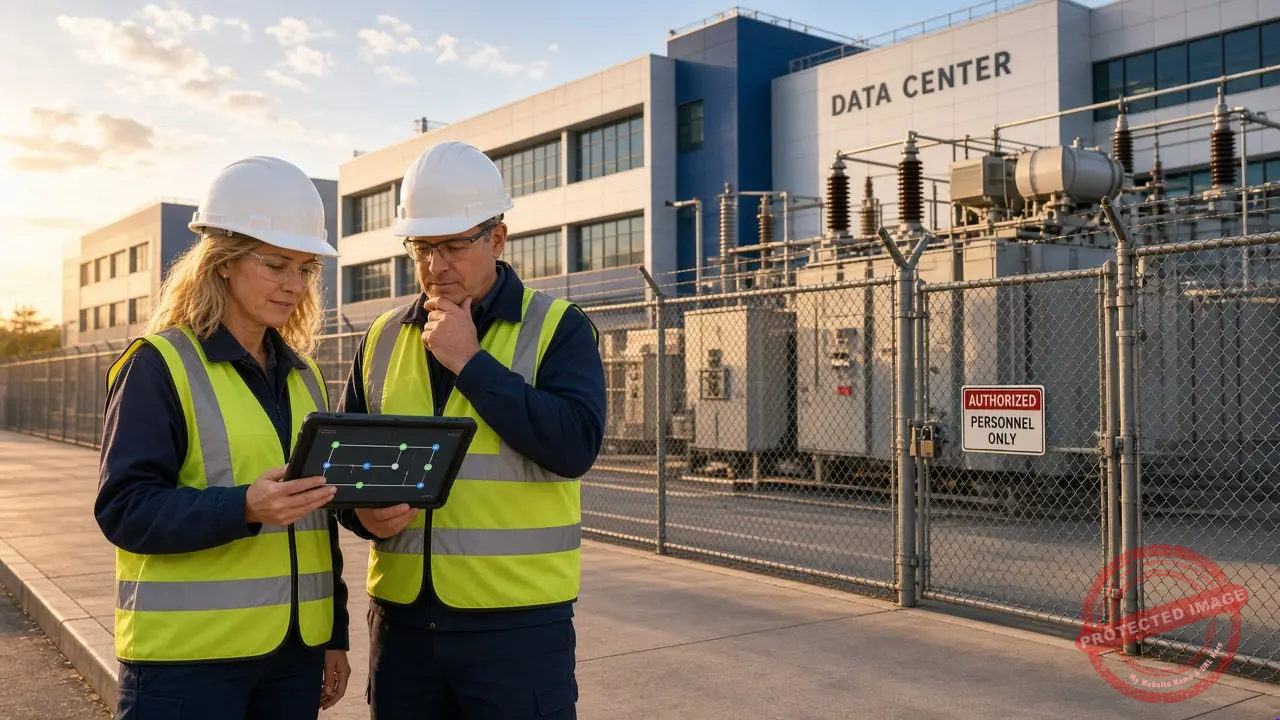
A tablet outside a substation can display information; it is not evidence that someone standing there should operate high-voltage equipment. Communications security, access rights, measurement quality, and clearly assigned responsibilities belong alongside the sensors in any deployment plan.
Flexible demand must become a verified service
Some data-center electricity demand can be adjusted rather than treated as permanently fixed. Google’s March 19 announcement reported integrating one gigawatt of demand-response capacity into long-term contracts with multiple United States utilities. The company describes limiting or shifting a portion of machine-learning workloads to reduce local power demand during selected periods. 5
That figure is contracted capacity reported by Google, not a measurement of one gigawatt being continuously reduced, newly generated, or simultaneously available everywhere. The company explicitly notes limits to flexibility and says the capability will exist only at certain locations. 5
Michael Terrell, Google’s head of advanced energy, presents demand response as one component of responsible electricity growth alongside new energy resources and planning. His account connects workload flexibility to utility relationships rather than suggesting that computing can simply disappear whenever the grid is constrained. 5
For an industrial customer, the practical questions concern timing and obligations. How much demand can change, with what notice, for how long, and under which service constraints? Which measurements demonstrate delivery, and what happens when the requested response conflicts with operational requirements?
Demonstrations are testing the operating relationship
EPRI’s DCFlex initiative says nine active demonstration sites are testing data-center flexibility. Its work spans grid-informed facility design, utility programs, interconnection practices, planning, and distribution-connected data centers. These are attempts to develop workable operating frameworks, not a universal guarantee of faster connections or lower customer bills. 3
That breadth matters because flexibility involves more than scheduling a computing task. A utility needs a response it can account for; a facility needs to preserve the services it has promised; and both need evidence of what happened at the electrical connection. Connected meters and suitable monitoring help connect a request with an observed result.
A useful evaluation should include the period after an event. Reducing demand briefly may defer work rather than eliminate its energy requirement. Operators should examine recovery and any subsequent load increase, instead of treating a short reduction as permanent energy savings.
What industry leaders should ask before expanding
Data-center developers and utilities can turn these developments into concrete procurement questions. Which assets are measured, how often, and with what confidence? Are timestamps aligned? Can the readings be associated reliably with the correct feeder, transformer, and customer connection? What becomes unavailable when communications fail?
The operating plan should distinguish measured demand from forecast demand, equipment ratings from available service, and contracted flexibility from delivered response. A proposed campus load is not an observed operating profile. Likewise, an estimated improvement from additional sensing is not a verified increase in connection capacity.
Success should be assessed through defined trials and engineering review: whether measurements identify relevant conditions, whether agreed actions produce the intended response, and whether normal service is maintained within established requirements. No single dashboard should be treated as proof of reliability, safety, or economic value.
Consider a joint field review at a campus boundary. The facility manager brings the planned operating schedule; the utility engineer brings network limits and maintenance information. Together they compare actual readings with the assumptions used in the connection study. An unexplained discrepancy becomes an investigation, not an excuse to raise a rating. This is where connected information becomes useful to industry: it gives different organizations a shared basis for questions, while preserving the engineering authority needed to decide whether an operational change is appropriate for that particular site and circumstance.
Looking ahead: connect the grid evidence, not just the devices
The timely IoT opportunity around data centers is industrial and physical. It lies in connecting the meter, the supplying network, equipment-condition information, and the people responsible for operating them. November’s feeder-visibility discussion adds urgency, while earlier government research and active demonstrations show the wider engineering work already underway. 123
Sensors will not substitute for transformers, transmission projects, or generation. Better observations can, however, support more informed decisions about maintenance, connection studies, and demand flexibility. For data centers and the communities sharing their grid, that is the more credible promise of IoT: not effortless power, but a clearer, testable understanding of how power is used and delivered.
Written by: Peter Jonathan Wilcheck and Ray Anderson.
References
- EGM, November 4, 2026: Digitizing The Missing Middle: Feeder Intelligence for AMI 1.0 Through 2.0
- U.S. Department of Energy, May 28, 2026: Monitoring Oscillations from Large Data Centers
- EPRI: Data Center Flexible Load Initiative (DCFlex), current program overview
- Todd Monson and collaborators, DOE TRAC Peer Review, September 2026: Developing Nuclear Magnetic Resonance Sensor for Real-Time Monitoring of Transformer Health
- Michael Terrell, Google, March 19, 2026: A new milestone for smart, affordable electricity growth
Post Disclaimer
The information provided in our posts or blogs are for educational and informative purposes only. We do not guarantee the accuracy, completeness or suitability of the information. We do not provide financial or investment advice. Readers should always seek professional advice before making any financial or investment decisions based on the information provided in our content. We will not be held responsible for any losses, damages or consequences that may arise from relying on the information provided in our content.

 AAPL
 AMD
 CIS.HA
 DELL
 IBM
 INTC
 MSFT
 GOOG
 HPE
 NVDA
 TSLA
 TMC
 MSI
 NOK
 OPEAZZX
