


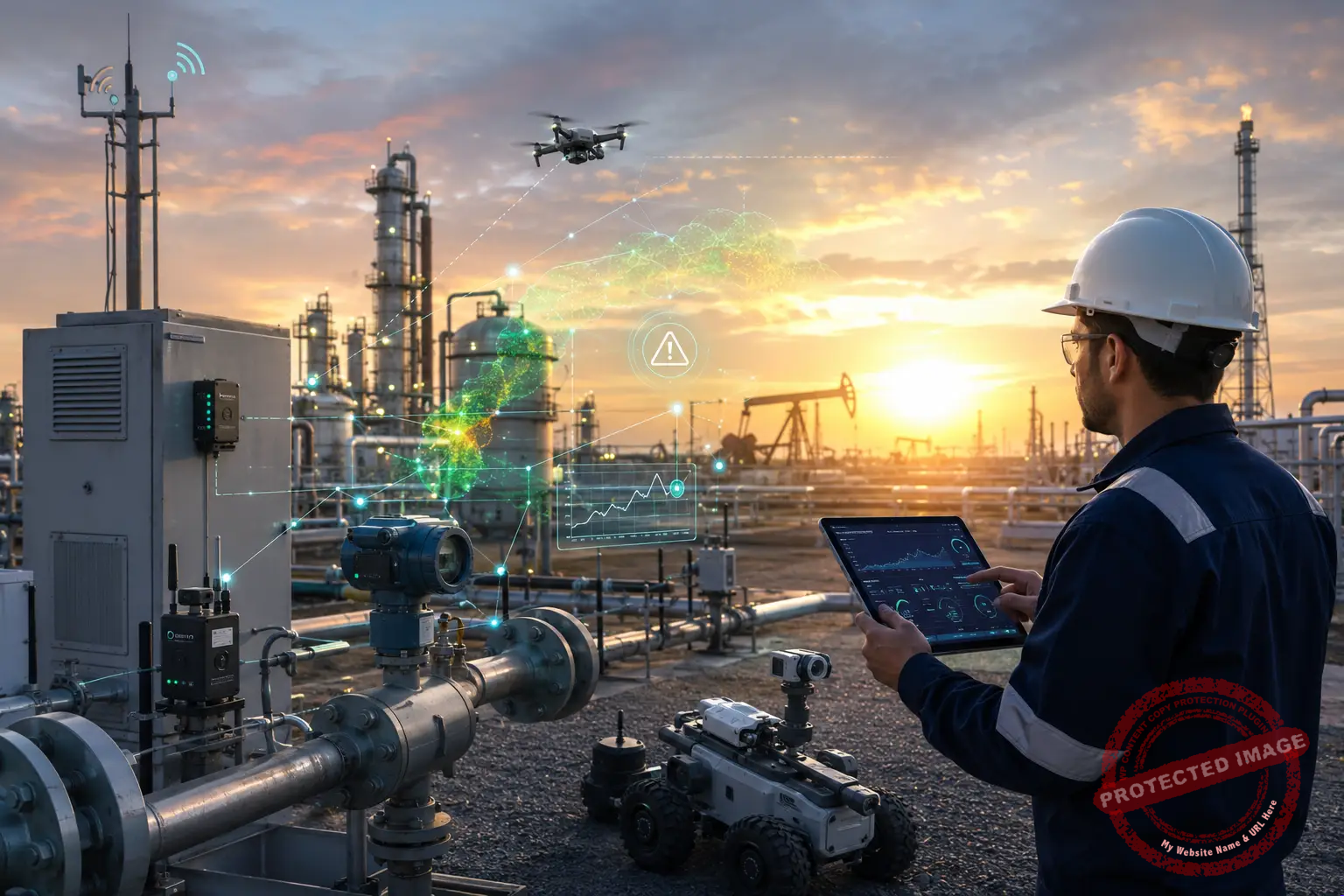
In this article, from my perspective, you will come to be aware the next five key points for Edge AI and Industrial IoT in the oil and gas industry:
- Why oil and gas IoT is entering a new phase
- Edge AI at wells, pipelines, refineries, and production systems
- Methane monitoring as an operational data problem
- Private 5G and rugged connectivity for remote assets
- Cybersecurity, governance, and the path to autonomous operations
Oil and gas companies have been collecting sensor data for decades, but 2026 is different. The newest wave of Internet of Things technology is not just about connecting pumps, valves, compressors, rigs, pipelines, and storage tanks to dashboards. The industry is moving toward field-level intelligence, where connected devices can sense conditions, run AI models locally, alert operators faster, and in some cases recommend or trigger operational actions within approved limits.
That matters because oil and gas operations are unusually hard environments for digital transformation. Assets are remote. Connectivity is uneven. Equipment is expensive. Downtime is costly. Safety risk is real. Environmental scrutiny is rising. Cybersecurity threats increasingly target operational technology, not just corporate systems. The most valuable IoT systems in this industry are therefore not the flashiest. They are the systems that keep working in constrained, hazardous, high-stakes environments.
The latest and greatest IoT technology for oil and gas is the convergence of four capabilities: edge AI, advanced methane sensing, private industrial connectivity, and secure operational technology architecture. Together, they are turning IoT from a monitoring layer into an operating layer.
Edge AI is the first major shift. Traditional IoT architectures often send data from field devices to cloud platforms for analysis. That model still has value for fleet-wide analytics, planning, reporting, and long-term optimization. But many oil and gas decisions cannot wait for perfect connectivity or centralized processing. A compressor vibration anomaly, a pressure deviation, a flare event, or a leak signature may need attention immediately.
Edge AI brings computing closer to the asset. Instead of streaming every data point back to a central system, an edge device can process sensor data at the well pad, production facility, refinery unit, pipeline station, or offshore platform. It can filter noise, detect anomalies, classify equipment behavior, and send only meaningful events upstream. This reduces bandwidth needs and improves response time. It also supports operations where connectivity is intermittent or expensive.
Recent industry activity shows where the market is heading. SLB and Qualcomm announced a 2026 collaboration focused on edge AI for energy operations, combining low-power edge computing with oilfield IoT workflows for wells, facilities, and production systems. The important point is not one vendor partnership. It is the direction of travel: AI is moving from a remote analytics layer into the physical operating environment.
For executives, the business case is strongest in three areas. First, predictive maintenance can become more precise because models can analyze equipment behavior continuously, not just during scheduled inspection windows. Second, production optimization can become more responsive because local systems can identify constraints and recommend adjustments faster. Third, safety can improve because edge systems can detect abnormal conditions, worker exposure risks, or equipment failures before they escalate.
Methane monitoring is the second major shift. Methane has become a board-level issue because it touches climate strategy, regulatory exposure, investor confidence, operational efficiency, and lost product value. The International Energy Agency’s 2026 methane analysis notes that the energy sector remains a major source of human-caused methane emissions and that many fossil fuel methane emissions can be reduced with existing technology. For oil and gas operators, that makes methane a data, workflow, and accountability challenge.
The new IoT model for methane is layered. Fixed sensors can monitor high-risk equipment and facilities. Mobile sensors can be mounted on vehicles. Drones can inspect hard-to-reach infrastructure. Aircraft and satellites can identify larger emission events across regions. Infrared cameras and other optical technologies can help local teams locate leaks. The value comes when these sources feed an integrated operational workflow rather than producing isolated reports.
In practical terms, an operator needs to know: Where is the emission? How large is it? Is it persistent or intermittent? Which asset is likely responsible? Is the release caused by faulty equipment, maintenance activity, abnormal operating conditions, or an unknown source? Who is accountable for investigation and repair? How quickly must the response happen? IoT is the connective tissue that turns detection into action.
The EPA’s Methane Super Emitter Program illustrates this shift toward technology-enabled transparency. The program is designed around third-party remote sensing technologies such as satellites, aerial vehicles, and mobile monitoring. Although implementation timelines have been extended, the underlying direction is clear: large methane events are becoming more visible, more traceable, and more operationally actionable.
The third major shift is private industrial connectivity. Oil and gas facilities often span wide geographies, metal-heavy environments, hazardous zones, and remote terrain. Wi-Fi alone is not enough for many use cases. Public cellular may not provide the reliability, coverage, control, or security required for mission-critical operations. This is why private LTE and private 5G are gaining attention.
Private 5G can support dense sensor deployments, worker safety wearables, autonomous inspection robots, drones, rugged tablets, machine vision cameras, and mobile field equipment. More importantly, it gives operators greater control over coverage, device access, traffic prioritization, latency, and segmentation. For a refinery, that can mean reliable connectivity for inspection teams and mobile maintenance. For upstream operations, it can mean better monitoring across well pads and production assets. For pipelines, it can support remote stations, video analytics, and anomaly detection.
The Qualcomm and Aramco Digital collaboration announced in 2025 is a useful signal. The companies described plans to commercialize edge AI industrial IoT technologies using Aramco Digital’s 450 MHz 5G industrial network to connect devices such as rugged equipment, robots, drones, cameras, sensors, and other IoT assets. That is the architecture many large industrial operators are moving toward: a managed industrial network, intelligent edge devices, and AI models that can be deployed and updated across the field.
Still, connectivity is not the strategy. It is the foundation. The strategic value comes from the use cases that the network enables. A private 5G deployment should be tied to measurable operational outcomes: fewer manual inspections, faster incident response, reduced downtime, better emissions visibility, improved worker safety, or more consistent production performance.
The fourth major shift is cybersecurity. Every connected sensor, gateway, controller, camera, robot, wearable, and edge server expands the operational attack surface. Oil and gas leaders cannot treat IoT cybersecurity as an IT add-on after deployment. It has to be designed into the architecture from the beginning.
NIST’s operational technology security guidance remains relevant here because OT systems have different requirements than ordinary enterprise IT. Availability, safety, reliability, deterministic behavior, and physical process integrity matter. A patching strategy that works for office software may be unacceptable for a production control environment. A network design that is convenient for data access may be risky if it exposes control systems or legacy assets.
A mature oil and gas IoT program should include asset inventory, network segmentation, identity and access management, secure remote access, vulnerability management, logging, incident response, and lifecycle planning for edge devices. It should also define clear boundaries between monitoring systems, advisory analytics, and systems that can influence operations. The closer AI moves to operational control, the more governance matters.
This is where many IoT programs succeed or stall. A pilot can prove that sensors work. A dashboard can prove that data exists. But scaled value requires operating discipline. Data quality must be trusted. Field teams must understand alerts. Maintenance workflows must be connected to findings. Cybersecurity teams must know which devices exist and how they are managed. Executives must fund not only the technology, but also the process redesign that makes the technology useful.
The strongest oil and gas IoT strategies in 2026 will not chase every new device. They will focus on high-value operational questions. Which assets create the most downtime? Which emissions sources carry the highest compliance and reputational risk? Which inspections are dangerous, slow, or expensive? Which production constraints could be detected earlier? Which remote decisions would improve if AI could run locally?
From there, leaders can build a practical roadmap. Start with critical assets and measurable outcomes. Choose sensors based on the failure modes or operating conditions that matter. Deploy edge computing where latency, bandwidth, or resilience justify it. Use private wireless where coverage and control are strategic. Integrate methane monitoring into work management systems. Treat cybersecurity as a design requirement, not a cleanup project.
The future of IoT in oil and gas is not a fully autonomous field with humans removed from the loop. The more realistic and valuable future is supervised autonomy: systems that observe continuously, detect problems earlier, recommend better actions, automate bounded tasks, and escalate decisions when human judgment is needed. That model fits the reality of oil and gas, where safety, reliability, and accountability are non-negotiable.
In 2026, the best IoT programs will be judged less by how many devices are connected and more by how intelligently those devices improve operations. Edge AI will make remote assets smarter. Methane sensing will make emissions more visible. Private 5G will make field connectivity more dependable. Strong OT security will make the whole system safer to scale. For oil and gas leaders, the opportunity is to move IoT out of the dashboard era and into the decision era.
References
- International Energy Agency: Global Methane Tracker 2026
- U.S. EPA: Methane Super Emitter Program
- SLB: SLB Collaborates with Qualcomm on Edge AI Solutions for Energy Operations
- Qualcomm: Qualcomm and Aramco Digital to Drive Industry Transformation Through Advanced Edge AI for Industrial IoT
- NIST: SP 800-82 Rev. 3, Guide to Operational Technology Security
Researched and written by Peter Jonathan Wilcheck
Post Disclaimer
The information provided in our posts or blogs are for educational and informative purposes only. We do not guarantee the accuracy, completeness or suitability of the information. We do not provide financial or investment advice. Readers should always seek professional advice before making any financial or investment decisions based on the information provided in our content. We will not be held responsible for any losses, damages or consequences that may arise from relying on the information provided in our content.
 AAPL
AAPL AMD
AMD CIS.HA
 DELL
DELL IBM
IBM INTC
INTC MSFT
MSFT GOOG
GOOG HPE
HPE NVDA
NVDA TSLA
TSLA TMC
TMC MSI
MSI NOK
NOK OPEAZZX