


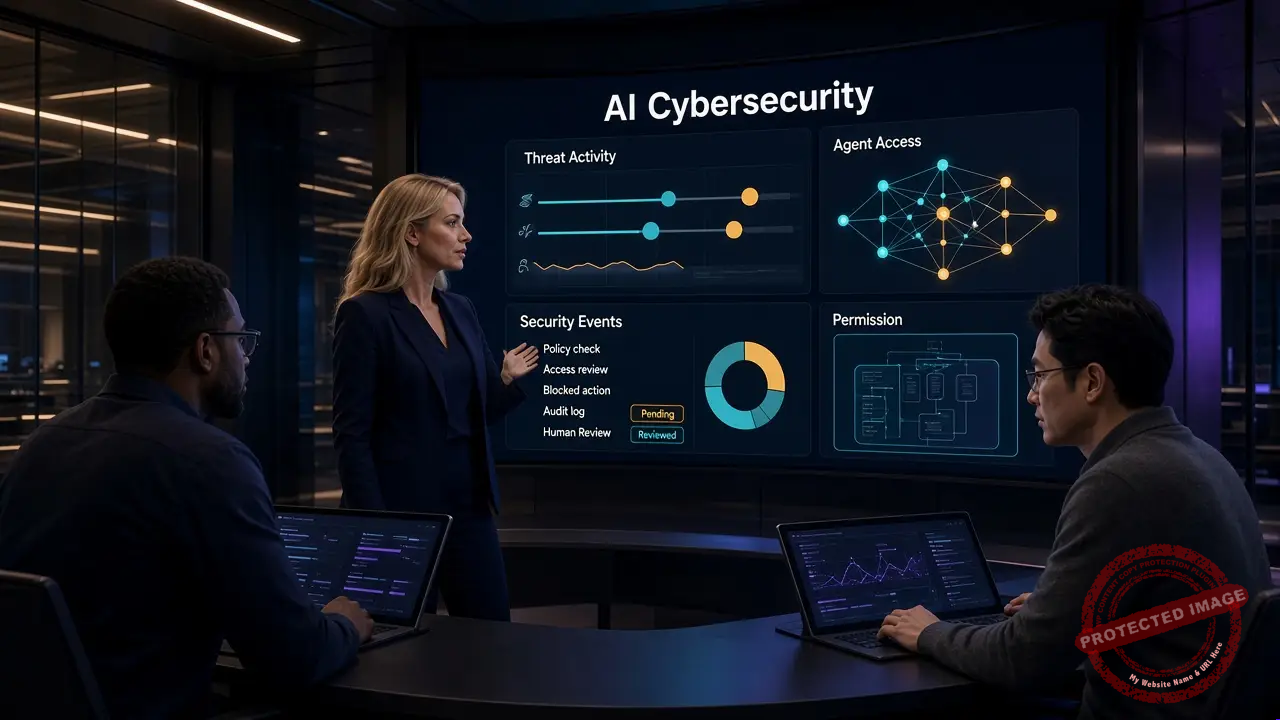
Prompt injection turns ordinary business content into a potential instruction channel. The enterprise response is moving beyond safer answers toward restricted permissions, runtime protection and accountable human decisions.
A security team can protect a laptop, verify an employee’s identity and still face a new problem when that employee delegates work to an AI agent. The agent may read legitimate documents, encounter hostile instructions inside them and use its authorized tools for something the employee never requested.
That is why protecting AI agents deserves a place alongside familiar conversations about using AI to detect threats. An assistant that drafts an answer creates one kind of exposure. An agent that can change files, invoke business applications or transmit information creates another: language can influence an action with operational consequences.
Recent primary evidence makes this a consequential security priority, without establishing any most-viewed ranking. Microsoft’s November 5 security update emphasizes task-scoped agent authority and containment, while NIST’s identity work documents substantial stakeholder engagement. Neither source measures this website’s readership.12
The durable question for enterprise leaders is straightforward: if an agent misinterprets what it reads, which independent control prevents the resulting unauthorized action?
Distinguish Security for AI From AI for Security
AI-enabled security uses models to help classify suspicious activity, summarize investigations or prioritize alerts. Securing AI concerns the models, tools, identities, data and execution environments that make AI applications work. Organizations need both, but purchasing an intelligent security assistant does not automatically secure every other agent in the business.
The difference becomes tangible in a hypothetical customer-service workflow. An agent reads a support attachment to prepare a response. Hidden instructions attempt to redirect it toward confidential account information. The attachment is evidence for the task, not authority to change the task.
OWASP describes this external-content pathway as indirect prompt injection. Its guidance warns that retrieval-augmented generation and fine-tuning do not fully mitigate the vulnerability. Better access to relevant documents can improve answers without making every document trustworthy.3
The defensive objective is therefore broader than filtering offensive language. It is preserving the boundary between material an agent should analyze and instructions it is actually authorized to follow.
Identity Establishes Who Acts, Not Whether the Action Is Right
Existing identity controls remain essential. An agent needs an owner, an understandable purpose and access appropriate to its work. However, authenticating a legitimate agent does not establish that every subsequent tool request reflects legitimate user intent.
NIST’s National Cybersecurity Center of Excellence reported receiving feedback from more than 600 commenters on its software and agentic AI identity concept paper. Its September update identifies software development as the first implementation use case for demonstrating agent identification, authentication and authorization.2
That is evidence of standards and implementation interest, not proof that a finished universal agent-security standard exists. It also does not establish adoption rates or attack prevalence.
For a business deployment, the practical implication is to connect identity with a narrower description of authority. A document-review agent may need access to a particular project folder. It does not necessarily need permission to share that folder externally, change user accounts or operate unrelated applications.
The enterprise should be able to identify the human sponsor, the agent instance and the approved task without treating them as interchangeable identities.
Put Boundaries Outside the Model
Microsoft’s update describes Dynamic Permissions as authority scoped to the current task and its duration, with risk-sensitive access changes and human approval for consequential actions. It also announces general availability of Microsoft Execution Containers, described as operating-system-enforced containment for local agents.1
Those are vendor descriptions of capabilities, not independently verified guarantees of effectiveness across every environment. The distinction is especially important because the same announcement describes some integrations as upcoming.
The broader architectural lesson is useful regardless of supplier: a model’s instruction to behave safely should not be the only barrier protecting sensitive resources. Filesystem access, network destinations, executable operations and business permissions need controls that do not depend solely on the model accepting a warning.
Least privilege reduces the consequences of a mistake but does not eliminate mistakes. A compromised agent can still misuse whatever access remains. Teams must consider both the size of that access and the sensitivity of each permitted action.
This is containment, not a promise that prompt injection has been solved.
Runtime Protection Needs a Coverage Map
Microsoft’s Defender documentation describes AI agent runtime protection as a preview feature that inspects supported agent events or covered network flows. Depending on the available inspection point, it can audit suspicious activity or block harmful actions before execution.4
Coverage is conditional. The documentation distinguishes agent-native interfaces from network inspection and states that network inspection does not support certificate pinning or HTTP/3. Security teams should not infer complete visibility simply because endpoint protection is installed.
Audit mode also means observation, not prevention: the action continues while the detection is recorded. Microsoft recommends beginning with audit mode to assess detections before moving to blocking.4
A responsible evaluation therefore maps the actual agent, operating environment, integration and enforcement point. What can the control inspect? What can it stop? Which actions remain outside coverage? Who reviews a detection that interrupts important work?
A product demonstration can show a supported attack being blocked. It cannot establish that all unfamiliar attacks, protocols or agent configurations will receive the same protection.
Human Approval Must Describe the Consequence
Human oversight is necessary, but a poorly designed approval prompt can become another routine click. A reviewer needs enough context to understand the proposed action, the affected resource and the reason escalation is occurring.
Anthropic’s Frontier Red Team frames agent security across four interacting components: the model, its harness, its tools and its environment. Its April research discussion stresses that safeguards at multiple layers still do not guarantee protection against prompt injection.5
The team also describes a practical tension: repeated approval requests create friction and users can tune them out. That observation supports designing approvals around meaningful decisions rather than assuming more interruptions always mean stronger control.
For an enterprise, a request to transmit information should identify the destination and information involved. Permission to analyze a document should not silently expand into permission to disclose it. Higher-impact operations deserve stronger verification than ordinary, reversible reads.
These are recommended design principles, not claims that every available agent already implements them consistently.
Evaluate Outcomes, Not Just Detection Counts
A useful pilot starts with a bounded business process and a controlled test environment. Define the permitted task, the data boundary and the operations requiring human review before introducing suspicious content.
Testing should use approved simulations and synthetic information, not production secrets or unsuspecting users. The purpose is to establish whether the system preserves the intended boundary while allowing legitimate work to continue.
OWASP recommends least privilege, separation of external content, human approval for high-risk operations and adversarial testing. It does not present any single measure as a foolproof defense.3
Measure more than the number of alerts. Did the agent attempt an unauthorized action? Did an independent control stop it? Could the reviewer understand what happened? Were legitimate tasks blocked unnecessarily? Could responders revoke authority and preserve relevant evidence?
Those questions expose the difference between recognizing suspicious wording and preventing business harm. They also help distinguish model behavior from the effects of surrounding controls, making vendor comparisons more useful than a single headline benchmark.
Make the Operating Model Explicit
Responsibility should extend beyond the security operations center. Application owners define acceptable behavior. Identity teams manage authorization. Platform teams maintain execution boundaries. Security analysts investigate suspicious events, while privacy and legal specialists help determine what evidence may be retained.
An inventory should connect those responsibilities to each deployed agent and its enabled tools. A list of application names without owners, data access or action permissions leaves important questions unanswered.
Change management matters too. Adding a tool or expanding access can alter an agent’s risk even when the underlying model stays the same. Reassess the workflow when its authority changes, not only when its vendor announces a new model.
This governance does not require treating every agent as equally dangerous. Prioritize workflows where external content meets sensitive information or consequential actions.
Recovery planning should address the agent’s unfinished work as well as its access. If responders stop a workflow, somebody must establish which actions completed, which were rejected and which require reconciliation. Restarting the agent without that review can repeat a consequential operation or leave an incomplete business record. Logs should support that reconstruction without unnecessarily copying confidential prompts into broadly accessible monitoring systems. Retention, access control and incident ownership belong in the design before an emergency. This is an operational recommendation, not a demonstrated product benefit; its value depends on the quality of the organization’s records, permissions and response process under realistic conditions.
Looking Ahead: Protect the Decision Boundary
The emerging security challenge is not that AI makes traditional controls irrelevant. It is that useful AI autonomy introduces another route through which those controls can be exercised for the wrong purpose.
Microsoft’s recent product direction, NIST’s identity work, OWASP’s guidance and Anthropic’s research converge on a practical conclusion: trustworthy deployment requires more than a persuasive answer or an authenticated connection.1235
Enterprises should insist on visible ownership, constrained authority, supported enforcement points and meaningful human review. None guarantees perfect safety. Together, they make the decisive question answerable: when an agent encounters hostile instructions, does the business retain control over what happens next?
Written by: Peter Jonathan Wilcheck and Ray Anderson.
References
- Alym Rayani, Microsoft Security: What’s new in Microsoft Security: November 2026 (November 5, 2026)
- NIST: Comments on Software and Agentic AI Identity Concept Paper (September 29, 2026)
- OWASP Gen AI Security Project: LLM01:2025 Prompt Injection
- Microsoft Learn: AI Agent Runtime Protection with Microsoft Defender for Endpoint (Preview)
- Anthropic Frontier Red Team: Trustworthy agents in practice (April 9, 2026)
Post Disclaimer
The information provided in our posts or blogs are for educational and informative purposes only. We do not guarantee the accuracy, completeness or suitability of the information. We do not provide financial or investment advice. Readers should always seek professional advice before making any financial or investment decisions based on the information provided in our content. We will not be held responsible for any losses, damages or consequences that may arise from relying on the information provided in our content.
 AAPL
 AMD
 CIS.HA
 DELL
 IBM
 INTC
 MSFT
 GOOG
 HPE
 NVDA
 TSLA
 TMC
 MSI
 NOK
 OPEAZZX
