


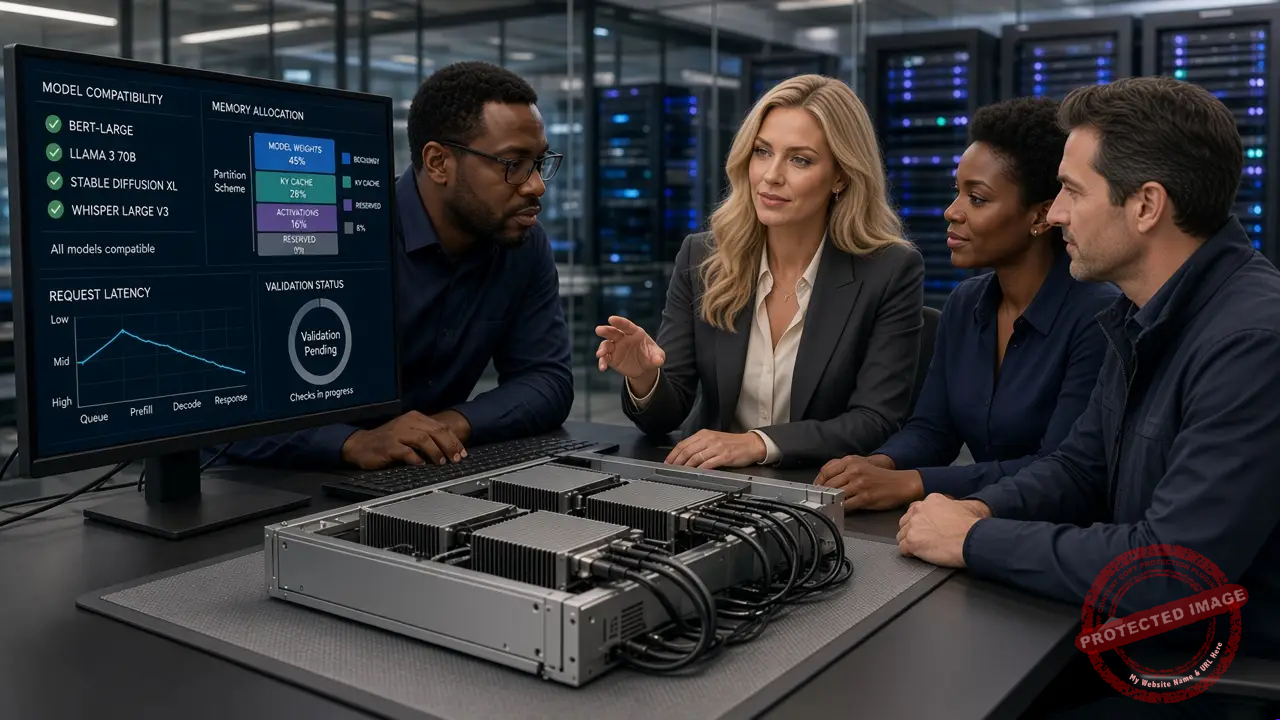
Fresh accelerator software and cloud partitioning releases are changing how enterprises should compare AI hardware, measure performance, and decide what to buy.
The most consequential accelerator news is not always a new processor. Sometimes it is the software that makes a processor usable, or a deployment option that lets several smaller applications share an expensive device without competing for the same GPU memory.
Releases dated 2026-11-04 and 2026-11-06 illustrate that shift. NVIDIA’s CUDA 13.5 update adds general availability support for Vera Rubin architecture. AWS has introduced Multi-Instance GPU support for SageMaker inference components. Together, they put software readiness and workload placement alongside chip specifications in the purchasing conversation. 12
For enterprise buyers, the question becomes more precise: which hardware and software combination can serve the application reliably, at an acceptable cost, with evidence that survives scrutiny?
A software milestone is not a hardware delivery date
NVIDIA’s CUDA 13.5 release brings Vera Rubin support from early developer access to general availability. That is an software milestone, but it should not be rewritten as proof that every Rubin system is shipping, stocked, or available in every cloud region. Procurement still requires confirmation of a specific system and delivery commitment. 1
The update also addresses how accelerators are shared. NVIDIA describes improvements to its Multi-Process Service, including weighted scheduling and mechanisms for allocating GPU processing resources. These capabilities matter when different applications compete for accelerator time rather than consuming an entire device continuously. 1
There are boundaries. A supported programming environment does not validate every model, operator, container, or operational tool an enterprise needs. Features described as public previews should remain previews in purchasing documents, not become implied production guarantees.
For a bank introducing a document assistant, that means testing its own model and security controls. For a manufacturer deploying visual inspection, it means checking the complete application rather than assuming a newer accelerator automatically improves every stage.
The new partitioning option changes the buying calculation
AWS’s SageMaker capability supports NVIDIA Multi-Instance GPU, or MIG, through inference components on supported real-time endpoints. MIG divides a compatible GPU into hardware partitions with dedicated compute and memory resources. The number and shape of partitions depend on the device. 2
That creates a practical opportunity for organizations running several modest inference services. A retailer might evaluate separate partitions for product classification and customer assistance instead of reserving a full GPU for each service. This is an illustrative deployment choice, not a reported customer outcome.
Crucially, AWS bills the complete instance rather than charging separately for each GPU slice. Partitioning can improve how purchased capacity is used; it does not automatically create fractional instance pricing or lower the monthly bill. 2
The announcement also sets operating constraints. Partition profiles remain fixed for an inference component’s lifetime. Changing the layout requires a new endpoint and traffic migration. Support depends on the instance family, region, endpoint configuration, and available quota. 2
Those details belong in a business case. A consolidation plan can become an expensive migration if teams overlook memory headroom or underestimate the effort of changing a production allocation.
Memory, latency, and isolation still set the limits
Partitioning is not a universal answer. Model weights are only part of memory demand. Cached conversation state and runtime overhead also consume space, and longer inputs or greater concurrency can change the requirement substantially. 2
A service that appears comfortable during a demonstration may behave differently during a busy customer support period. Enterprises should therefore test input lengths, output lengths, arrival patterns, and simultaneous requests before selecting a partition profile.
Nor should hardware partitioning be mistaken for complete tenant security. AWS explains that surrounding instance resources, including host memory, storage, and networking, remain shared. A regulated workload still needs an explicit isolation design and appropriate access controls. 2
AWS’s published performance comparison is useful precisely because it is conditional. Its cost advantage varies with the workload and traffic level. At lower demand, the alternative full GPU configuration can be less expensive. That is vendor testing, not an independent promise of savings for every application. 2
The practical lesson is to compare cost per acceptable response at the required latency, not simply count how many models can be loaded onto a device.
AMD shows why model support belongs in accelerator strategy
AMD’s fresh technical article describes day-zero support for Kimi K3.1 Pro on Instinct MI355X GPUs through ATOM and vLLM. Its account details specialized attention paths, memory handling, and communication work across an eight-GPU configuration. 3
The broader signal is that accelerator competition increasingly includes how quickly a platform can run a newly released model correctly. Buyers evaluating an alternative ecosystem need more than a compatibility statement; they need a maintained deployment path for the models their business actually uses.
AMD’s measurements remain AMD measurements. They depend on specified software, numerical formats, request shapes, and testing configurations. They are not an independent comparison with every competing accelerator, and a supported long context does not guarantee that many maximum-length requests fit simultaneously. 3
Enterprises should ask whether the published recipe matches the supported production stack. They should also examine model quality after optimization, operational support, and the skills needed to diagnose failures.
This is not a reason to dismiss alternative hardware. It is a reason to evaluate competition at the application level, where portability costs and useful performance become visible.
Read the benchmark category before reading the headline
A stronger comparison framework already exists. MLPerf Inference working group chairs Miro Hodak and Frank Han describe the latest results as a snapshot of engineering investment, with 30 submitters and 120 systems across its datacenter and edge suites. Their analysis highlights software improvements alongside new accelerators. 4
That leadership perspective matters because it challenges a simplistic upgrade story. Better results can come from improved software on existing hardware, while impressive new hardware results may involve preview systems rather than equipment ready for immediate procurement.
MLCommons distinguishes Available systems from Preview and research or internal configurations. It also separates Closed submissions, intended for comparable testing with the reference model, from Open submissions that allow broader model changes. Those labels are essential context, not administrative decoration. 5
A buyer should compare the same model, scenario, quality requirement, accelerator count, and availability category before drawing conclusions. Offline throughput and interactive responsiveness answer different business questions. Neither should silently substitute for the other.
Power claims deserve similar care. MLCommons validates full-system power measurements for the accompanying benchmark, not arbitrary chip power ratings or every possible deployment. A rack’s nameplate specification is not a measured cost per completed inference. 5
Turn the announcements into a purchasing discipline
The next procurement exercise should begin with a workload portfolio. Separate interactive assistance, document processing, image analysis, and scheduled batch jobs. Record their quality requirements, demand variation, data restrictions, and acceptable response times before comparing accelerators.
Then request reproducible evidence. Ask suppliers to identify the exact hardware, software versions, model configuration, numerical precision, and region behind their results. Require a clear distinction between a generally available service, a preview feature, a published recipe, and a promised future deployment.
For shared GPU capacity, test contention and recovery as well as normal operation. Confirm what happens when a model grows, a partition runs out of memory, a driver changes, or traffic must move to another endpoint. Include migration effort and idle capacity in the financial comparison.
These are recommended evaluation practices, not claims that any one platform already passes every test. Their purpose is to connect product announcements to a decision the business can defend.
What a useful acceptance trial should reveal
Consider a hospital administration team assessing an assistant for correspondence, using governed test data rather than patient records in an uncontrolled demonstration. Its evaluation should distinguish accurate answers from fast but unsuitable responses. A platform that generates more text is not necessarily completing more acceptable work.
Run the same approved request set on shortlisted configurations, then repeat it under a realistic mix of quiet and busy periods. Include larger documents and concurrent sessions. Record failures, response delays, and the staff effort needed to investigate them. These operational observations can expose a mismatch that a headline throughput figure conceals.
For finance teams, translate those observations into a complete service budget. Include the full instance charge, supporting infrastructure, software support, migration work, and the capacity retained for demand spikes. Do not treat a laboratory improvement as a guaranteed reduction in the annual operating budget.
This approach also preserves negotiating leverage. A buyer can request correction of a demonstrable limitation instead of debating competing marketing language. It becomes easier to retain an existing accelerator, adopt a newer generation, or qualify another supplier when all three choices face the same acceptance criteria. The decision remains tied to a business requirement rather than architectural fashion.
Looking ahead: buy demonstrated capability
The accelerator market is becoming more interesting because hardware advances and software advances are arriving together. CUDA support, managed partitioning, optimized model serving, and more representative benchmarking expand the options available to enterprise teams.
They also demand more careful interpretation. Software availability is not hardware delivery. Partitioning is not automatic savings. Vendor measurements are not universal results. A preview benchmark is not a purchase order.
The organizations that benefit most will ask suppliers to demonstrate the application they intend to operate, under conditions they expect to face. The winning accelerator will be the one that delivers acceptable results within those constraints, not merely the one with the loudest specification sheet.
Written by: Peter Jonathan Wilcheck and Ray Anderson.
References
- NVIDIA CUDA 13.5 Brings NVIDIA Vera Rubin GA Support — NVIDIA.
- SageMaker inference now supports Multi-Instance GPU to maximize GPU utilization for model endpoints — AWS.
- Kimi K3.1 Pro on AMD Instinct GPUs: Day-0 support and optimization — AMD.
- Where the Industry Is Investing: A Look at MLPerf Inference v6.1 — MLCommons.
- MLPerf Inference: Datacenter — methodology, availability, and power measurements — MLCommons.
Post Disclaimer
The information provided in our posts or blogs are for educational and informative purposes only. We do not guarantee the accuracy, completeness or suitability of the information. We do not provide financial or investment advice. Readers should always seek professional advice before making any financial or investment decisions based on the information provided in our content. We will not be held responsible for any losses, damages or consequences that may arise from relying on the information provided in our content.

 AAPL
 AMD
 CIS.HA
 DELL
 IBM
 INTC
 MSFT
 GOOG
 HPE
 NVDA
 TSLA
 TMC
 MSI
 NOK
 OPEAZZX
