


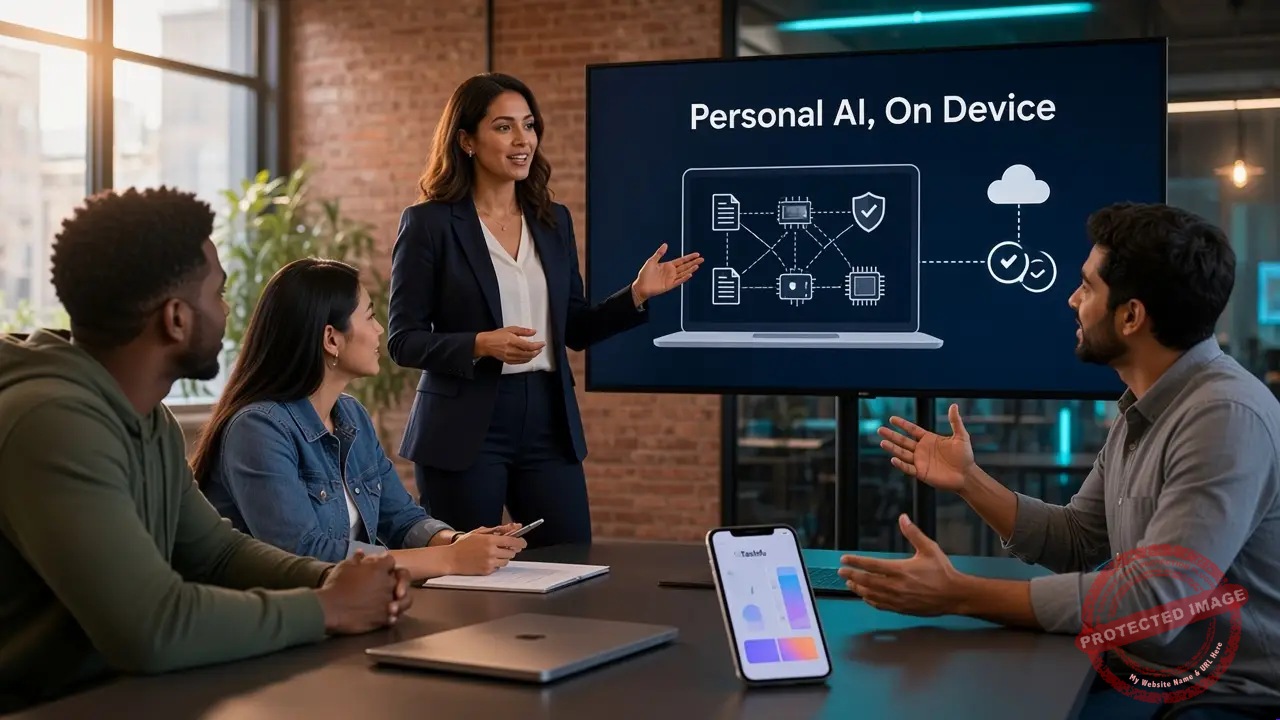
Fresh local-first announcements put personal knowledge and user control at the center of AI, but running nearby is not the same as learning safely.
The next contest in personal AI is not simply about which model answers the hardest question. It is about which system can use your working context without turning every private document, preference, and conversation into a cloud transaction. Two announcements in the first week of November 2026 make that contest concrete: webAI released its Mac app, while CORe announced a shift toward a local-first platform. [1][2]
These developments do not establish a market winner or prove that local assistants are universally better. They do sharpen the question behind hyper-personalized Edge AI: can intelligence adapt to the individual while keeping its data flows understandable, its resource demands manageable, and its authority under control?
What changed this November
On November 5, webAI announced public availability of its Mac app, describing small reasoning models running on the user’s computer without per-token charges. Its Personas combine roles, selected knowledge, and tools. The company describes several Personas collaborating on assignments, with connectors spanning services including Slack and DocuSign. Those are vendor descriptions of capabilities, not independent performance measurements. [1]
“With the webAI app, we’re making cloud AI optional,” said David Stout, the company’s CEO and cofounder, in the announcement. His statement captures the commercial proposition: private work should not automatically require sending the underlying document to a remote model. It does not mean every connected application or action becomes offline. [1]
CORe’s November 1 announcement points in a similar direction through a different strategy. The company says its next platform will keep chats, memories, and settings on the user’s machine, support local runtimes, and be entirely open-source. It also says its existing cloud lineup remains available during the transition. This is a stated direction, not evidence that every promised component has shipped. [2]
Together, the announcements provide a timely November hook. They show vendors competing over where personal context lives and how users control it. They do not, by themselves, demonstrate sales momentum, widespread adoption, or that this is the most popular technology category.
Personalization is more than a local model
Edge inference means executing a trained model near the source of data, such as on a laptop or phone. Personalization means changing the experience around an individual, task, or environment. The two can overlap, but neither implies the other. A generic model running offline remains generic until relevant context or adaptation changes its behavior.
A useful distinction separates three layers. First, instructions can specify tone, format, or preferences. Second, retrieval can supply relevant documents or selected memories when a request arrives. Third, adaptation can change trainable parameters so the model develops specialized behavior. An assistant can feel personal through the first two layers without retraining after every conversation. [3][4]
webAI’s user-configured Personas illustrate why that distinction matters. Choosing a role, knowledge, and tools can customize an experience, but the release does not establish that the app continuously trains a separate model for each user. Buyers should not substitute the word personalization for a precise explanation of how information influences an answer. [1]
Consider a hypothetical consultant preparing a client proposal. Local retrieval could supply approved project notes and a preferred writing template. That may solve the immediate problem without teaching the model to permanently remember the client. If facts change, replacing a document can be more straightforward than correcting knowledge embedded in trained parameters.
Learning on the device is a separate challenge
Apple’s published PLUM research explores a different route: incorporating prior conversations through low-rank adapters. Lucie Charlotte Magister and her coauthors identify two constraints: conversations arrive sequentially, and personalization must be parameter-efficient to be viable per user. Their pipeline turns conversations into additional question-and-answer examples used for adapter fine-tuning. [4]
That is research into learning from personal history, not proof that a commercial assistant already offers safe, automatic lifelong memory. The distinction matters because storing a conversation, retrieving it, and training on it produce different technical and governance obligations. Users need to know which operation occurred and what options exist to correct or remove information.
Apple’s developer documentation explains that low-rank adaptation freezes the original model weights while training smaller adapter matrices. Such adapters can specialize skills, styles, or domains without updating the entire base model. However, training an adapter for a product is not automatically the same as training privately on every customer’s device. [3]
The deployment details are consequential. Apple’s current adapter page says toolkit version 26.0.0 is its last release and is incompatible with operating systems numbered 27 and later. It also says adapters match specific system model versions. Developers should treat this as a concrete compatibility constraint, not assume an older customization workflow carries forward unchanged. [3]
Hardware still sets the boundaries
Local intelligence does not make compute free. It moves part of the cost into devices, memory, storage, energy, and engineering. webAI’s announcement removes per-token charging from its stated proposition, but it does not remove the need to assess performance on the actual Mac a person uses. A billing model is not a latency benchmark. [1]
Training is harder still. In October 2025 research, Apple’s Congzheng Song and Xinyu Tang describe memory-efficient backpropagation for mobile fine-tuning. They report experiments on an iPhone 15 Pro Max involving models from 0.5 billion to 4 billion parameters using less than one gigabyte of memory. This is a bounded research result, not a guarantee for every device or workload. [5]
The authors also explain why the distinction between inference and adaptation matters: backpropagation can require substantially more memory than simply running a model. An enterprise evaluating personal AI should therefore ask separately about response quality, training feasibility, thermal behavior, and the frequency of updates. A device capable of answering locally may not support continuous adaptation economically. [5]
Apple’s adapter toolkit offers another reminder. Its documented training requirements include an Apple silicon Mac with at least 32 gigabytes of memory or Linux GPU machines. The resulting adapter can support on-device inference, but the training workflow itself has meaningful infrastructure requirements. Local execution and local training should never be treated as interchangeable claims. [3]
Privacy depends on the whole route
Keeping inference local can reduce exposure to remote model services, but privacy must be evaluated across the workflow. A connector accessing a hosted collaboration platform still interacts with that platform. A user selecting an external provider changes the data boundary. CORe explicitly describes an exception for information users choose to send to outside providers. [1][2]
That makes data-flow documentation more valuable than a blanket private-AI label. Organizations should identify what stays on the endpoint, what is fetched from connected services, what leaves for remote processing, and what is retained afterward. Local files also require access controls, appropriate backup policies, and protection against unauthorized software or users.
Personal memory introduces additional questions. Which facts are stored because the user requested them, and which are inferred? Can a person inspect, correct, or delete those facts? Does deleting a conversation also remove associated summaries or learned adaptations? These are evaluation questions, not claims that the products discussed here already answer them adequately.
A cloud-assisted design may still be useful when a task exceeds local capability. The requirement is an explicit boundary: disclose the handoff, minimize transferred context, and preserve the user’s ability to decline. Moving more work to the edge should expand informed choice rather than disguise remote processing behind a local interface.
What enterprises should test first
Start with one bounded workflow using approved information: drafting internal notes, finding material in a restricted project folder, or adapting a document to a known format. Establish a baseline without personalization, then test whether adding relevant context improves accuracy and reduces correction effort. More remembered information is not automatically a better result.
Measure accepted outputs, response times, device resource use, and behavior when connectivity disappears. Test stale preferences, conflicting documents, and revoked access. Keep permission to retrieve information separate from permission to send messages, sign documents, or change business records. A personalized assistant should not gain broader authority simply because it has accumulated more context.
A useful pilot should also include a reset exercise. Give the assistant an outdated preference, replace it with a corrected instruction, and check whether subsequent outputs follow the correction. Repeat the test after restarting the application. This separates a persuasive demonstration from evidence that memory and retrieval behave consistently over time.
For shared computers, define whose context is currently active before testing convenience features. A proposal assistant that recalls the wrong client or exposes a previous user’s working material has failed even if its prose is excellent. Evaluate those boundaries with synthetic examples first, then expand access only when the organization can explain the resulting behavior and recover from mistakes without compromising another person’s private information.
Looking ahead: useful memory, visible boundaries
November’s local-first announcements suggest a sharper direction for hyper-personalized Edge AI: the competition is moving beyond compact models toward control of personal context. The opportunity is meaningful, particularly for sensitive work. But genuine progress will be measured by useful personalization, transparent processing, and manageable deployment costs, not by how confidently an assistant claims to know its user.
The winning experience need not keep every task offline or retrain constantly. It must explain what it remembers, where computation happens, and when human approval is required. That is the practical standard for personal AI that works closer to people without asking them to surrender control.
Written by: Peter Jonathan Wilcheck and Ray Anderson.
References
- webAI, “webAI Launches webAI App for On-Device AI With No Per-Token Charges,” company announcement distributed by PR Newswire, November 5, 2026
- CORe, “CORe is going local-first,” November 1, 2026
- Apple Developer, “Foundation Models adapter training,” current documentation reviewed November 7, 2026
- Lucie Charlotte Magister, Katherine Metcalf, Yizhe Zhang, and Maartje ter Hoeve, “On the Way to LLM Personalization: Learning to Remember User Conversations,” Apple Machine Learning Research, July 2025
- Congzheng Song and Xinyu Tang, “Memory-Efficient Backpropagation for Fine-Tuning LLMs on Resource-Constrained Mobile Devices,” Apple Machine Learning Research, October 2025
Post Disclaimer
The information provided in our posts or blogs are for educational and informative purposes only. We do not guarantee the accuracy, completeness or suitability of the information. We do not provide financial or investment advice. Readers should always seek professional advice before making any financial or investment decisions based on the information provided in our content. We will not be held responsible for any losses, damages or consequences that may arise from relying on the information provided in our content.

 AAPL
 AMD
 CIS.HA
 DELL
 IBM
 INTC
 MSFT
 GOOG
 HPE
 NVDA
 TSLA
 TMC
 MSI
 NOK
 OPEAZZX
