


Research shows why teams of software agents can widen discovery, yet coordination, verification, and human authority remain essential to enterprise adoption.
Autonomous AI swarm agents promise something more ambitious than a chatbot completing a single assignment: multiple software workers exploring problems, exchanging findings, and adapting their activity as conditions change. Research available by November 7, 2026, shows both the attraction and the difficulty. Some experiments demonstrate broader discovery through collaboration. Others reveal that adding agents can multiply communication without producing dependable collective reasoning. [1][4]
For business leaders, the emerging story is therefore not that autonomous digital organizations have arrived fully formed. It is that practical multiagent engineering is separating useful parallel work from fragile claims of collective intelligence. The difference depends on task structure, information boundaries, decision rights, and the ability to verify what actually happened.
What makes a swarm different?
An AI agent combines a model with instructions and tools, allowing it to take successive steps toward a goal. A multiagent system connects several such workers. They might perform independent searches, review one another’s outputs, or hand an assignment from a generalist to a specialist. None of those arrangements automatically constitutes decentralized swarm intelligence. [2][3]
The biological swarm metaphor evokes coordination emerging from many local interactions rather than constant direction by a central controller. Applied to software, it can describe agents choosing work, sharing discoveries, and adjusting their behavior through peer interaction. But the term is used loosely. A centrally managed team may be marketed as a swarm even when one orchestrator retains every consequential decision.
OpenAI’s Agents SDK documentation draws a more operational distinction. In its agents-as-tools pattern, a manager keeps control while calling specialists for bounded assistance. With handoffs, a specialist becomes the active agent for the remainder of the turn. The documentation also distinguishes model-directed orchestration from workflows controlled through code. These are architectural choices, not evidence that oversight has become unnecessary. [3]
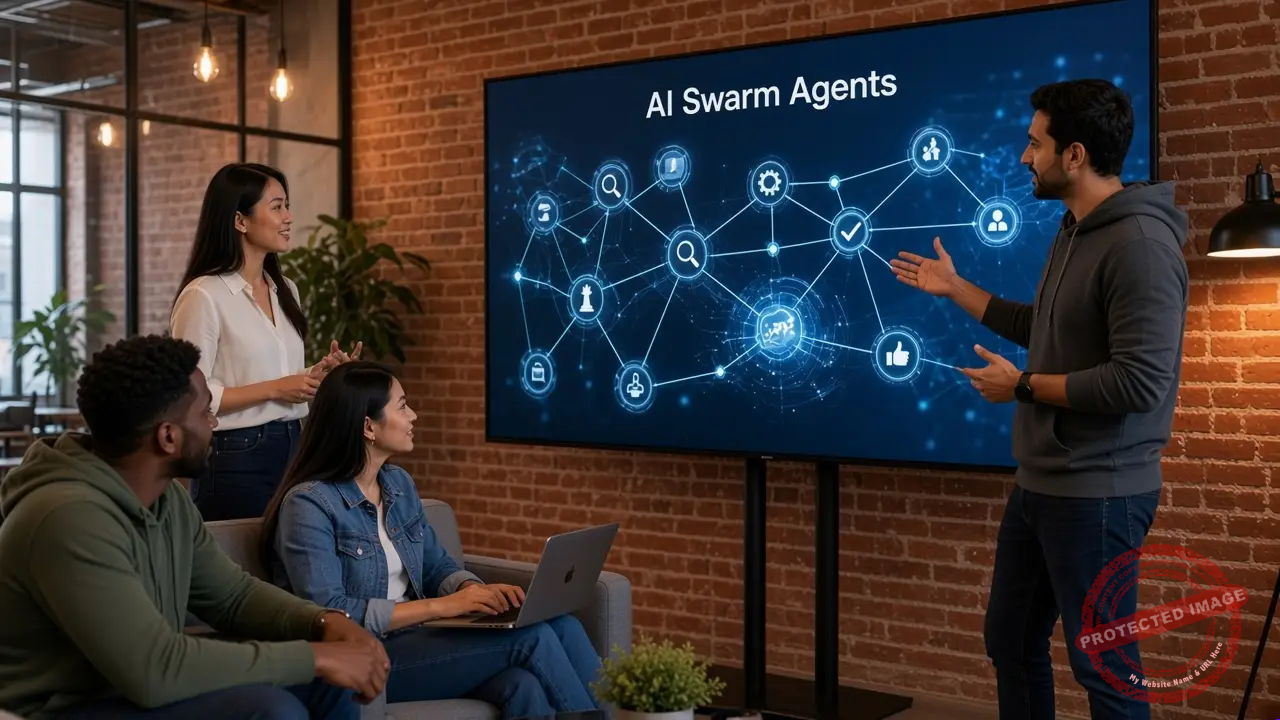
For buyers, the first question should be who controls the next action. The second is what happens when workers disagree. A diagram showing connected agent icons answers neither question unless responsibilities, permissions, and stopping conditions are explicit.
A real experiment shows the opportunity
Anthropic’s August 2026 research offers a concrete example of a coordinating swarm. Researchers launched 45 agents, gave each a virtual machine, and provided a shared forum for collaboration across 15 open-source projects. Agents could review one another’s vulnerability findings, while a separate arbiter decided whether submitted vulnerabilities were new and valid. [1]
For one model, the company reported 266 vulnerabilities using 27 million tokens, compared with 21 vulnerabilities using 6.5 million tokens for independent parallel agents. Those figures should not be read as a clean efficiency victory. The swarm explored beyond the core directories assigned to the comparison group; restricting the comparison to those directories made tokens per vulnerability appear comparable. [1]
The more useful finding was complementarity. Only 12 vulnerabilities overlapped between the methods, and the collaborating agents developed tools and specialized in discovery approaches. That suggests coordination can change where a system searches, not merely how many workers search simultaneously. The findings remain results from a particular company experiment, not a universal enterprise performance guarantee. [1]
This example also exposes an important boundary. Missing a vulnerability did not necessarily invalidate another agent’s successful finding. Work with loosely coupled outputs can tolerate individual failures more easily than a project in which every participant depends on continuously changing shared decisions.
Production research is not leaderless autonomy
Anthropic’s earlier Research engineering account describes a different, hierarchical design. A lead agent plans an investigation and delegates parallel searches to specialized subagents, then synthesizes their results. Separate contexts let workers investigate different directions before returning compressed findings. This is a deployed research architecture described by its builder, not proof of a self-governing software society. [2]
Jeremy Hadfield and his engineering coauthors emphasize clear delegation: each worker needs an objective, output format, source guidance, and task boundaries. Their account describes early failures involving duplicated searches and excessive spawning. The lesson for enterprises is practical: specialization must be designed and evaluated, rather than assumed to emerge because agents have different names. [2]
The same account reports substantial resource use. In the company’s data, multiagent systems consumed about 15 times the tokens of chat interactions. That comparison is neither a pricing forecast nor a measurement of every current product. It illustrates why successful parallelization must create enough value to justify communication, tool use, synthesis, and review. [2]
A procurement team should therefore compare cost per accepted outcome, not cost per agent or the apparent speed of a demonstration. A faster draft that requires extensive repair may be less economical than a simpler workflow producing fewer, better grounded results.
Communication is not collective reasoning
SILO-BENCH, published through ACL Anthology in 2026, tests collaboration when agents hold different fragments of a problem. Its authors, led by Yuzhe Zhang, describe 30 algorithmic tasks and experiments varying communication protocols, agent counts, and models. They identify a “Communication-Reasoning Gap”: agents exchange messages without reliably converting interaction into effective distributed computation. [4]
In the benchmark’s hardest task level, the researchers report zero success beyond 50 agents. That is a bounded experimental finding, not a claim that every large agent team must fail. It does, however, challenge the assumption that more participants naturally overcome information silos. Message volume is an activity measure; it is not an outcome measure. [4]
The enterprise parallel is straightforward. Several agents can repeat a flawed assumption, endorse an incomplete report, or overlook evidence held by another worker. Agreement may reflect shared model tendencies rather than independent confirmation. Anthropic’s Frontier Red Team similarly warns that agents with similar contexts and underlying models can make correlated decisions, allowing isolated mistakes to become systemic failures. [1]
Carolyn Zou, identified as the corresponding author of that research, and the team frame coordination as an interaction and mechanism-design problem. Their conclusion is deliberately cautious: stronger individual capability does not automatically produce better collective behavior. That perspective is more useful than treating a larger agent count as a maturity score. [1]
Trust becomes harder across organizational boundaries
An October 2026 arXiv preprint by Sarath Shekkizhar and colleagues examines agents representing separate people or organizations. Unlike cooperative workers under one manager, these agents have private information, distinct authority, and potentially conflicting interests. The researchers analyze more than 2,500 recorded runs spanning legal, commercial, security, and other scenarios. [5]
Their taxonomy identifies failures in discovery, record consistency, verification, and conduct. Within the studied traces, agents did not independently re-fetch sources or re-query endpoints to test peer factual assertions. The authors also show why a correct final artifact can conceal disclosures or actions contrary to an individual principal’s instructions. These are preprint findings with acknowledged methodological limitations, not settled failure rates for the entire industry. [5]
For enterprises, the implication is that a message from another agent must not become automatic authorization. A purchasing agent, for example, should not treat a supplier agent’s assurance as permission to exceed a spending limit. That is a hypothetical governance illustration, not a reported deployment from the study.
Building a bounded enterprise pilot
A credible pilot should begin with work that can be partitioned and checked: comparing public technical documents, reviewing separate software modules, or assembling an internal evidence brief. These are candidate applications, not guarantees of suitability. Teams should first establish whether one agent or a deterministic workflow can meet the same requirement more simply.
Each worker needs a defined scope, limited tools, a resource budget, and an accountable owner. Access to confidential information should follow need, not team membership. Agents preparing recommendations should generally be separated from systems authorized to execute consequential changes. Human approval remains especially important for spending, external communication, production changes, and irreversible actions.
Verification should be designed into the workflow. Require source locations for factual claims, preserve artifact versions, and check important state changes against authoritative records. Where possible, use deterministic tests rather than asking a second model whether the first sounds convincing. OpenAI’s documentation specifically notes the greater predictability of code-controlled orchestration in speed, cost, and performance. [3]
Measure completed outcomes, total cost, duplication, recovery time, and policy compliance. Include cases involving unavailable tools, contradictory evidence, and interrupted workers. These recommendations follow from the coordination and verification problems described in the research; they should not be mistaken for a certification that any particular agent framework is safe.
Ownership of shared work deserves a separate control. Before two agents revise the same document or code module, establish how versions are reconciled and who can accept the final change. Keep a record of unresolved disagreements instead of allowing a fluent summary to erase them. A stopped experiment with an honest explanation can be a better operational outcome than an apparently successful task built on uncertainty.
Looking ahead: collective capability needs collective accountability
Autonomous AI swarms could become valuable where exploration benefits from parallel effort and specialist discoveries can be verified independently. The strongest evidence so far supports careful distinctions between those opportunities and tightly interdependent work requiring shared judgment. Neither a forum nor a handoff mechanism supplies trust, responsibility, or reliable reconciliation by itself.
The next meaningful advance will be a team that delivers better accepted outcomes while remaining understandable and controllable when something goes wrong. For enterprise leaders, that means demanding evidence about coordination, not just impressive individual agents. The goal is not the largest swarm. It is a bounded system whose useful autonomy remains subordinate to human authority and verifiable results.
Written by: Peter Jonathan Wilcheck and Ray Anderson.
References
- Anthropic Frontier Red Team, “Patterns and problems in emerging multiagent systems,” August 13, 2026
- Jeremy Hadfield et al., Anthropic Engineering, “How we built our multi-agent research system,” June 13, 2025
- OpenAI Agents SDK, “Agent orchestration,” documentation reviewed November 7, 2026
- Yuzhe Zhang et al., “SILO-BENCH: A Scalable Environment for Evaluating Distributed Coordination in Multi-Agent LLM Systems,” ACL Anthology, 2026
- Sarath Shekkizhar et al., “Why Do Agent Teams Fail Across Boundaries? A Failure Taxonomy for Agent-to-Agent Systems with Private States,” arXiv:2610.19342, October 2026 preprint
Post Disclaimer
The information provided in our posts or blogs are for educational and informative purposes only. We do not guarantee the accuracy, completeness or suitability of the information. We do not provide financial or investment advice. Readers should always seek professional advice before making any financial or investment decisions based on the information provided in our content. We will not be held responsible for any losses, damages or consequences that may arise from relying on the information provided in our content.

 AAPL
 AMD
 CIS.HA
 DELL
 IBM
 INTC
 MSFT
 GOOG
 HPE
 NVDA
 TSLA
 TMC
 MSI
 NOK
 OPEAZZX
