


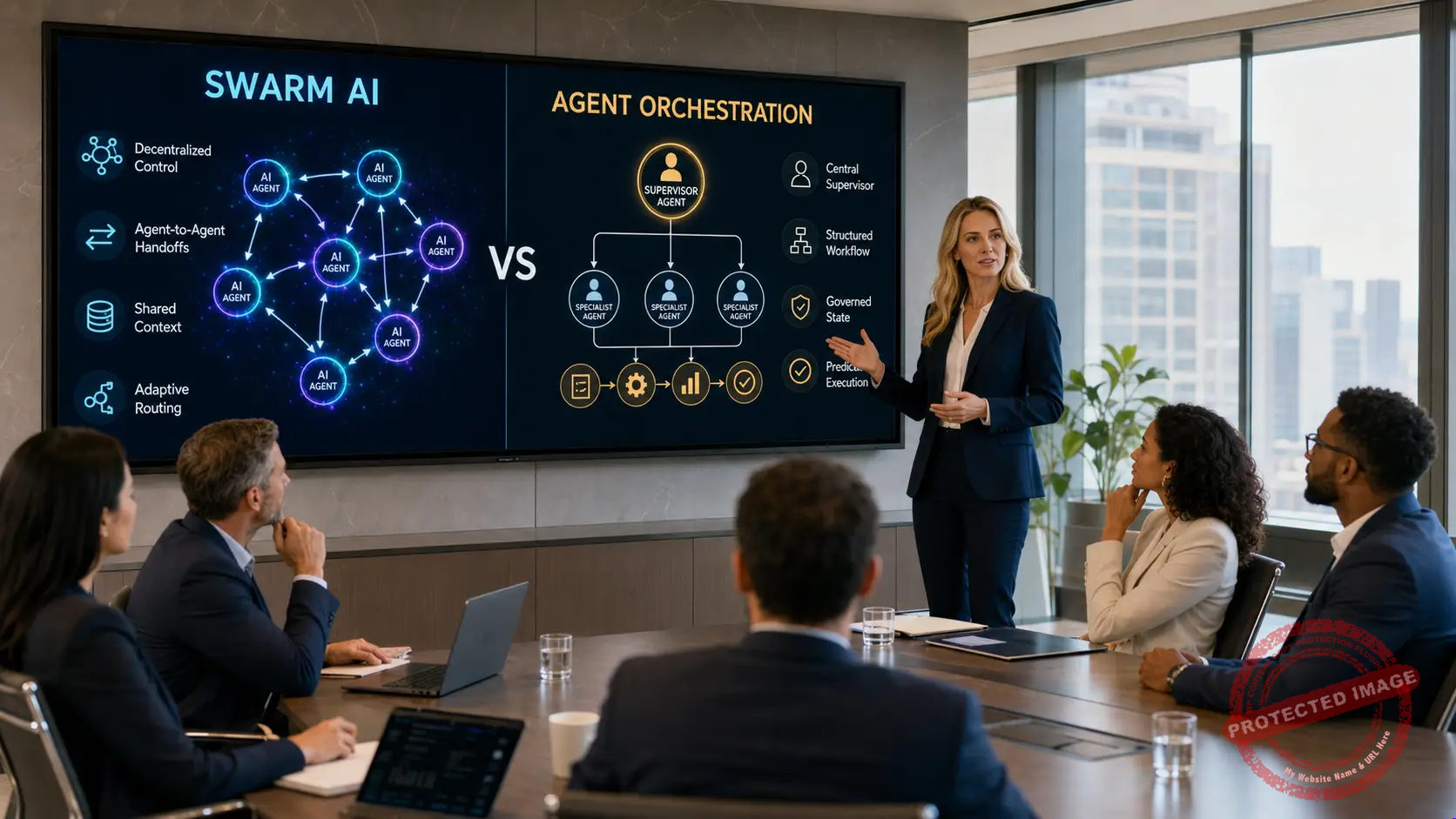
As businesses move from single AI assistants to teams of specialized agents, two terms increasingly appear: swarm AI and agent orchestration. They are often presented as competing architectures—one decentralized, the other centrally controlled. That comparison is useful, but incomplete.
Swarm AI is one coordination pattern within the broader field of multi-agent orchestration. It gives agents greater freedom to decide which specialist should act next. Agent orchestration coordinates agents, tools, data, state, policies, and human approvals to complete a business objective. It may use a supervisor, a predefined workflow, decentralized handoffs, or a hybrid.
The real question, therefore, is not simply “swarm or orchestration?” It is: how much decision-making authority should be distributed among agents, and how much should remain under explicit system control?
What Is Swarm AI?
The phrase swarm AI has two related meanings. Traditionally, swarm intelligence describes decentralized, self-organizing systems inspired by ants, bees, and birds. Participants follow local rules, yet useful group behavior emerges without one entity directing every action.
In generative AI, “swarm” often refers more narrowly to a multi-agent handoff pattern. Specialized agents share context, and the active agent decides when another specialist should continue. OpenAI’s experimental Swarm framework popularized this model through agents and handoffs. OpenAI has since replaced it with its production-oriented Agents SDK, but handoffs remain central: one agent delegates, and the receiving specialist takes control of that portion of the conversation. OpenAI’s documentation describes Swarm as an experimental educational framework built around agents and handoffs.
Microsoft AutoGen uses similar language. Its Swarm pattern allows agents to delegate work according to their capabilities while sharing the same message context. Instead of asking a permanent manager which agent should act at every step, agents make local routing decisions based on the evolving task. Microsoft AutoGen explicitly distinguishes this local decision-making from reliance on a central orchestrator.
Imagine a customer-service swarm containing billing, technical-support, returns, and retention agents. The first agent routes the request. If a technical problem becomes a refund request, the technical agent can transfer control directly to returns. The path emerges dynamically.
What Is Agent Orchestration?
Agent orchestration is the coordinated management of multiple AI agents and the resources they use. It determines how tasks are decomposed, how work is assigned, what context each agent receives, when agents run sequentially or in parallel, how results are validated, and when a human must intervene.
Orchestration takes several forms. A router classifies a request and selects a specialist. A supervisor dynamically plans work, calls subagents, evaluates outputs, and owns the final response. A workflow graph defines stages, branches, retries, approval gates, and termination conditions. Event-driven orchestration activates agents when state changes occur.
This means orchestration is not necessarily rigid. LangGraph distinguishes workflows with predetermined code paths from agents that dynamically choose their own actions, while supporting both within a stateful graph. CrewAI similarly combines collaborative “Crews” with structured, event-driven “Flows.” Anthropic’s orchestrator-workers pattern uses a central model to break down a task dynamically, delegate subtasks, and synthesize the results. These systems can be highly adaptive even though control is more explicit than in a pure swarm.
Consider an enterprise market-analysis workflow. A planning agent defines the research questions; separate agents collect financial, competitive, technical, and regulatory information; a synthesis agent combines the findings; a fact-checking agent validates important claims; and a human executive approves publication. The order, quality gates, and final ownership are deliberately orchestrated, even if individual agents retain autonomy within their assignments.
The Core Differences
The clearest difference is where routing authority resides. In a swarm, the active agents usually decide when and where to hand off work. In supervisor-based orchestration, a manager decides which specialists to call. In workflow orchestration, code and state transitions determine the permitted path. None of these approaches eliminates autonomy; they distribute it differently.
The second difference is predictability. Swarms are responsive to unexpected requests because their paths can evolve organically. That flexibility is valuable when designers cannot anticipate every valid conversation. However, two similar inputs may travel through different agents, making behavior harder to reproduce. Structured orchestration constrains the possible routes, which generally makes execution easier to test, trace, audit, and optimize.
The third difference concerns state and memory. Swarm implementations commonly pass shared conversation history so the next agent understands what has already occurred. That convenience can also create large prompts, expose unnecessary information, or confuse specialists with irrelevant context. Orchestrated systems can manage state more selectively, giving each agent only the data required for its role. Importantly, shared memory is not exclusive to swarms, and handoffs do not automatically guarantee durable memory. Memory architecture must be designed separately.
The fourth difference is governance. A decentralized handoff pattern may allow agents to reach the correct specialist quickly, but it can also make permissions and accountability less obvious. Enterprise orchestration can enforce rules such as: research agents may read customer records but cannot alter them; transaction agents require approval above a dollar threshold; and externally published content must pass compliance review. Central visibility is especially important in finance, healthcare, industrial operations, cybersecurity, and other regulated or safety-sensitive environments.
The fifth difference is cost and performance. Swarms may avoid unnecessary manager calls, but fluid handoffs can produce loops, repeated context, or excessive agent-to-agent conversation. Orchestrated workflows introduce coordination overhead, yet they can impose budgets, parallelize independent work, cache results, limit retries, and route simple tasks to smaller models. The cheaper architecture depends on task design—not on the label attached to it.
Finally, the two patterns fail differently. A swarm may suffer from ambiguous ownership, circular handoffs, context drift, or premature termination. A centralized orchestrator can become a bottleneck or single point of failure, and a poorly designed workflow may be too restrictive for novel situations. Both require termination rules, observability, evaluations, error handling, and human escalation.
When Swarm AI Is the Better Choice
Swarm-style coordination works best when inputs are unpredictable, several specialists may become relevant during one interaction, and conversational continuity matters more than following a fixed sequence. Strong candidates include customer support, service desks, interactive troubleshooting, sales qualification, travel assistance, and collaborative simulations.
Even in these cases, “decentralized” should not mean uncontrolled. Production swarms still need permitted handoff relationships, scoped tools, access controls, maximum-turn limits, logging, and escalation paths. A useful swarm has freedom within boundaries.
When Structured Orchestration Is Better
More explicit orchestration is preferable when a process contains mandatory stages, produces consequential actions, or must demonstrate how a decision was reached. Examples include financial reporting, claims processing, contract analysis, software delivery pipelines, data extraction, compliance reviews, and industrial workflows that interact with operational technology.
For instance, an industrial AI system should not allow agents to improvise unrestricted actions against factory equipment. A monitored workflow can separate diagnosis from recommendation, simulate the proposed change, check safety constraints, request human approval, and only then authorize execution. Here, predictability and governance outweigh conversational fluidity.
The Strongest Enterprise Architecture Is Often Hybrid
Most mature systems will combine both approaches. A central workflow can establish objectives, budgets, security policies, checkpoints, and completion criteria. Within a controlled stage, specialist agents can collaborate dynamically, hand off work, or operate in parallel. Their results can then return to a supervisor or deterministic validation layer before any consequential action occurs.
An industrial transformation platform, for example, might use orchestration to ingest sensor data, detect an anomaly, create a case, and enforce approval requirements. Inside the diagnostic stage, a swarm of vibration, thermal, maintenance-history, and production-scheduling agents could investigate collaboratively. The system gains local adaptability without surrendering enterprise control.
My perspective
Swarm AI distributes more coordination authority among agents; agent orchestration deliberately manages how agents, tools, memory, and controls work together. Swarms emphasize emergent routing and flexible handoffs. Structured orchestration emphasizes visibility, repeatability, and governance. But they are not opposites: a swarm is itself an orchestration pattern, and a sophisticated orchestrated system can contain swarm-like collaboration.
The best architecture is determined by business risk and workflow variability. Use greater agent autonomy where discovery and responsiveness create value. Use tighter orchestration where accuracy, safety, compliance, and accountability are nonnegotiable. For most enterprise applications, the winning design will be hybrid—autonomous enough to adapt, but structured enough to trust.
References
- OpenAI. “Agent Orchestration.” OpenAI Agents SDK.
Explains LLM-directed and code-directed orchestration, manager agents, specialist agents, handoffs, and hybrid coordination patterns.
https://openai.github.io/openai-agents-python/multi_agent/ - Microsoft. “Swarm.” AutoGen Documentation.
Defines the swarm pattern in which specialized agents share context and independently decide when to hand tasks to other agents.
https://microsoft.github.io/autogen/stable/user-guide/agentchat-user-guide/swarm.html - LangChain. “Workflows and Agents.” LangGraph Documentation.
Distinguishes predefined workflows from dynamic agents and explains routing, parallelization, orchestrator-worker, and evaluator-optimizer patterns.
https://docs.langchain.com/oss/python/langgraph/workflows-agents - Anthropic. “Building Effective AI Agents.”
Provides a practical framework for understanding workflows, autonomous agents, routing, parallelization, and centralized orchestrator-worker architectures.
https://www.anthropic.com/engineering/building-effective-agents - CrewAI. “Flows.” CrewAI Documentation.
Explains structured, event-driven agent orchestration incorporating shared state, conditional logic, branching, persistence, and coordinated multi-agent execution.
https://docs.crewai.com/en/concepts/flows
Research and written by: Peter Jonathan Wilcheck
Post Disclaimer
The information provided in our posts or blogs are for educational and informative purposes only. We do not guarantee the accuracy, completeness or suitability of the information. We do not provide financial or investment advice. Readers should always seek professional advice before making any financial or investment decisions based on the information provided in our content. We will not be held responsible for any losses, damages or consequences that may arise from relying on the information provided in our content.
 AAPL
AAPL AMD
AMD CIS.HA
 DELL
DELL IBM
IBM INTC
INTC MSFT
MSFT GOOG
GOOG HPE
HPE NVDA
NVDA TSLA
TSLA TMC
TMC MSI
MSI NOK
NOK OPEAZZX