


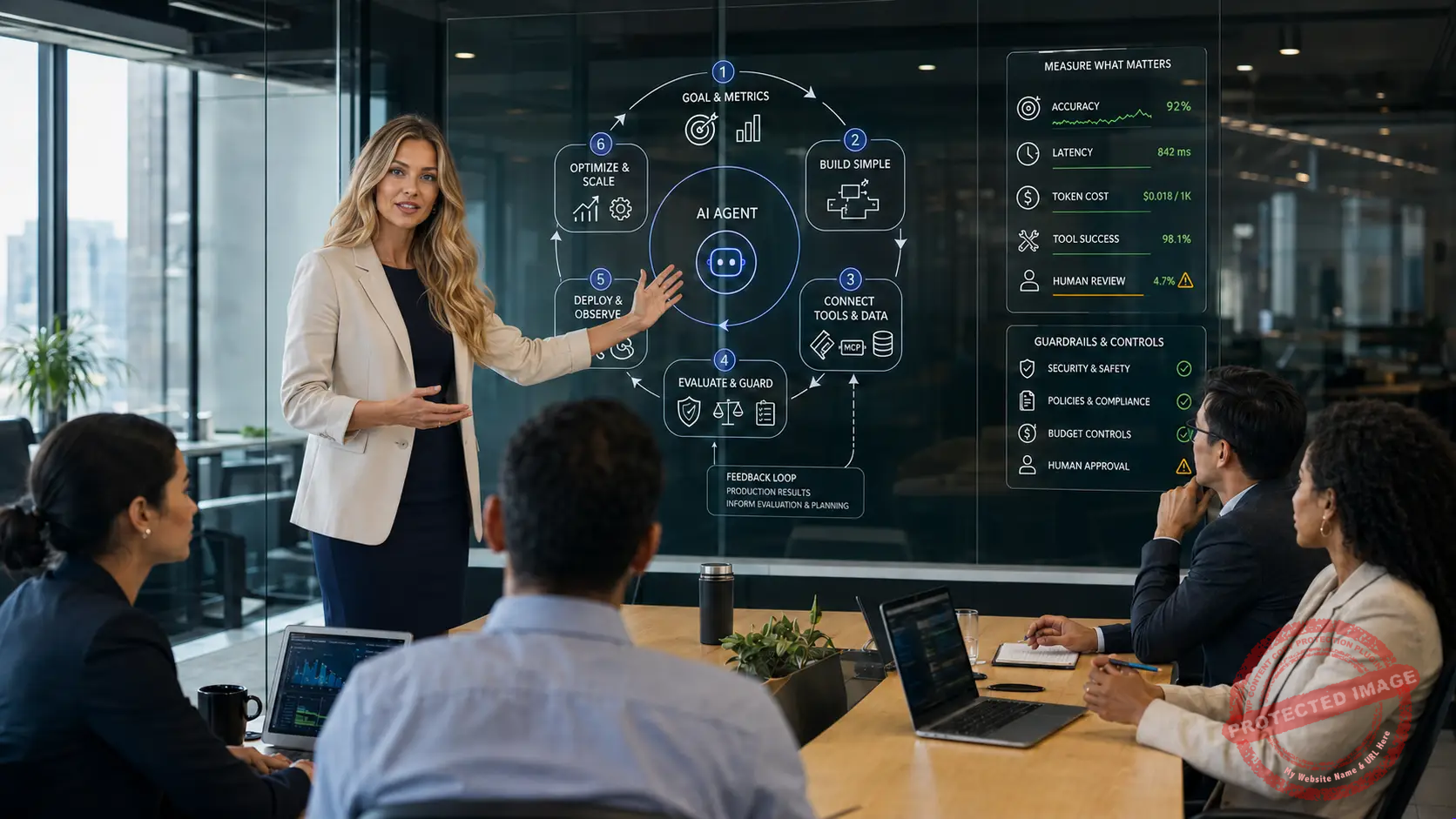
Building an AI Agent Workflow That Is Reliable, Efficient, and Easier to Maintain
An AI agent can perform impressively during a controlled demonstration yet become unpredictable when exposed to real users, changing data, unavailable tools, ambiguous requests, and production-scale traffic. Building the agent is therefore only one part of the challenge. The larger objective is creating an operating system around it that produces measurable results while controlling risk, latency, token consumption, and maintenance.
No AI workflow can be guaranteed to require no updates. Models, APIs, regulations, organizational policies, and business processes will continue changing. The practical goal is to create a modular, observable, and governed workflow in which updates are infrequent, testable, reversible, and limited to the affected component.
1. Begin With a Business Contract
Every agent should start with a clearly defined business outcome—not a collection of interesting AI capabilities. Document the task, process owner, intended users, required inputs, permitted actions, expected outputs, response-time requirements, cost limits, and conditions requiring human intervention.
Success must also be measurable. Relevant metrics may include completion accuracy, processing time, tool-call success, escalation frequency, customer satisfaction, cost per completed task, and the percentage of work requiring correction.
For example, an accounts-receivable agent should not simply be instructed to “help collect invoices.” Its objective could be to identify invoices more than 30 days overdue, prepare approved reminder messages, update the customer record, and escalate disputed balances without independently changing payment terms.
2. Stabilize the Process Before Automating It
Automating an inconsistent process creates an inconsistent agent. Before development begins, map the existing workflow, remove unnecessary steps, identify exceptions, establish decision authority, and determine which records represent the authoritative source of truth.
This stage often reveals that the organization does not need a sophisticated agent initially. A deterministic workflow, search function, or conventional automation may solve part of the problem more reliably and inexpensively.
Both OpenAI and Anthropic recommend beginning with the simplest design capable of producing the required outcome. Complexity should be introduced only when it provides measurable value. Anthropic specifically emphasizes simple, composable patterns before sophisticated autonomous architectures in its guidance on building effective agents.
3. Use the Minimum Necessary Autonomy
A solo agent is usually the best starting point. It is easier to evaluate, observe, secure, and maintain than a multi-agent system. Additional agents should be introduced only when the workflow contains genuinely different responsibilities, tool permissions, knowledge domains, or operating constraints.
For example, a sales workflow might eventually use a research agent, qualification agent, proposal agent, and CRM-update agent. However, creating four agents before proving that one agent can reliably research and qualify a prospect introduces unnecessary routing, memory, and debugging problems.
When multi-agent capabilities become justified, select the control pattern intentionally:
- A supervisor centrally assigns work and validates results.
- Peer handoffs allow specialists to transfer responsibility directly.
- A swarm allows decentralized agents to coordinate dynamically.
- A stateful workflow restricts agents to predetermined transitions.
The architecture should reflect the risk and predictability requirements of the business process—not the desire to use the most advanced design.
4. Define Inputs, Outputs, State, and Memory
Natural-language instructions alone are insufficient for reliable production systems. Each agent needs a clear operational contract defining required inputs, accepted formats, output schemas, tool permissions, stopping conditions, and error responses.
Structured outputs reduce ambiguity. Instead of allowing an agent to return an unrestricted description of a prospective customer, require fields such as account name, industry, revenue range, qualification score, evidence, confidence, and recommended next action.
Memory must also be controlled. Short-term state may track the current task, completed steps, tool results, and unresolved questions. Long-term memory should retain only information that is authorized, useful, current, and appropriately secured. Passing entire conversation histories among agents increases token costs and may expose irrelevant or sensitive information.
5. Connect Tools and Data Securely
An enterprise agent becomes operationally valuable when it can interact with databases, APIs, CRM systems, documents, communication platforms, and business applications. Those connections also create the greatest potential damage.
Every tool and Model Context Protocol connection should employ authentication, least-privilege permissions, schema validation, rate limits, timeouts, retry limits, logging, and explicit error handling. Read permissions should be separated from write permissions, and sensitive actions should require stronger authorization.
A customer-support agent, for example, may be allowed to retrieve an order and draft a refund recommendation. Issuing the refund should require policy validation and, above a designated value, human approval.
Agents should also receive only the tools required for their assigned roles. Restricting the available toolset reduces accidental actions, security exposure, reasoning confusion, and maintenance requirements.
6. Establish Guardrails and Human Control
Guardrails must operate at multiple levels. Input controls detect prohibited, malicious, or incomplete requests. Reasoning controls constrain what the agent may decide. Tool controls govern which actions it may execute. Output controls validate factual, legal, financial, safety, and formatting requirements.
Human approval should be risk-based. Routine, reversible, low-value actions may run autonomously. High-impact or irreversible actions—such as deleting data, transferring funds, terminating accounts, making legal representations, or communicating sensitive decisions—should require approval.
The NIST Generative AI Risk Management Profile provides a useful foundation for integrating trustworthiness and risk management into the design, deployment, use, and evaluation of generative-AI systems.
7. Build a Permanent Evaluation System
Testing an agent with several successful prompts does not demonstrate production readiness. Agents operate across multiple turns, call external tools, modify state, and adapt based on intermediate results. Their evaluation must therefore measure both the final answer and the path used to produce it.
Create a representative “golden” evaluation set containing normal tasks, edge cases, incomplete requests, conflicting instructions, tool failures, outdated records, unsafe requests, and adversarial inputs. Measure task completion, factual accuracy, policy compliance, correct tool selection, handoff quality, latency, token consumption, and human-correction rates.
Run this evaluation set whenever a model, prompt, tool, knowledge source, policy, or workflow changes. Anthropic’s guidance on evaluating AI agents explains why systematic evaluations make behavioral changes visible before they harm production users.
8. Engineer the Workflow for Failure
Reliable agent systems assume that components will sometimes fail. APIs become unavailable, models return invalid structures, databases time out, and agents may repeat an action or enter an unproductive loop.
The workflow should include timeouts, bounded retries, circuit breakers, safe defaults, fallback models, checkpoints, escalation routes, and clear stopping conditions. Actions should be idempotent whenever possible, meaning that retrying them does not produce duplicate payments, messages, orders, or records.
For example, before sending a customer email, the system should check whether the same approved communication has already been sent. If an agent repeatedly fails to complete a task, it should preserve its state, summarize the problem, and transfer the case to a human rather than continuing indefinitely.
9. Deploy Gradually and Maintain Version Control
Production deployment should progress from sandbox testing to an internal pilot, limited user group, controlled production percentage, and finally broader release. High-risk actions can initially operate in “shadow mode,” where the agent recommends an action but does not execute it.
Prompts, models, workflows, schemas, tools, knowledge sources, and policies should all be versioned. Every release should record what changed, why it changed, which evaluations passed, who approved it, and how to roll it back.
This prevents a common problem: correcting one failure through an undocumented prompt change that silently introduces failures elsewhere. OpenAI’s practical guide to building agents discusses model selection, tool design, orchestration, and layered guardrails for production systems.
10. Monitor Operations and Apply FinOps
Traditional uptime monitoring is not enough. An agent may be technically available while producing weak decisions, excessive tool calls, unnecessary tokens, or too many human escalations.
Operational dashboards should track accuracy, completion rates, latency, tool errors, routing decisions, memory growth, approval frequency, safety events, token consumption, infrastructure expense, and cost per successful outcome. Individual execution traces help teams understand which agent acted, which tools it called, what state changed, and where the workflow failed.
FinOps should connect spending to business value. A less expensive model may handle classification and extraction, while a stronger reasoning model is reserved for complex cases. Caching, context reduction, routing, batching, and smaller specialist models can reduce expenses without weakening results.
A Practical Example: An Invoice-Processing Agent
Consider a company processing emailed supplier invoices. The first release might use one agent to extract invoice fields, compare them with purchase-order data, and prepare an accounting entry. The agent cannot approve payment.
The evaluation set includes duplicate invoices, missing purchase orders, mismatched totals, altered banking details, unreadable attachments, and unavailable accounting systems. When confidence is low or banking information changes, the workflow automatically requests human review.
After the solo agent proves reliable, integration through governed tools allows it to retrieve purchase orders and create draft records. A second fraud-review agent may later analyze anomalies, while a supervisor controls routing and approvals. Observability measures extraction accuracy, exception rates, processing time, token cost, and duplicate prevention. This progression produces dependable automation without prematurely creating an elaborate multi-agent system.
Key Players in the AI-Agent Market
The current market includes model providers, cloud platforms, orchestration frameworks, and operational platforms:
- OpenAI provides models, agent-building capabilities, tool use, tracing, guardrails, and an Agents SDK.
- Anthropic offers Claude models, agent-development guidance, tool integration, agent evaluation practices, and the Claude Agent SDK.
- Microsoft offers Foundry Agent Service for building, deploying, governing, and scaling enterprise agents.
- Google Cloud provides Vertex AI Agent Builder, Agent Engine, and the Agent Development Kit for developing and operating agents.
- Amazon Web Services offers Amazon Bedrock Agents and supporting infrastructure for connecting foundation models, company data, APIs, and applications.
- LangChain provides LangChain, LangGraph, and LangSmith for agent construction, durable orchestration, persistence, human intervention, tracing, evaluation, and deployment. Its LangGraph overview explains these orchestration capabilities.
- CrewAI provides an open-source framework and enterprise platform for role-based agents, crews, controlled flows, deployment, and multi-agent operations.
The right selection depends on existing cloud infrastructure, regulatory obligations, development skills, model requirements, deployment preferences, and the degree of operational control needed.
My look forward
The most maintainable AI agent is not necessarily the most autonomous or complex. It is the one built around a stable business process, measurable outcomes, structured interfaces, controlled tools, rigorous evaluations, failure recovery, observability, and accountable ownership.
Organizations should prove value with a focused solo agent, secure its integrations, prepare users, and scale into multi-agent orchestration only when the business case demands it. That disciplined progression turns an impressive demonstration into a reliable and economically sustainable operating capability.
Five Key References
- NIST — Generative AI Risk Management Profile
- OpenAI — A Practical Guide to Building AI Agents
- Anthropic — Building Effective Agents
- Anthropic — Demystifying Evaluations for AI Agents
- LangChain — LangGraph Overview
Researched and written by: Peter Jonathan Wilcheck
Www.peterjonathanwilcheck.com
Post Disclaimer
The information provided in our posts or blogs are for educational and informative purposes only. We do not guarantee the accuracy, completeness or suitability of the information. We do not provide financial or investment advice. Readers should always seek professional advice before making any financial or investment decisions based on the information provided in our content. We will not be held responsible for any losses, damages or consequences that may arise from relying on the information provided in our content.
 AAPL
AAPL AMD
AMD CIS.HA
 DELL
DELL IBM
IBM INTC
INTC MSFT
MSFT GOOG
GOOG HPE
HPE NVDA
NVDA TSLA
TSLA TMC
TMC MSI
MSI NOK
NOK OPEAZZX