


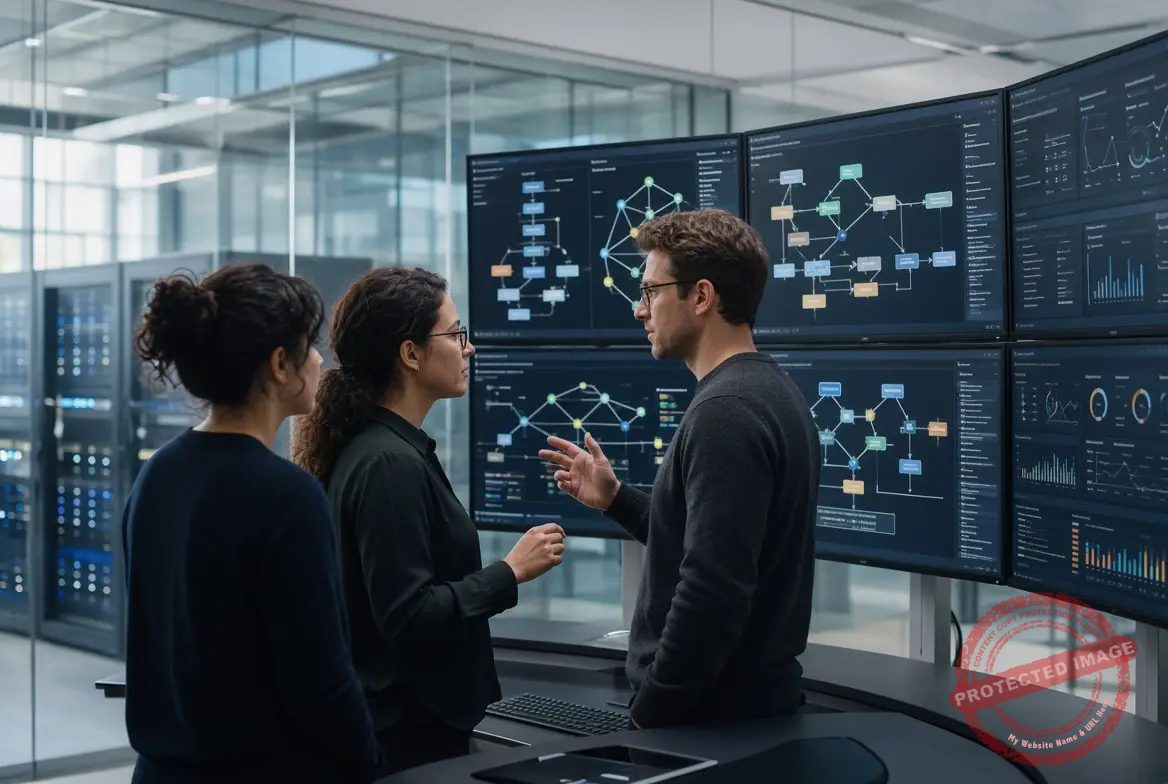
AgentOps is now the operating layer for agentic AI. The industry has stopped asking whether agents can finish a task. The new question is whether anyone can see what they did, why they did it, and whether the next hundred agents will behave the same way. That is the shift from demos to operations. Agentic AI plans, calls tools, and acts with limited supervision. AgentOps keeps those actions measurable, owned, and reversible when the system is no longer a single chatbot on a laptop.
What this AgentOps guide covers
This article walks through how AgentOps works in production, why Autoresearch is the stress test, how agent sprawl starts, and what IT leaders should demand before they scale.
What changed when agents left the pilot
A chatbot answers. An agent acts. It can open a ticket, query a warehouse, write code, file a clinical note, or launch a literature search while you are in another meeting.
Over the past year, platforms such as OneAdvanced and others have incorporated that behaviour into actual workflows—such as those in the fields of finance, healthcare, and legal services. The company has also mentioned the idea of combining specialized agents on a sovereign stack, with the policies placed next to the model rather than in a slide deck. That is the correct approach; agents lacking context and rules cannot scale and will therefore multiply.
Microsoft has said the quiet part out loud with Agent 365. Inventory first. Name, owner, lifecycle, where it was created, where it runs. Once you cannot list the agents, you cannot secure them. Deloitte has warned that a large share of agentic projects could be cancelled by 2027 if cost, complexity, and risk stay unaddressed. The market can still grow. The failure mode is not “the model is dumb.” It is “nobody owned the loop.”
AgentOps is not another dashboard name
AgentOps sits after DevOps, MLOps, and LLMOps. Those practices watch code, models, and prompts. Agents add a decision tree that can change mid-run. Red Hat describes AgentOps as a way to monitor the brain of the system in real time: identity, tool access, cost, and the thought path that led to step three before step two.
AWS frames the same idea as four pillars on Bedrock AgentCore: governance and security, build and operations, evaluation, and observability. Databricks published a Big Book of AgentOps this month that treats the topic as an operating system for the enterprise, not a vendor checkbox. Architecture, evaluation, cost, and stakeholder alignment sit in the same manual.
That is the tone IT specialists should copy. If your agent stack has traces but no owner, you have telemetry, not operations. Teams already writing about agent observability are pointing at the same gap: you cannot govern what you cannot see.
The practical AgentOps stack is boring on purpose. Session traces, not isolated logs. Tool-call records with arguments and results. Cost per run and cost per successful outcome. Evaluation harnesses that score the path, not just the final paragraph. Human-on-the-loop gates for money, identity, production change, and regulated data. Versioned prompts and policies. An identity for every agent that is not a shared service account from 2019.
Autoresearch is the AgentOps stress test
Scientific workflows make the stakes visible. Autoresearch, as the literature now uses the word, is the spectrum of AI-managed research work: grounding in papers, forming a hypothesis, running an experiment or analysis, checking the result, and writing it up. Some systems stay in “vibe research,” where a person steers every stage. Others try to close more of the loop overnight.
That is exciting for tech enthusiasts and dangerous for decision makers. A literature agent that invents a citation is not a cute hallucination. It is a poisoned method. Execution-grounded frameworks such as AutoResearch try to treat runtime errors, failed citation checks, and reviewer agents as filters, not afterthoughts.
The lesson for enterprise IT is the same whether the output is a paper or a purchase order: the agent must leave evidence. If you cannot replay the decision, AgentOps has already failed.
The sprawl problem AgentOps has to stop
Agents are easy to create and hard to retire. Copilot Studio, cloud consoles, SaaS agent builders, and internal no-code tools all mint new workers. OneAdvanced went from a first agent to more than fifty in weeks on AWS. That speed is the product pitch. It is also the operational threat.
An agent capable of provisioning cloud resources does not count as a user or as a pipeline. Governance models designed for people and Terraform fail to account for the third category. IT specialists should assume that sprawl is already taking place and that shadow agents will show up in departments which had not submitted a ticket.
The fix is not a ban. The fix is AgentOps: a registry, a graduation path from sandbox to production, and an Agent Development Life Cycle that looks like change management instead of a weekend prompt. CIOs have months, not years, to retrofit that backbone before agent adoption outruns architecture.
What decision makers should demand from AgentOps
Ask for an inventory. If the vendor cannot tell you how many agents exist, stop the rollout. Ask who owns each agent when it fails at 2 a.m. Ask what the agent is allowed to spend, which tools it can touch, and what happens when evaluation scores drop.
Ask whether traces survive long enough for audit. Ask how Autoresearch-style workflows handle citations, data lineage, and human sign-off before anything leaves the building. Then fund the unglamorous layer. Orchestration without evaluation is theater. Evaluation without governance is a lab notebook. Governance without observability is a policy PDF.
You need all three, plus cost controls, because agent loops can burn tokens the way an unbounded cron job burns compute. Human-on-the-loop is not a retreat. It is how you raise autonomy without handing the company keys to a system that cannot explain itself.
The mature AgentOps pattern is management by exception: agents run, verify, retry, and escalate only the decisions that require a person. That only works if AgentOps is already watching the path.
A working AgentOps posture for 2026
Start with a small fleet of named agents and one control plane. Instrument every tool call. Score outcomes weekly. Kill agents that cannot show their work. Put scientific or high-risk workflows on the strictest rails first, because Autoresearch will expose weak evidence habits faster than a marketing bot will.
Treat OneAdvanced-style sector context and policy-in-the-flow as the default, not an extra SKU. Agentic AI will keep getting better at doing the job. AgentOps is how you keep the job from doing you. The organizations that win this year will not be the ones with the most agents. They will be the ones that can tell you, without a war room, what those agents decided yesterday and why that was allowed.
References
- Announcing the Databricks Big Book of AgentOps — https://www.databricks.com/blog/announcing-databricks-big-book-agentops
- How OneAdvanced deployed over 50 AI agents on UK-sovereign AWS — https://aws.amazon.com/blogs/machine-learning/how-oneadvanced-deployed-over-50-ai-agents-on-uk-sovereign-aws/
- AgentOps: Operationalize agentic AI at scale with Amazon Bedrock AgentCore — https://aws.amazon.com/blogs/machine-learning/agentops-operationalize-agentic-ai-at-scale-with-amazon-bedrock-agentcore/
- AI agent orchestration, Deloitte Insights — https://www.deloitte.com/us/en/insights/industry/technology/technology-media-and-telecom-predictions/2026/ai-agent-orchestration.html
- What is AgentOps?, Red Hat — https://www.redhat.com/en/topics/ai/agentops
Written and researched by Peter Jonathan Wilcheck
Post Disclaimer
The information provided in our posts or blogs are for educational and informative purposes only. We do not guarantee the accuracy, completeness or suitability of the information. We do not provide financial or investment advice. Readers should always seek professional advice before making any financial or investment decisions based on the information provided in our content. We will not be held responsible for any losses, damages or consequences that may arise from relying on the information provided in our content.
 AAPL
AAPL AMD
AMD CIS.HA
 DELL
DELL IBM
IBM INTC
INTC MSFT
MSFT GOOG
GOOG HPE
HPE NVDA
NVDA TSLA
TSLA TMC
TMC MSI
MSI NOK
NOK OPEAZZX