


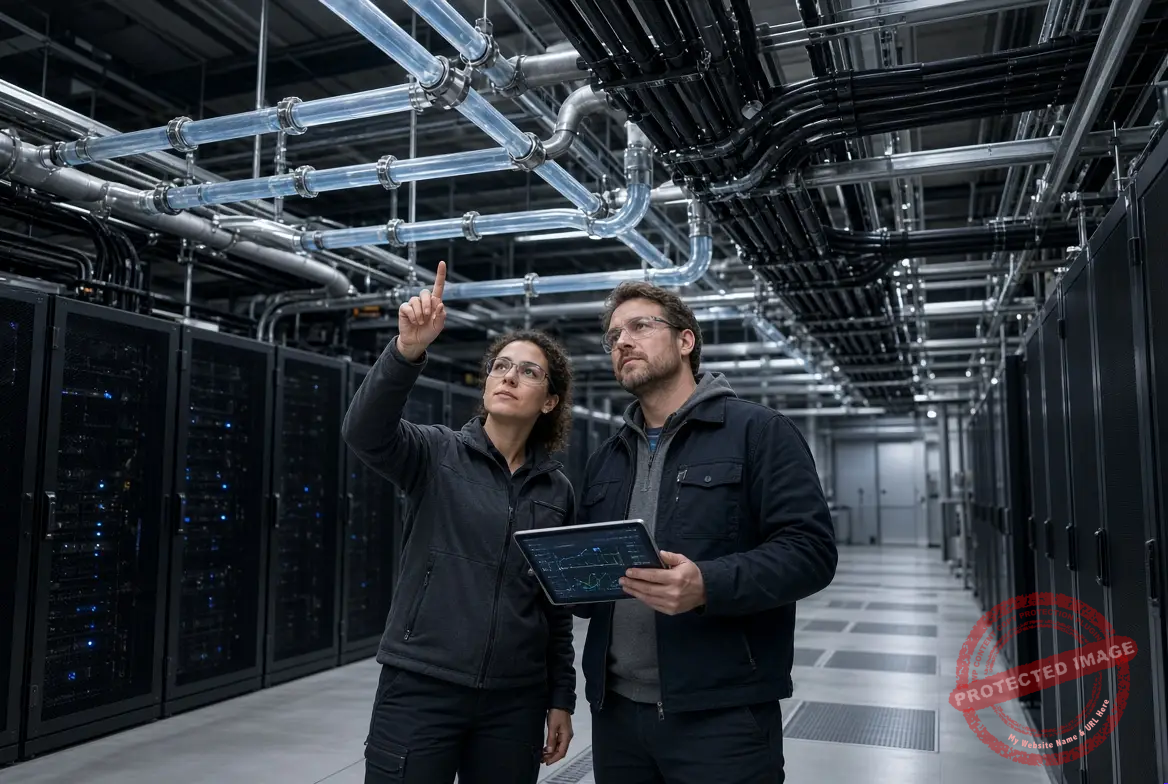
The fourth quarter of 2026 is not a time for planning; it is a period of reckoning. The chips that were ordered last year are now arriving, the racks which were originally specified at 30 or 50 kilowatts are being required to operate at 100 kilowatts and higher, and the buildings that were designed with air cooling and a satisfactory connection from the utility are now being treated as if they were factories. The problems in question are no longer just theoretical; they can be seen on loading docks, in queues of transformers, and in the lease agreements that had promised a certain density even though the mechanical plant is not yet capable of supporting it.
The dilemmas that are already here
Four problems are on top of each other. The first of these is density. Above about 50 kilowatts per rack, air cooling ceases to be practical and the AI racks that are important this quarter have already gone beyond that threshold. Direct-to-chip liquid cooling is now the standard for high-end AI equipment. TrendForce predicts that liquid cooling will account for about 53 percent of AI chips in 2026. This is not merely a preference; it is a matter of physics, since air cannot carry away the heat without turning the aisle into a wind tunnel.
The other issue is the actual delivery of power, not just the power figures. Dell’Oro has been open about this point: the delay is generally due to problems upstream of the white space.
It takes years to install transformers, medium-voltage switchgear, and on-site generation. A cold-plate loop can be put into operation more quickly than a substation can be switched on. People keep referring to cooling since they can see the pipes. What usually causes the delay is the iron that connects the campus to the grid.
The third issue is the discrepancy between the amount of space that is leased and the amount that is actually usable. Although many colocation facilities still have vacant tiles, a lot fewer are able to accommodate a 140 to 160 kilowatt rack together with direct liquid cooling, the appropriate busway, and a heat-rejection system which doesn’t cause the rest of the floor to be submerged. Space that lacks density is merely inventory rather than a product.
The fourth issue is time. The interconnection queues in the United States still contain over 2,000 gigawatts of generation and storage. Large power transformers, which used to take one year to complete, now take two to four years. Utilities and developers have different calendars. Surveys continually reveal a one-and-a-half to two-year difference between when operators expect power to be available and when utilities state that they can deliver it. That difference is known as the Q4 mood.
What colocators are facing
There is a request being made of colocation companies to offer a service for which most of their current fleet was not designed. Enterprise racks continue to be concentrated around much lower densities. AI customers require liquid cooling loops, CDUs, manifolds, leak detection, and a power supply route that won’t fail when a training job increases in size. Making the necessary modifications to an air-cooled data centre is not something that can be done in a weekend; it involves civil engineering work, structural inspections, plumbing, and in many cases takes between 12 and 18 months even if the building is capable of undergoing the changes.
This results in a two-speed market, with new data centres designed for a capacity of 60 to 80 kilowatts and those exceeding 100 kilowatts being able to secure leases. The older halls, on the other hand, will be occupied by standard cloud and enterprise equipment or will end up half empty as the sales staff explain why the advertised megawatts can’t be allocated to that row. Both the wholesale and retail colo sectors experience the same kind of pressure, although in different forms. Wholesale customers come in with a density requirement and a go-live date, while retail customers arrive with a cabinet count and then find out that the cabinet is no longer the relevant unit. The relevant unit is now the liquid-cooled domain and the feeder that keeps it running.
Colocators are likewise under pressure due to customer demands for flexibility that they are unable to manage. In return for quicker interconnection, utilities want interruptible or flexible load. AI tenants demand five-nines and no throttling throughout a training run. One side has to lose that debate, or else someone has to purchase batteries, on-site generation, and software which is able to shut down cooling and computing without breaching the SLA. This negotiation is taking place this quarter, not in a white paper for 2028.
What data center companies and hyperscalers are facing
The big companies have capital and do not keep any spare transformers. They are currently purchasing mechanical and electrical equipment in advance, holding onto land with the benefit of having power options, and considering the act of energizing as the actual product. Both Equinix and similar companies have already stated that the gates will be determined by power, permits, and people, not just by steel. Behind-the-meter generation, the use of gas, fuel cells, and private networks are no longer unusual; they are the way to avoid having to wait for a utility that is four hundred months away in a busy PJM area.
The same mathematical challenges are even more severe for the hyperscalers. Each new generation of GPU increases rack power faster than the data centre can be redesigned. A building designed to house Blackwell-class racks will not automatically accommodate the next generation without adding more chillers, more capacity for heat rejection, and a new electrical setup. Certain campuses are currently considering 400-volt distribution and will later move to 800-volt DC since there’s no more room for copper and connectors. Cooling and power have now become a single design issue; if you try to treat them separately you end up with a row of very expensive silicon.
There is also a reliability dilemma which teams feel in their stomachs. Liquid loops tend to leak and high-density racks fail in ways that air-cooled rooms never did. A cooling incident is no longer just a hot aisle; it can in fact be a wet aisle. It is in Q4 that more of these systems move from pilot to production, which means that more operators will find out whether their leak detection measures, isolation valves, and runbooks were written for a brochure or for a Tuesday night.
What resolve actually looks like this quarter
By December no one is going to come up with a new grid. The viable solutions are for smaller and more practical setups. When designing new capacity it should be for liquid first, not as a possibility in the future. For AI data halls, 60 to 80 kilowatts should be considered the minimum with a route to 100 kilowatts. The long-lead electrical equipment should be purchased before the slab is poured. The interconnection applications should be paired with a flexibility proposal that the utility can use in its modelling: this should include storage, on-site generation, and agreed curtailment periods that safeguard the training peaks without pretending that the campus is a hospital.
Closed-loop cooling is gaining ground since water-related issues won’t delay action. Direct-to-chip cooling is still the most commonly used method. Immersion cooling remains a specialist solution and is not the standard, particularly in situations where the rules regarding fluids are uncertain. Heat reuse and dry coolers will be mentioned more frequently in discussions between communities than in the brochures for racks.
For buyers the Q4 checklist is both simple and strict. Don’t lease megawatts. Instead, lease energized, liquid-ready megawatts which have a date confirmed by the utility. Find out where the heat escapes the building. Find out which transformer is pending and when it will be shipped. Find out what will happen when the next generation of GPUs adds another 80 kilowatts to the same space. If the answer to that is just a shrug, then you are purchasing a story rather than a hall.
The quarter ahead
Throughout 2026 the industry will continue to debate over which constraint is ‘the’ constraint. Those concerned with cooling will cite the plumbing, while the power people will point to the substations. Both have a point since heat and watts are merely the same amount of energy expressed in two different forms. The companies that manage to get through April without having stranded racks will be the ones that stopped seeing the facilities as something that came after the chip order. Today the building is the product and the chip is just the tenant.
References
- Power—not cooling—remains AI infra’s biggest bottleneck, says Dell’Oro — https://rcrtech.com/ai-infrastructure-news/power-cooling-ai-infra/
- AI Rack Density’s Real Limits: Power, Cooling, Failure Risk — https://www.datacenterknowledge.com/ai-data-centers/ai-rack-density-s-real-limits-power-cooling-failure-risk
- Data centers are ready to negotiate flexibility for speed — https://www.utilitydive.com/news/data-centers-flexibility-utilities-speed-to-power/822588/
- Liquid Cooling Becomes Standard for High-End AI Infrastructure, TrendForce — https://www.trendforce.com/presscenter/news/20260817-13183.html
- AI’s Physical Constraints: How AI Rewired the Data Center — https://www.tigerdata.com/blog/how-ai-rewired-the-data-center
written and researched by Peter Jonathan Wilcheck
Post Disclaimer
The information provided in our posts or blogs are for educational and informative purposes only. We do not guarantee the accuracy, completeness or suitability of the information. We do not provide financial or investment advice. Readers should always seek professional advice before making any financial or investment decisions based on the information provided in our content. We will not be held responsible for any losses, damages or consequences that may arise from relying on the information provided in our content.
 AAPL
AAPL AMD
AMD CIS.HA
 DELL
DELL IBM
IBM INTC
INTC MSFT
MSFT GOOG
GOOG HPE
HPE NVDA
NVDA TSLA
TSLA TMC
TMC MSI
MSI NOK
NOK OPEAZZX