



When people say “swarm AI” and “AI swarm,” they often sound as if they are naming the same thing. In casual conversation, they sometimes are. In technical and executive settings, however, the order of the words matters because it signals two different design traditions. Swarm AI usually begins with the swarm: decentralized collective behavior, often inspired by ants, bees, birds, fish, or human groups connected through decision platforms. AI swarm usually begins with the AI: multiple autonomous or semi-autonomous AI agents coordinating work across tools, data, workflows, and sometimes robots.
That distinction matters in 2026 because enterprises are starting to combine both ideas. Smart factories, logistics centers, cyber defense teams, and research labs increasingly need systems that adapt locally, coordinate globally, and remain governable. The result is not just another vocabulary debate. It is a practical architecture question: are you optimizing a distributed system through swarm principles, or are you coordinating a group of intelligent agents through AI orchestration?
The Clean Distinction
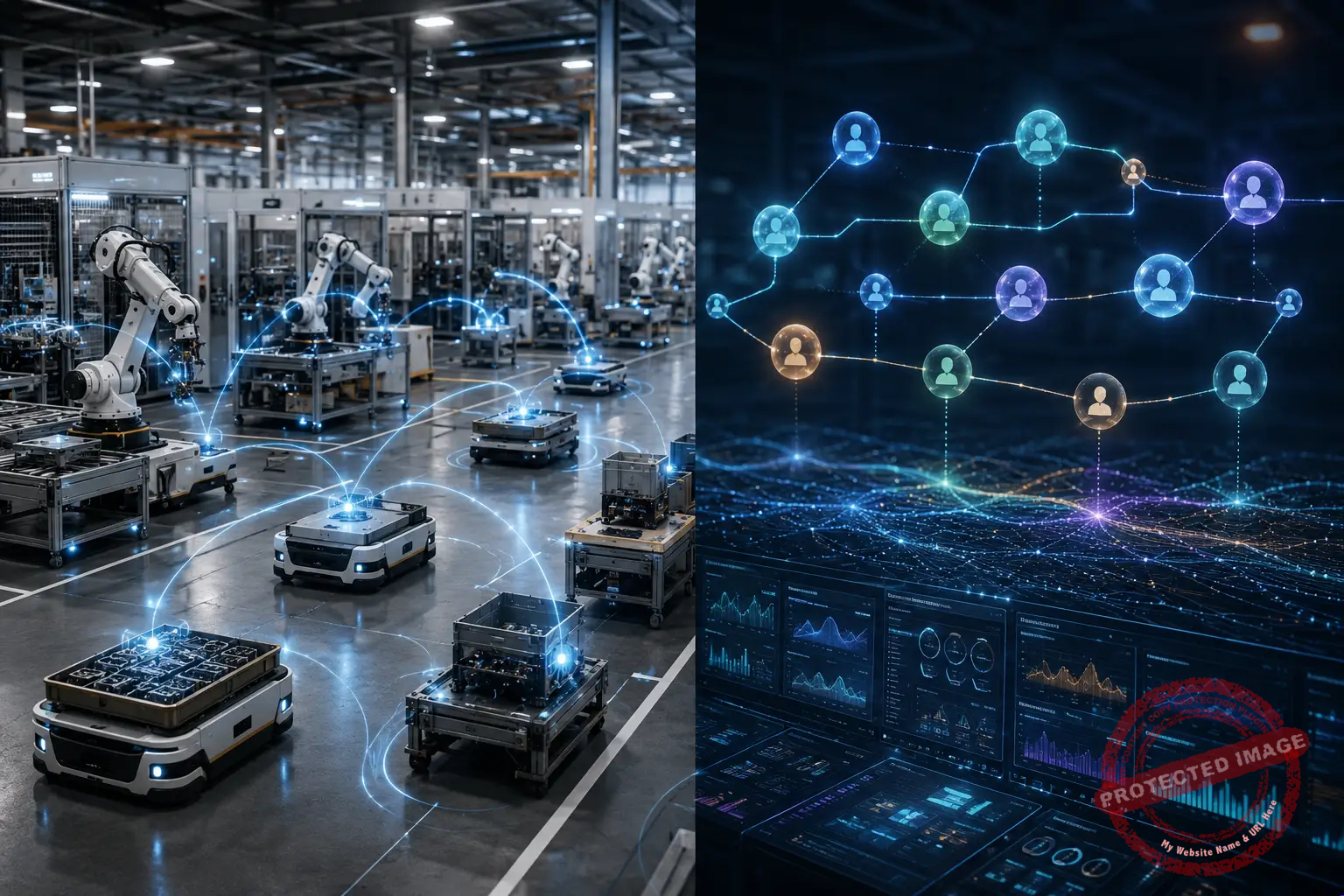
The short definition: swarm AI is intelligence produced by many interacting participants following local rules. AI swarm is work performed by many AI agents that divide, negotiate, or hand off tasks. Swarm AI asks, “How can collective behavior solve a problem without central command?” AI swarm asks, “How can multiple AI agents cooperate to complete a complex goal?”
Swarm AI is the older and more formal concept. It sits close to the field of swarm intelligence, which studies natural and artificial systems made of many individuals coordinating through decentralized control and self-organization. In nature, no single ant owns the colony’s full route plan. No individual bird computes the entire flock pattern. Global behavior emerges from local sensing, simple rules, environmental feedback, and repeated interaction. In computing, this has inspired ant colony optimization, particle swarm optimization, evolutionary search, swarm robotics, traffic routing, resource allocation, and human-in-the-loop collective decision platforms.
The important phrase is “emergent behavior.” Swarm AI does not require every participant to be a large language model, a reasoning agent, or even very smart. The intelligence may come from the system’s structure rather than from any one member. A scheduling algorithm can treat jobs, machines, or routes as interacting elements. A robot fleet can use local rules to avoid congestion. A human decision swarm can combine many judgments through a platform that shapes group convergence. The result may look intelligent because the group adapts faster than a central planner.
AI swarm, by contrast, is a newer term shaped by the rise of agentic AI. Here the units are AI agents: software entities with goals, instructions, memory or state, tool access, and the ability to call models, APIs, databases, or other agents. An AI swarm might include a research agent, a planning agent, a code agent, a compliance agent, a retrieval agent, and a human-escalation agent. They may operate in a graph, hierarchy, mesh, or handoff pattern. The system can be decentralized, but it does not have to be nature-inspired. Its practical purpose is usually task completion.
This is why “AI swarm” is common in conversations about multi-agent orchestration. Frameworks such as OpenAI’s Swarm repository introduced lightweight ideas like agents and handoffs for exploring coordination patterns. LangGraph popularized graph-based stateful workflows for single-agent and multi-agent applications. In production, many teams prefer explicit state, audit trails, retries, permissions, and deterministic guardrails over a romantic notion of agents freely self-organizing. The swarm metaphor is useful, but the engineering discipline is orchestration.
Manufacturing Makes the Difference Concrete
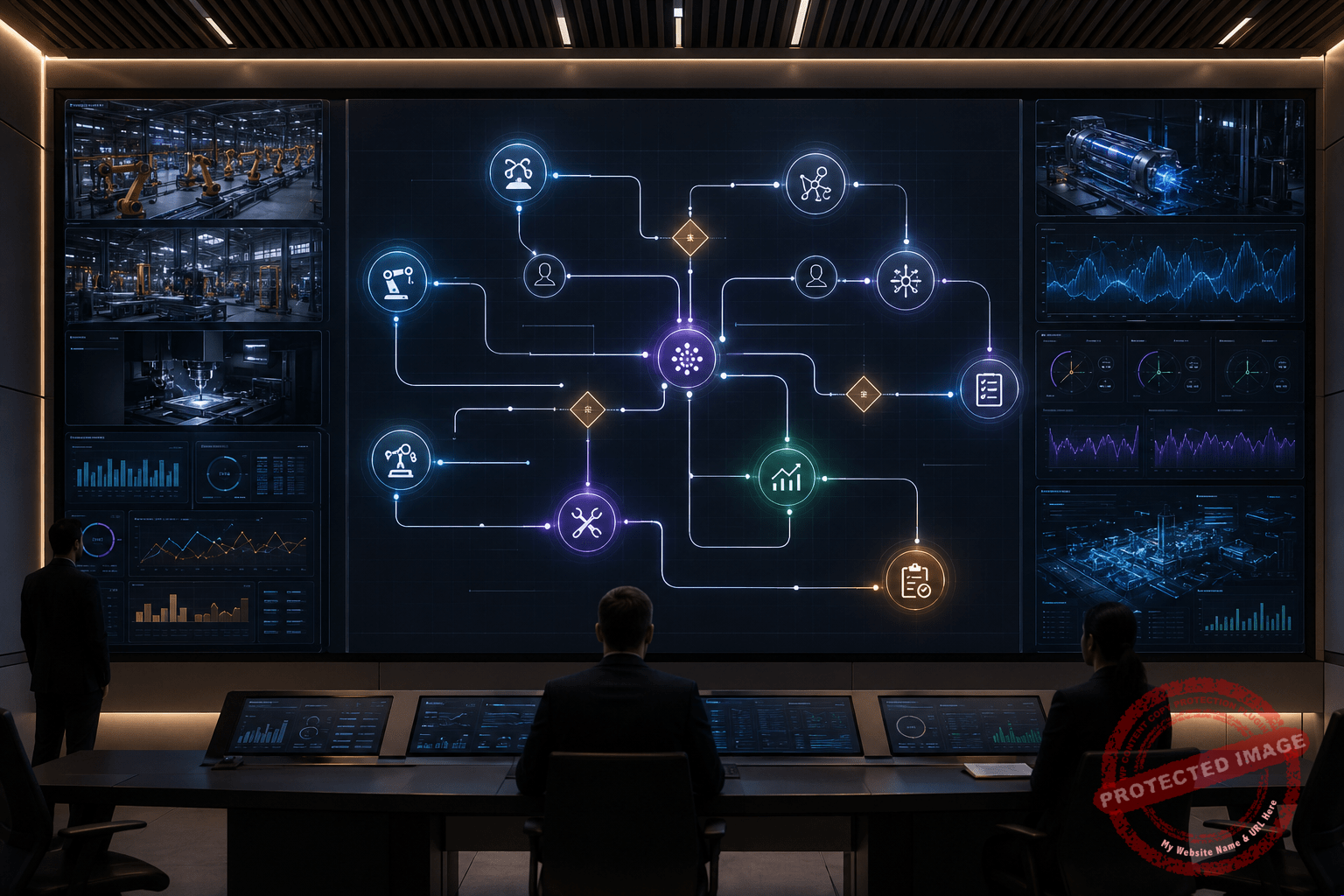
A manufacturing example makes the difference concrete. Consider dynamic shop-floor scheduling. Traditional ERP and MES planning often assumes that a central system can calculate the best schedule, publish it, and have the factory follow it. That works until a milling machine fails, a supplier shipment is late, or a rush order changes priorities. A swarm AI approach might use particle swarm optimization or ant colony optimization to let production options compete and adapt. Machines, jobs, conveyors, and operators can be modeled as local decision points. The schedule improves through repeated local adjustments rather than one brittle master plan.
That is different from an AI agent swarm for maintenance. In that design, one agent watches vibration data from IoT sensors, another queries maintenance logs, another checks inventory, another revises the schedule, and another drafts a message for the floor manager. These agents may use LLMs, retrieval systems, SQL tools, and workflow APIs. The value is not biological emergence; it is coordinated specialization. The system compresses diagnosis, planning, procurement, and communication into minutes, while preserving human review where safety or cost requires it.
The two approaches can be complementary. A factory might use swarm AI for the mathematical optimization of routes, queues, and machine assignments, while using an AI swarm for explanation, exception handling, supplier communication, and operator support. The first layer adapts the physical or operational system. The second layer reasons over context, documents, policies, and human language. Leaders should resist forcing one label to cover both. The architecture becomes clearer when each layer is named honestly.
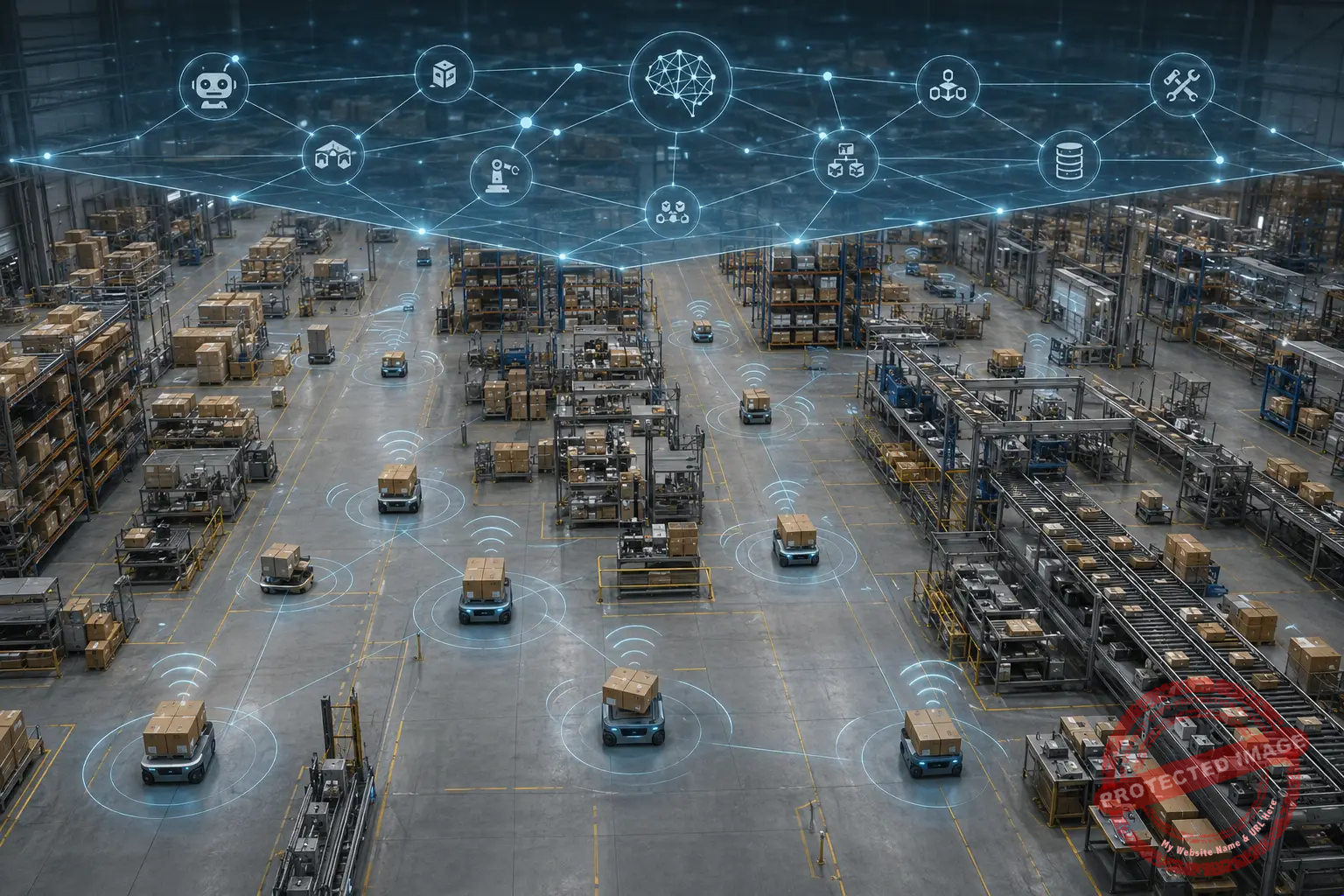
Robotics adds another useful boundary. Autonomous mobile robots in a plant or warehouse may coordinate through local rules: share obstacle information, avoid collisions, balance aisle traffic, and distribute picking tasks. That is close to swarm AI or swarm robotics, especially when no single central controller dictates every movement. ROS 2 and navigation stacks such as Nav2 provide practical building blocks for robot applications and autonomous navigation, though the actual swarm behavior depends on how teams design communication, task allocation, and fleet rules.
An AI swarm may sit above that robot layer. It may analyze order backlog, maintenance risk, workforce availability, and safety constraints, then request the robot fleet to prioritize certain zones. In well-designed systems, the language agents do not micromanage wheel movements. They set goals, evaluate exceptions, and coordinate with enterprise systems. The robot swarm handles spatial autonomy; the agent swarm handles cognitive and organizational work.
Governance, Security, and Builder Implications
The governance implications are also different. Swarm AI raises questions about emergent behavior, stability, observability, and constraint design. If local rules produce global outcomes, how do operators prove the system will not overload a machine, starve a work cell, or create unsafe robot congestion? Testing must include simulation, stress cases, boundary conditions, and careful monitoring of system-level behavior.
AI swarms raise questions about authority, tool use, identity, memory, prompt injection, data leakage, and human accountability. Which agent is allowed to purchase a part? Which can email a supplier? Which can change a production schedule? Which must stop and ask a person? In an enterprise, these questions are not philosophical. They determine whether a multi-agent system is a helpful assistant network or an ungoverned automation risk.
Security teams should pay special attention to the difference. In swarm AI, attacks may target signals, sensors, local coordination rules, or optimization objectives. A small amount of poisoned routing data can distort group behavior. In AI swarms, attacks may target prompts, tools, credentials, inter-agent messages, retrieved documents, or delegation chains. A malicious instruction hidden in a maintenance note could cause an agent to misuse a tool unless the system has strong input boundaries, policy checks, and approval gates.
For developers, the practical test is simple. If the main challenge is finding good solutions across a large, shifting search space, start with swarm AI methods: ant colony optimization, particle swarm optimization, genetic algorithms, distributed heuristics, or robot swarm control. If the main challenge is coordinating knowledge work across specialized capabilities, start with an AI swarm: graph orchestration, role-specific agents, shared state, handoffs, tool permissions, and human escalation.
For executives, the buying question is equally direct. Ask vendors what kind of “swarm” they mean. Are they offering decentralized optimization, human collective intelligence, robot fleet coordination, or LLM-based multi-agent automation? Each has different maturity, risks, infrastructure needs, and performance metrics. A swarm AI scheduling model might be judged by throughput, lateness, energy use, and resilience after equipment failure. An AI swarm maintenance system might be judged by mean time to diagnose, escalation accuracy, procurement cycle time, and auditability.
What to Watch Next
The terminology will probably remain messy through early 2027. Marketing teams like “swarm” because it sounds adaptive and powerful. Engineers need sharper language. The most useful convention is this: use “swarm AI” when the intelligence comes from collective, decentralized, often nature-inspired behavior; use “AI swarm” when multiple AI agents coordinate to perform tasks. When both are present, say so explicitly. A modern factory may run swarm AI underneath and an AI swarm above it.
What to watch next is convergence. The strongest systems will combine operational swarm intelligence with agentic coordination, but they will do it with visible controls. Expect more graph-based agent frameworks, more digital twins for testing emergent behavior, more robot fleet integration, and more governance demands around agent identity, tool permissions, and audit trails. The winners will not be the systems that sound most swarm-like. They will be the systems that adapt quickly, explain their choices, and let humans set the boundaries of autonomy.
The difference, then, is not academic. Swarm AI is a way to design collective intelligence. AI swarm is a way to organize intelligent workers, digital or robotic, into coordinated action. One teaches us how simple actors can produce complex adaptation. The other teaches us how capable agents can divide and complete complex work. The future of industrial autonomy will need both, but it will reward teams that know which one they are building.
Researched and written by Peter Jonathan Wilcheck
References
- Scholarpedia: Swarm Intelligence
- OpenAI Swarm GitHub Repository
- LangGraph: Agent Orchestration Framework
- ROS: Robot Operating System
- Nav2 Documentation
Focus Words
Tag Words
Keywords
Post Disclaimer
The information provided in our posts or blogs are for educational and informative purposes only. We do not guarantee the accuracy, completeness or suitability of the information. We do not provide financial or investment advice. Readers should always seek professional advice before making any financial or investment decisions based on the information provided in our content. We will not be held responsible for any losses, damages or consequences that may arise from relying on the information provided in our content.

 AAPL
AAPL AMD
AMD CIS.HA
 DELL
DELL IBM
IBM INTC
INTC MSFT
MSFT GOOG
GOOG HPE
HPE NVDA
NVDA TSLA
TSLA TMC
TMC MSI
MSI NOK
NOK OPEAZZX