


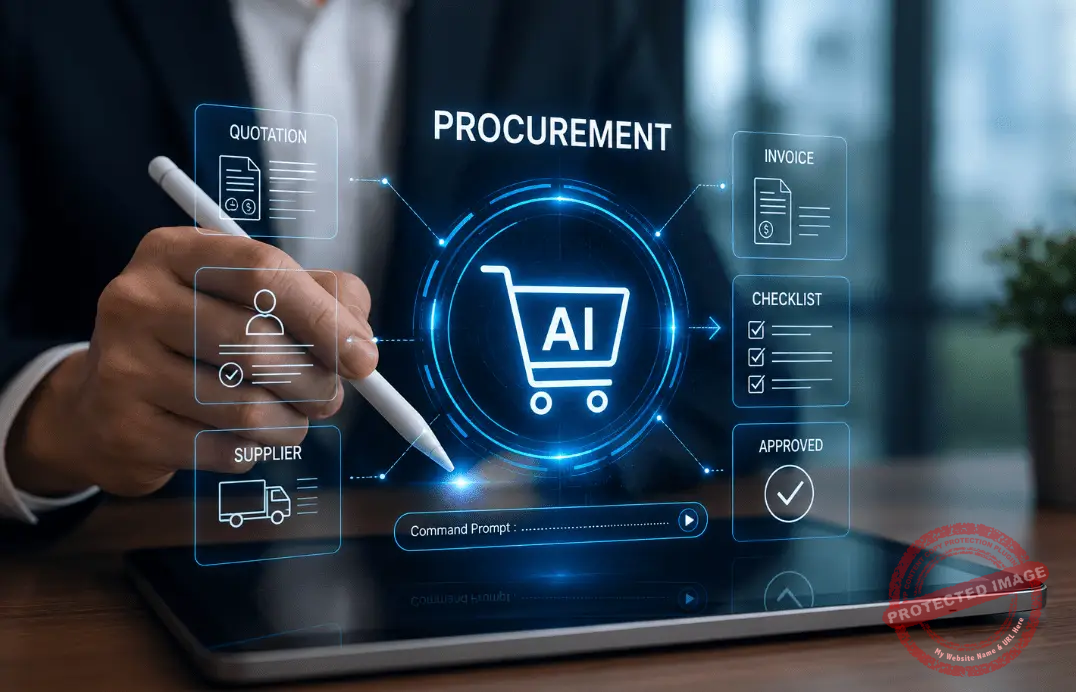
Agentic AI is arriving in procurement with a promise that sounds irresistible: software agents that monitor demand, search suppliers, compare proposals, draft sourcing events, and route exceptions without waiting for a buyer to click every button. For organizations under pressure to reduce cost and cycle time, this is a real opportunity. It is also a governance test. The question is no longer whether AI can help procurement teams work faster. The question is who controls the judgment embedded in the workflow.
Gartner’s April 2026 forecast that supply chain management software with agentic AI capabilities could grow from less than $2 billion in 2025 to $53 billion by 2030 signals how quickly vendors are repositioning their platforms. Procurement leaders should assume that sourcing suites, contract lifecycle tools, risk platforms, and ERP extensions will all claim some form of agentic capability. Some will be useful orchestration layers. Others will be rule engines with better marketing.
The practical distinction matters. A generative AI assistant summarizes a contract. An agentic sourcing tool may decide which suppliers to invite, what risk signals to prioritize, when to escalate, and how to sequence negotiations. That means the vendor’s model design, data access, integrations, and default settings become part of the enterprise operating model.
Vendor management therefore has to move upstream. Traditional due diligence asks whether the supplier is financially stable, secure, compliant, and capable. AI-specific due diligence must also ask how the system reasons, what data it learns from, how outputs are logged, whether recommendations are explainable, and what happens when the agent is wrong. NIST’s Generative AI Profile explicitly calls for procurement and vendor assessments to address intellectual property, privacy, security, embedded AI, ongoing monitoring, and third-party generative AI risks. That is not academic guidance; it is a buying checklist.
Contracts need the same update. Enterprises should prohibit vendors from using company data to train models unless expressly approved, define ownership and reuse rights for AI-generated outputs, require audit logs for agent decisions, and allocate liability for erroneous recommendations that lead to bad awards, missed obligations, or regulatory exposure. Service levels should cover not only uptime, but also model-change notice, rollback rights, monitoring evidence, and escalation paths.
The EU AI Act adds another reason to formalize this discipline. It entered into force on August 1, 2024, and becomes applicable on August 2, 2026, with phased exceptions. For high-risk AI systems, deployers have obligations around human oversight, relevant input data, monitoring, logging, and incident response. Even companies outside Europe should treat these expectations as a preview of where enterprise AI governance is heading.
There is also a softer risk: emotional incumbency. Once an AI agent is tuned to a company’s categories, suppliers, workflows, and negotiation history, teams may become reluctant to challenge the platform. Switching costs become behavioral as well as technical. Procurement leaders should counter this early by requiring model portability, exportable decision logs, documented configuration, and periodic competitive reviews. Those requirements preserve renewal leverage and make performance discussions evidence-based, rather than dependent on anecdotes from whichever team most likes the tool.
The best near-term operating model is not full autonomy. It is the 30% rule: let AI absorb repetitive processing, pattern detection, first drafts, intake triage, and routine monitoring, while humans retain control over exceptions, relationship strategy, risk tradeoffs, and final commitments. That division respects what machine learning does well without pretending that procurement judgment is paperwork. It also creates new roles, including AI product owners for procurement workflows and data translators who can connect category knowledge to model behavior.
Agentic procurement can become an advantage. But only if vendor management treats it as enterprise infrastructure, not a feature demo. The winners will be organizations that buy AI with leverage, govern it continuously, and keep human accountability close to every material decision.
Sources and References
Gartner, “Gartner Forecasts Supply Chain Management Software with Agentic AI Will Grow to $53 Billion in Spend by 2030,” April 7, 2026.
https://www.gartner.com/en/newsroom/press-releases/2026-04-07-gartner-forecasts-supply-chain-management-software-with-agentic-ai-will-grow-to-53-billion-in-spend-by-2030
NIST, Artificial Intelligence Risk Management Framework: Generative Artificial Intelligence Profile, NIST AI 600-1, July 2024.
https://nvlpubs.nist.gov/nistpubs/ai/NIST.AI.600-1.pdf
European Commission, “AI Act.”
https://digital-strategy.ec.europa.eu/en/policies/regulatory-framework-ai
EU Artificial Intelligence Act, Article 26, “Obligations of Deployers of High-Risk AI Systems.”
https://artificialintelligenceact.eu/article/26/
Researched and written by:
Peter Jonathan Wilcheck
AI/ML Engine, Machine Learning, Deep Learning, Data, and MLOPs
Post Disclaimer
The information provided in our posts or blogs are for educational and informative purposes only. We do not guarantee the accuracy, completeness or suitability of the information. We do not provide financial or investment advice. Readers should always seek professional advice before making any financial or investment decisions based on the information provided in our content. We will not be held responsible for any losses, damages or consequences that may arise from relying on the information provided in our content.
 AAPL
AAPL AMD
AMD CIS.HA
 DELL
DELL IBM
IBM INTC
INTC MSFT
MSFT GOOG
GOOG HPE
HPE NVDA
NVDA TSLA
TSLA TMC
TMC MSI
MSI NOK
NOK OPEAZZX