


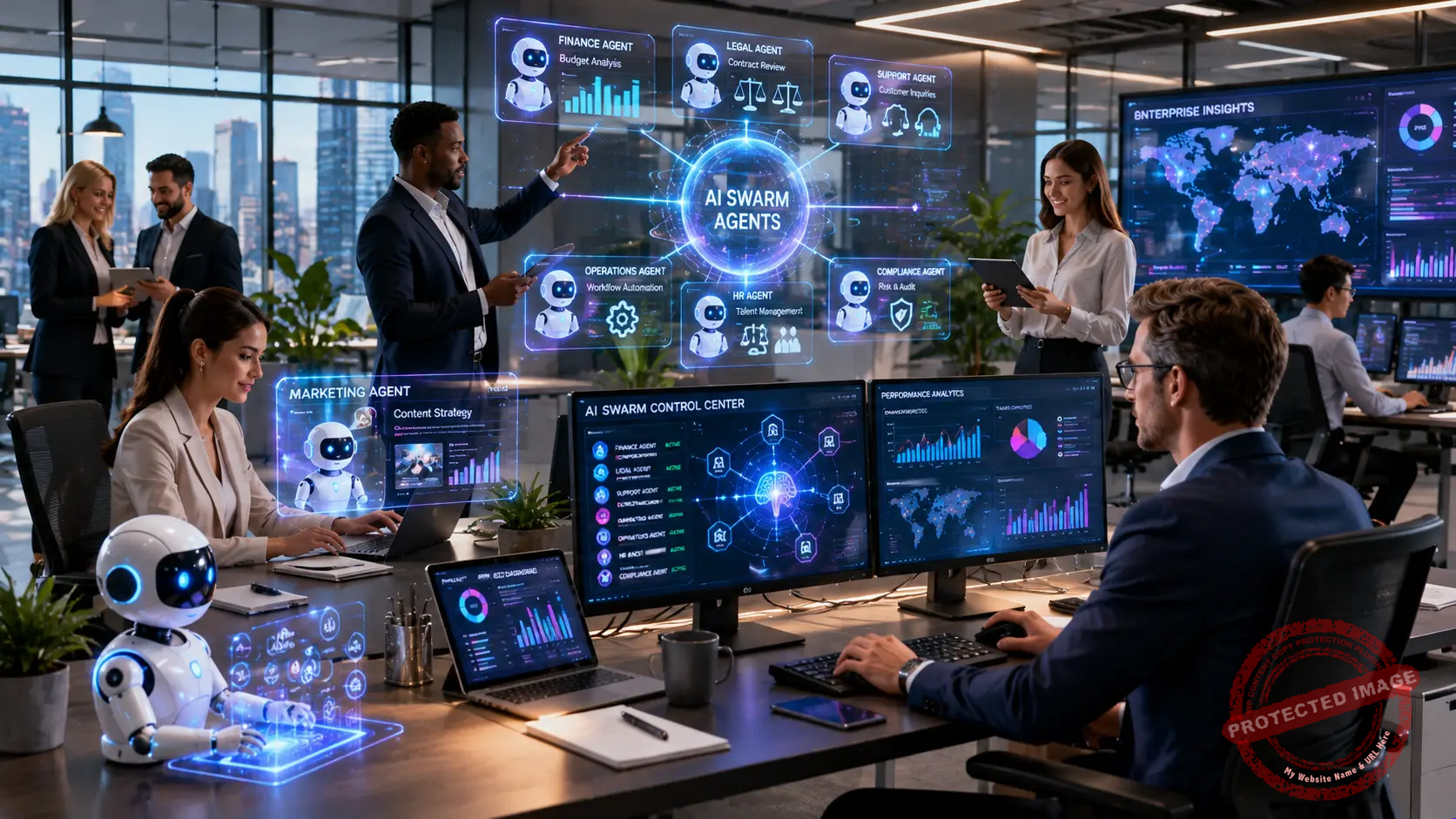
As of this week, July 5, 2026, the most important development in autonomous AI swarm agents is not a single model release. It is the fast convergence of open agent protocols into a production stack: A2A for agent-to-agent coordination, MCP for tool and data access, and a rapidly hardening security layer around both.
That may sound like infrastructure plumbing. It is not. It is the moment autonomous agents begin moving from isolated assistants into interoperable swarms that can discover one another, delegate work, use enterprise systems, and execute multi-step business processes across organizational boundaries. For executives, this is the beginning of an operating model shift. For developers, it is a design constraint. For security leaders, it is a new attack surface.

Why This Matters Now
The Agent2Agent protocol, originally developed by Google and now hosted by the Linux Foundation, has moved from early excitement into ecosystem momentum. The Linux Foundation reported that A2A grew from more than 50 supporting organizations to more than 150, including AWS, Cisco, Google, IBM, Microsoft, Salesforce, SAP, and ServiceNow. It also described A2A and MCP as complementary layers: A2A coordinates agents; MCP connects agents to tools and internal data.
That distinction matters. Early enterprise agents were mostly vertical: a coding agent, a customer-support agent, a finance agent, a procurement assistant. Swarm value appears when those agents can coordinate. A sales agent can ask a pricing agent for approved discount logic, a legal-review agent for contract risk, a support agent for customer history, and a finance agent for margin impact. The output is no longer one assistant answering a question. It is a temporary coalition of specialized systems completing a business task.
The practical consequence is that agent strategy is becoming architecture strategy. Companies will not win by buying the “best agent” in isolation. They will win by deciding which agents can talk, what they can see, what they can do, and when humans must intervene.
The Technical Shift: From Tools to Colleagues
MCP gave agents hands. It lets them reach tools, documents, databases, APIs, and workflow systems. A2A gives agents colleagues. It lets independent agents discover capabilities, negotiate interaction modes, manage collaborative tasks, and exchange information without exposing internal memory or implementation details.
The A2A specification is important because it treats agent collaboration as an operational protocol rather than a custom integration pattern. It includes discovery through agent cards, support for structured data and files, synchronous and asynchronous interactions, streaming updates, long-running tasks, and human-in-the-loop scenarios. Those are not academic details. They map directly to the enterprise workflows where agents are most valuable: onboarding suppliers, investigating claims, resolving outages, planning logistics, reconciling invoices, coordinating field service, and preparing compliance evidence.
The “swarm” in this context does not mean uncontrolled intelligence. A serious enterprise swarm is a governed network of specialized agents with bounded skills, defined identities, observable actions, and escalation rules. The best near-term systems will look less like science fiction and more like disciplined distributed operations: many small agents, narrow authority, strong telemetry, explicit handoffs.
The Catch: Protocols Also Standardize Risk
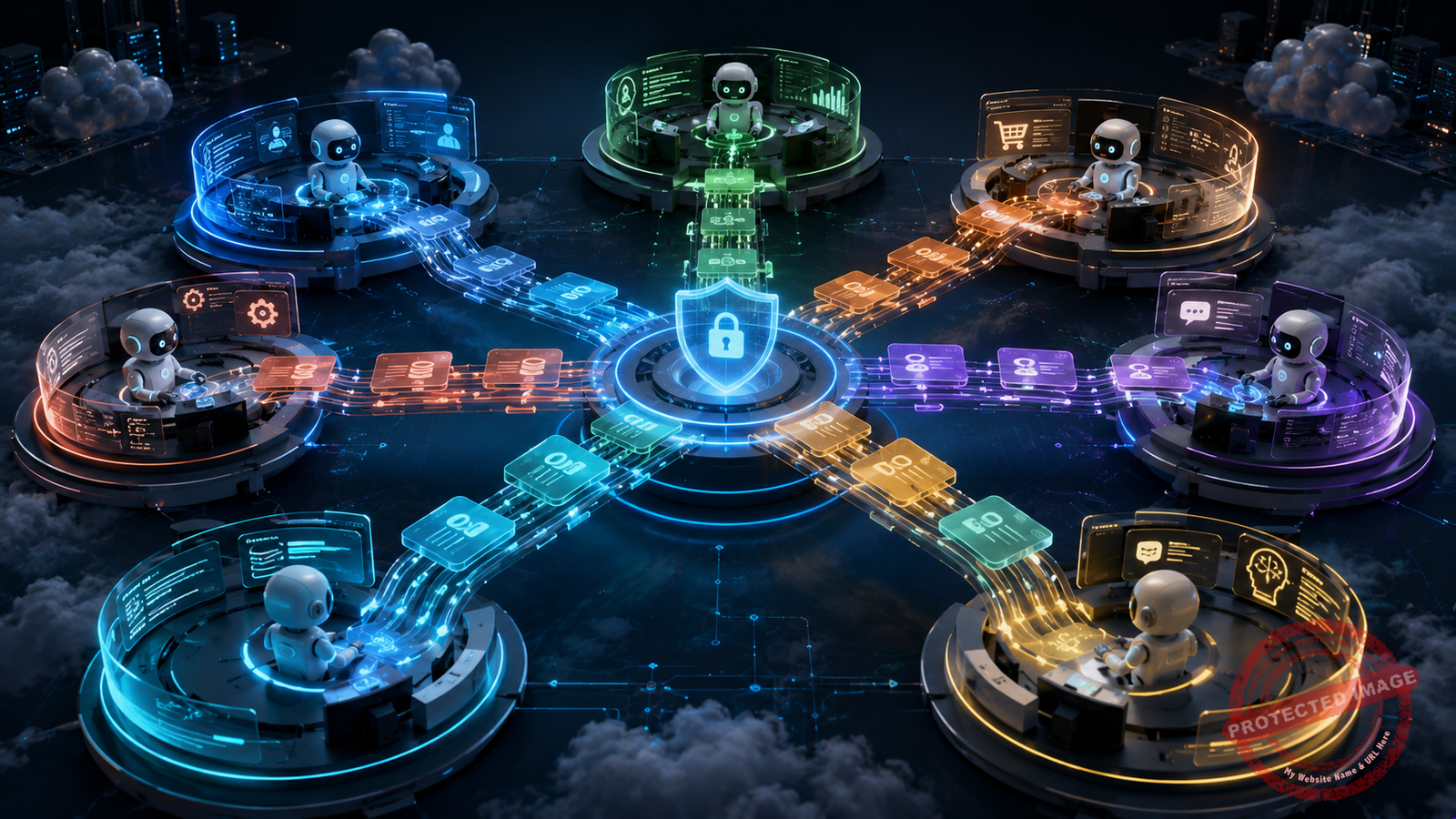
The same interoperability that makes agent swarms useful also makes failures propagate. If one agent trusts another agent’s output too readily, a bad instruction can move across the system. If a tool description is poisoned, an agent may treat malicious metadata as operational guidance. If an MCP server is overprivileged, a small workflow can become a data-loss event.
The National Security Agency’s May 2026 guidance on MCP is a signal that this is no longer theoretical. The NSA warned that MCP adoption has accelerated across business, finance, legal, software development, and other sensitive environments, while security practices are still catching up. Its concern was not simply authentication or input validation. It called out dynamic tool invocation, implicit trust relationships, and context sharing as systemic risks.
Microsoft’s June 30 security analysis made the issue even more concrete: when agents move from reading to acting, prompt injection changes character. A malicious instruction no longer just biases a summary. It can trigger an action. Microsoft described MCP tool poisoning as a supply-chain problem in which tool metadata can quietly redirect agent behavior inside an otherwise approved workflow.
This is the core executive takeaway: autonomous swarms turn integration security into decision security. It is not enough to ask, “Can this system access the database?” Leaders must ask, “Under what reasoning path, delegated by which agent, with what evidence, and with what human approval can this system act?”
Governance Becomes a Runtime Function
Traditional AI governance often focused on model selection, acceptable use, data handling, and post-hoc review. Swarm agents require governance at runtime. Every active agent needs an identity. Every tool call needs scope. Every delegation needs provenance. Every high-impact action needs an approval policy, rollback path, or kill switch.
The OWASP Top 10 for Agentic Applications for 2026 is useful because it frames the risk categories in agent-native terms: goal hijack, tool misuse, identity and privilege abuse, agentic supply-chain vulnerabilities, insecure inter-agent communication, cascading failures, and rogue agents. That vocabulary should become familiar to boards and architecture review committees. It describes how autonomous systems actually fail.
A mature enterprise agent program should therefore maintain an agent registry, approved tool registry, prompt and tool-description change control, least-agency permissions, red-team testing, behavioral logging, and anomaly detection across agent chains. “Least privilege” is necessary, but insufficient. An agent may have narrow access and still have too much freedom to decide when and why to use it.
The governance question for late 2026 is not whether agents are allowed. They already are. The question is whether organizations can observe and constrain multi-agent behavior before scale makes accountability impossible.

What Developers Should Build Differently
Developers building autonomous swarm systems should assume interoperability from day one. That means designing agents as bounded services, not omnipotent assistants. Each agent should advertise a narrow capability set, accept structured tasks, produce auditable outputs, and expose enough telemetry for downstream agents and humans to evaluate trust.
Agent cards and tool descriptions should be treated like production code. They influence behavior and deserve review, signing, versioning, and monitoring. MCP servers should be inventoried like third-party dependencies. A2A interactions should carry trace context so a completed task can be reconstructed across agents.
Testing also needs to change. Unit tests and prompt evaluations are not enough. Teams need adversarial workflow tests: poisoned tool metadata, malicious retrieved documents, compromised downstream agents, stale memory, conflicting goals, and unexpected delegation loops. The failure modes of swarms are often relational. One component behaves acceptably in isolation but dangerously in combination.
The better pattern is “small agents, explicit contracts.” Give agents limited authority, typed inputs, constrained tools, and clear escalation thresholds. Use human review for irreversible actions: payments, account changes, external communications, legal commitments, production deployments, and sensitive data transfers.
What Executives Should Decide This Quarter
The strategic opportunity is real. Interoperable swarms can compress cycle times across functions where work is fragmented: claims handling, supply-chain exception management, customer renewal operations, clinical administration, financial close, IT incident response, and enterprise sales support. These are not places where one chatbot changes the business. They are places where coordinated agents can remove handoff latency.
But the companies that benefit first will not be the ones with the most experimental agents. They will be the ones with the clearest operating model. Who owns an agent? Who approves its tools? Who can suspend it? How is liability assigned when one agent delegates to another? Which workflows are approved for autonomous execution, and which remain advisory?
By early 2027, these questions will likely separate serious deployments from expensive pilots. The winners will build agent platforms the way they build cloud platforms: shared identity, policy, observability, approved integrations, reusable controls, and clear ownership.

What To Watch Next
Watch three signals through the rest of 2026.
First, A2A interoperability testing and registries. Discovery is powerful only when organizations can trust who an agent is, what it claims to do, and whether its behavior matches its published capability.
Second, MCP security tooling. The market will move quickly toward metadata inspection, server allowlisting, tool-call policy enforcement, and runtime behavioral monitoring.
Third, agent identity. Non-human identities for agents will become a foundation for permissions, auditing, conditional access, and incident response.
The most important swarm-agent development right now is not that agents can cooperate. It is that the industry is beginning to standardize how they cooperate, and security institutions are warning that cooperation must be governed as live infrastructure. That is the bridge from impressive demos to enterprise-grade autonomous swarms.
References
- Linux Foundation: A2A Protocol Surpasses 150 Organizations
- A2A Project: Agent2Agent Protocol Specification
- NSA: Security Design Considerations for AI-Driven Automation Leveraging MCP
- OWASP: Top 10 for Agentic Applications for 2026
- Microsoft Security: Securing AI Agents: When AI Tools Move From Reading to Acting
Researched and written by Peter Jonathan Wilcheck
Post Disclaimer
The information provided in our posts or blogs are for educational and informative purposes only. We do not guarantee the accuracy, completeness or suitability of the information. We do not provide financial or investment advice. Readers should always seek professional advice before making any financial or investment decisions based on the information provided in our content. We will not be held responsible for any losses, damages or consequences that may arise from relying on the information provided in our content.
 AAPL
AAPL AMD
AMD CIS.HA
 DELL
DELL IBM
IBM INTC
INTC MSFT
MSFT GOOG
GOOG HPE
HPE NVDA
NVDA TSLA
TSLA TMC
TMC MSI
MSI NOK
NOK OPEAZZX