


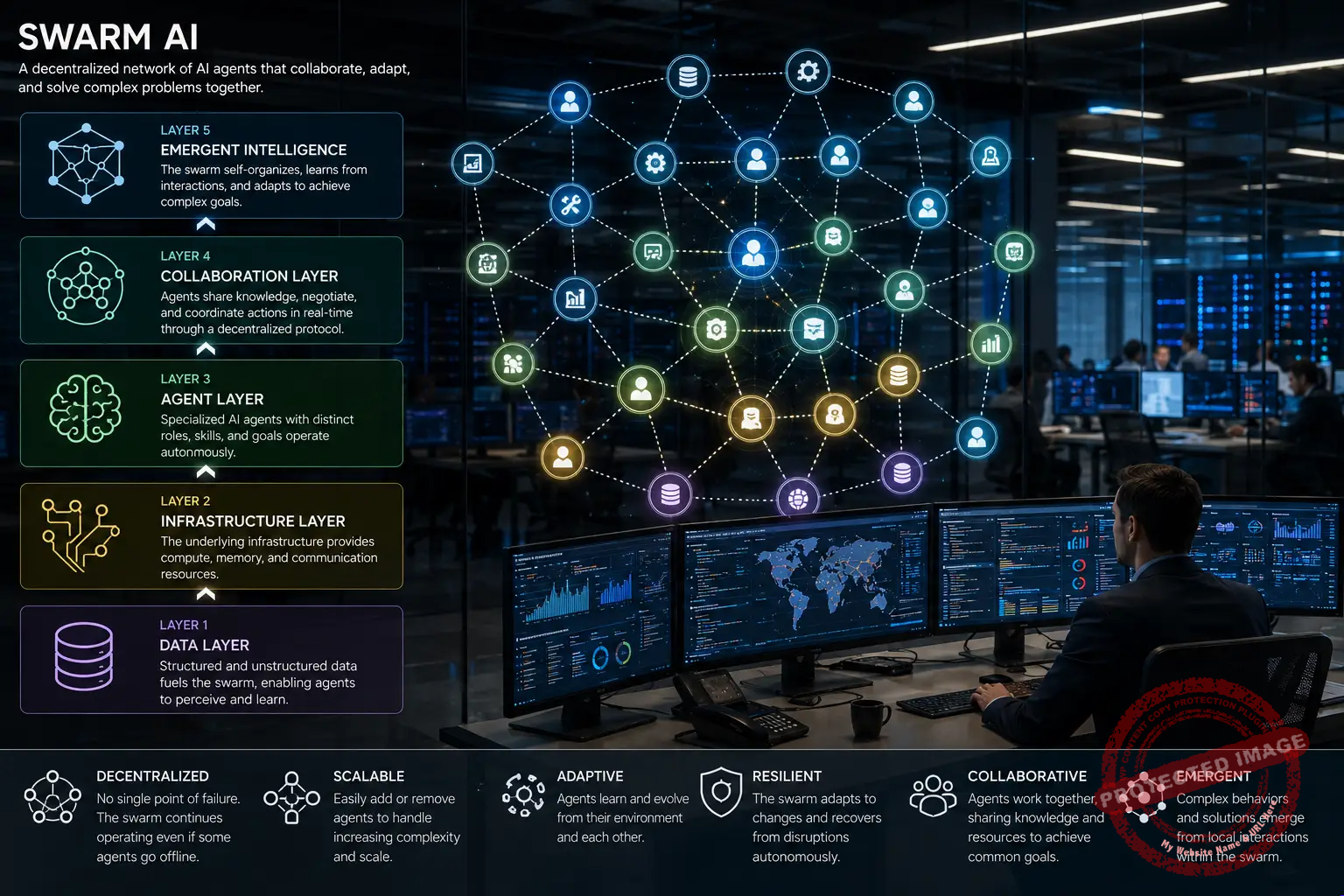
The most important autonomous AI swarm-agent development is the rapid hardening of the open agent protocol stack: Agent2Agent for agent-to-agent coordination, Model Context Protocol for controlled tool access, and emerging identity and governance standards for authorization, audit, and containment. This matters because enterprises are no longer asking whether individual AI agents can draft, search, code, or summarize. They are asking whether teams of agents can safely work across finance, operations, software, customer support, supply chains, and regulated workflows without collapsing into brittle integrations or uncontrolled automation.
The strategic shift is subtle but large. Autonomous swarms are moving from “many prompts” to “many accountable actors.” An agent that can discover another agent, delegate a task, exchange artifacts, call enterprise tools, and leave a traceable record is no longer a chatbot accessory. It is a participant in a distributed operating model. That is why protocol adoption is the story to watch for the rest of 2026 and into early 2027.
Why Protocols Became the Swarm Breakthrough
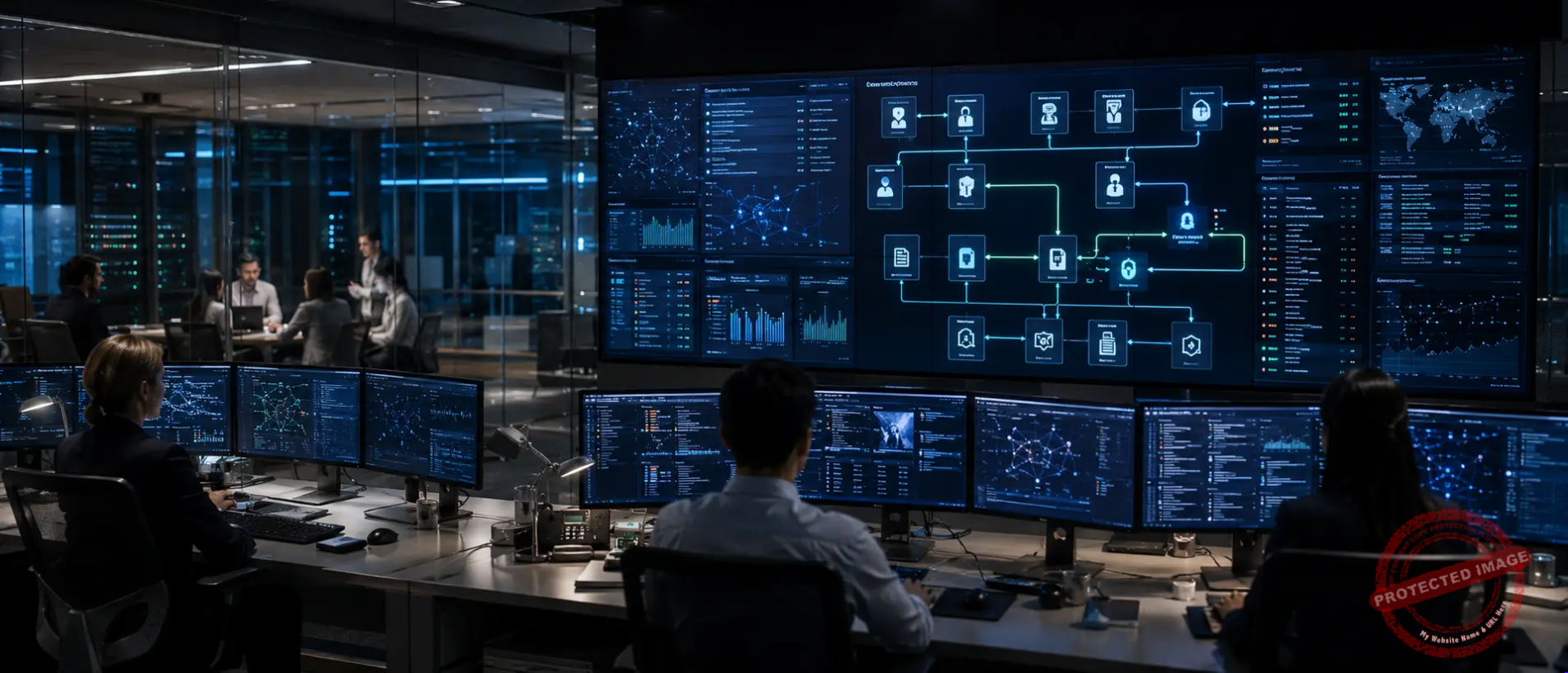
Swarm intelligence sounds futuristic, but the enterprise blocker has been ordinary: integration. A procurement agent, contract review agent, logistics agent, compliance agent, and payment agent cannot become a useful swarm if each one speaks a private dialect, has unclear permissions, or depends on a single vendor’s orchestration layer. Early pilots could fake coordination inside one platform. Production workflows cannot.
A2A addresses the coordination layer. Google introduced Agent2Agent in 2025 as an open protocol for agents from different vendors and frameworks to communicate, securely exchange information, and coordinate actions across enterprise systems. The Linux Foundation’s May 2026 update said A2A had moved beyond early experimentation, with more than 150 organizations involved and support landing in major cloud platforms. The same release framed A2A and MCP as complementary: A2A defines how agents communicate and coordinate; MCP defines how agents connect to tools and data.
That distinction is critical. MCP is the governed access layer: databases, files, applications, search tools, automation systems, ticketing platforms, and workflow engines become available through structured interfaces. A2A is the collaboration layer: agents can discover capabilities, delegate work, negotiate formats, and exchange artifacts. Together, they make a swarm less like a tangle of scripts and more like a network of role-bearing services.
The Governance Clock Is Ticking
The reason this is the week’s most important topic is that adoption and risk are accelerating together. Gartner warned in May 2026 that by 2027, 40% of enterprises could demote or decommission autonomous AI agents because governance gaps are discovered only after incidents. The warning is not anti-agent. It is anti-naive deployment. Treating every agent as either fully trusted or fully locked down ignores the real spectrum of autonomy.
A read-only research agent, a code-modifying developer agent, a claims-processing agent, and a payments agent do not deserve the same controls. The relevant question is not “is this AI safe?” It is “what can this agent see, decide, change, spend, approve, disclose, and delegate?” In a swarm, those questions multiply because one agent’s output may become another agent’s instruction.
NIST’s February 2026 AI Agent Standards Initiative shows that public-sector standards work is catching up to this architecture. The initiative explicitly focuses on agents capable of autonomous actions, secure operation on behalf of users, and interoperability across the digital ecosystem. That puts identity, authorization, provenance, and policy enforcement at the center of agent engineering.
Enterprise Deployment Examples That Matter
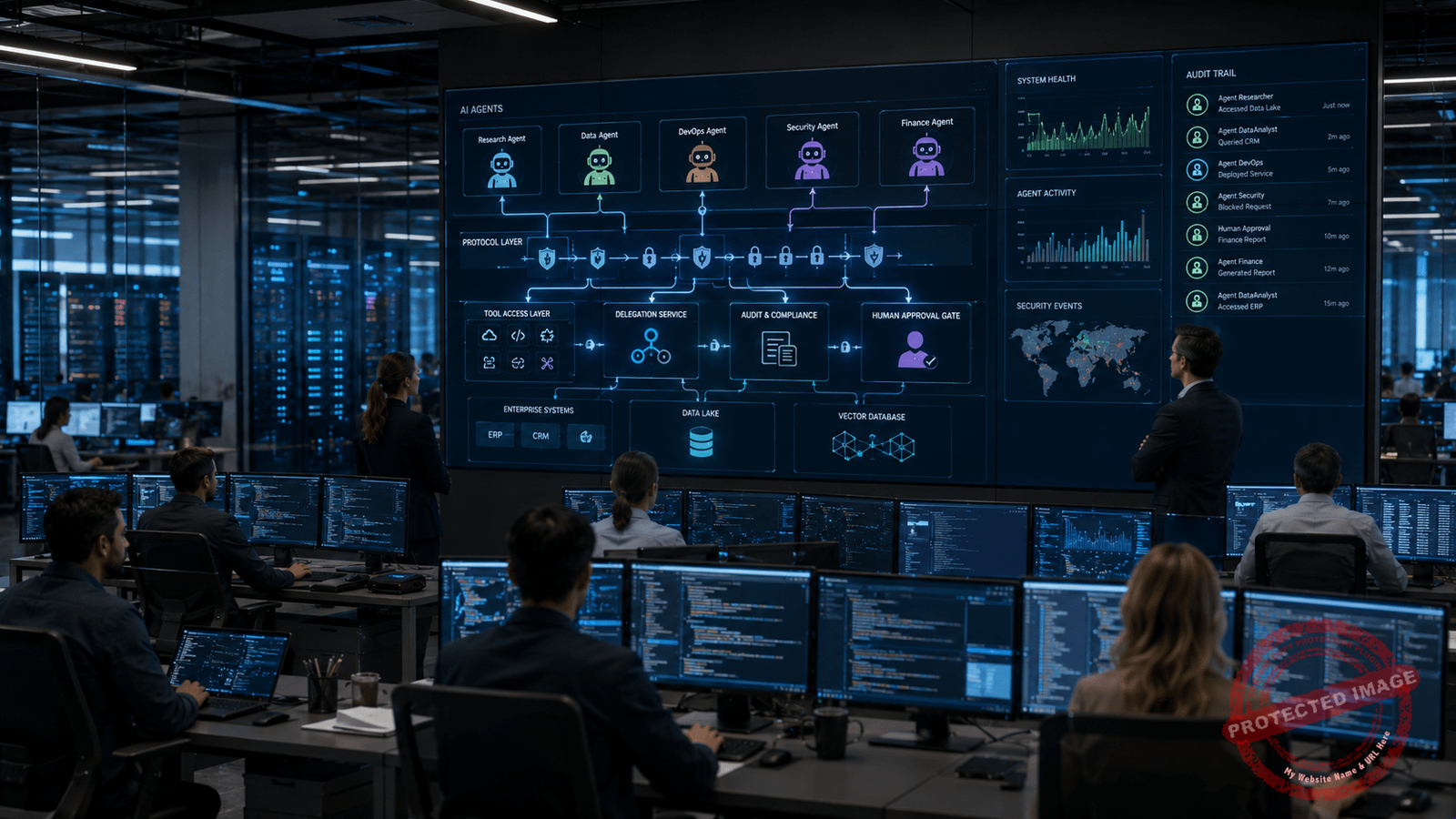
The most credible near-term deployments will not be open-ended “do everything” swarms. They will be bounded, role-specific agent teams wrapped around existing business systems.
In IT operations, a monitoring agent can detect an incident, an investigation agent can gather logs and recent change records, a remediation agent can propose rollback or scaling actions, and a change-control agent can check policy before execution. MCP gives each agent controlled access to observability data, runbooks, and automation tools. A2A lets them coordinate without hardwiring every handoff. The business outcome is faster mean time to resolution with better auditability than a human-only escalation chain, provided the final execution gates match risk.
In pharmaceutical and life-sciences operations, an evidence-gathering agent could assemble study records, a regulatory drafting agent could produce first-pass documentation, a validation agent could compare claims against source data, and a compliance agent could flag missing approvals. This is not a claim that swarms are replacing regulatory professionals. The practical value is cycle-time compression: experts spend less time assembling routine material and more time judging evidence quality, exceptions, and submission risk.
In supply chain and field service, a demand-sensing agent can identify shortages, a procurement agent can compare suppliers, a logistics agent can model delivery constraints, and a finance agent can check working-capital effects. If these agents are interoperable, the enterprise can move from dashboard review to coordinated decision preparation. Human leaders still approve high-impact moves, but the swarm can surface tradeoffs in hours instead of days.
In financial services, the opportunity and danger are both sharper. Research agents, portfolio-monitoring agents, liquidity agents, and compliance agents could coordinate around market events. But autonomous action at trading speed creates correlated behavior risk. For late 2026, the prudent pattern is bounded autonomy: agents may detect, analyze, simulate, and recommend, while execution authority remains tiered and interruptible.
What Builders Should Do Differently
For developers, the protocol stack changes the design center. The agent is no longer the whole product; the agent is one participant in an ecosystem. Builders should define explicit capability cards, structured task lifecycles, typed artifacts, permission scopes, and durable logs from the beginning. A swarm without observability is merely distributed uncertainty.
The most important engineering habit is to separate reasoning from authority. A model may infer what action would help, but a policy layer should decide whether the agent is allowed to read the data, invoke the tool, request another agent, or execute the change. In mature deployments, every agent should have an identity, every tool call should be attributable, and every delegation should preserve context without leaking unnecessary data.
Enterprises should also resist single-platform comfort. A monoculture may move quickly in pilots, but real companies run mixed clouds, legacy ERP, custom applications, SaaS estates, and partner ecosystems. Open protocols do not eliminate integration work, yet they reduce the chance that every new agent becomes another bespoke connector. That matters when the organization moves from ten agents to hundreds.
The Security Model Has to Become Swarm-Native
The hardest risks in swarm systems are not classic model errors alone. They are compound failures: prompt injection passed from one agent to another, excessive permissions hidden inside convenience integrations, stale context reused in a new workflow, or an agent delegating work to a less trusted peer. A swarm can amplify both productivity and mistakes.
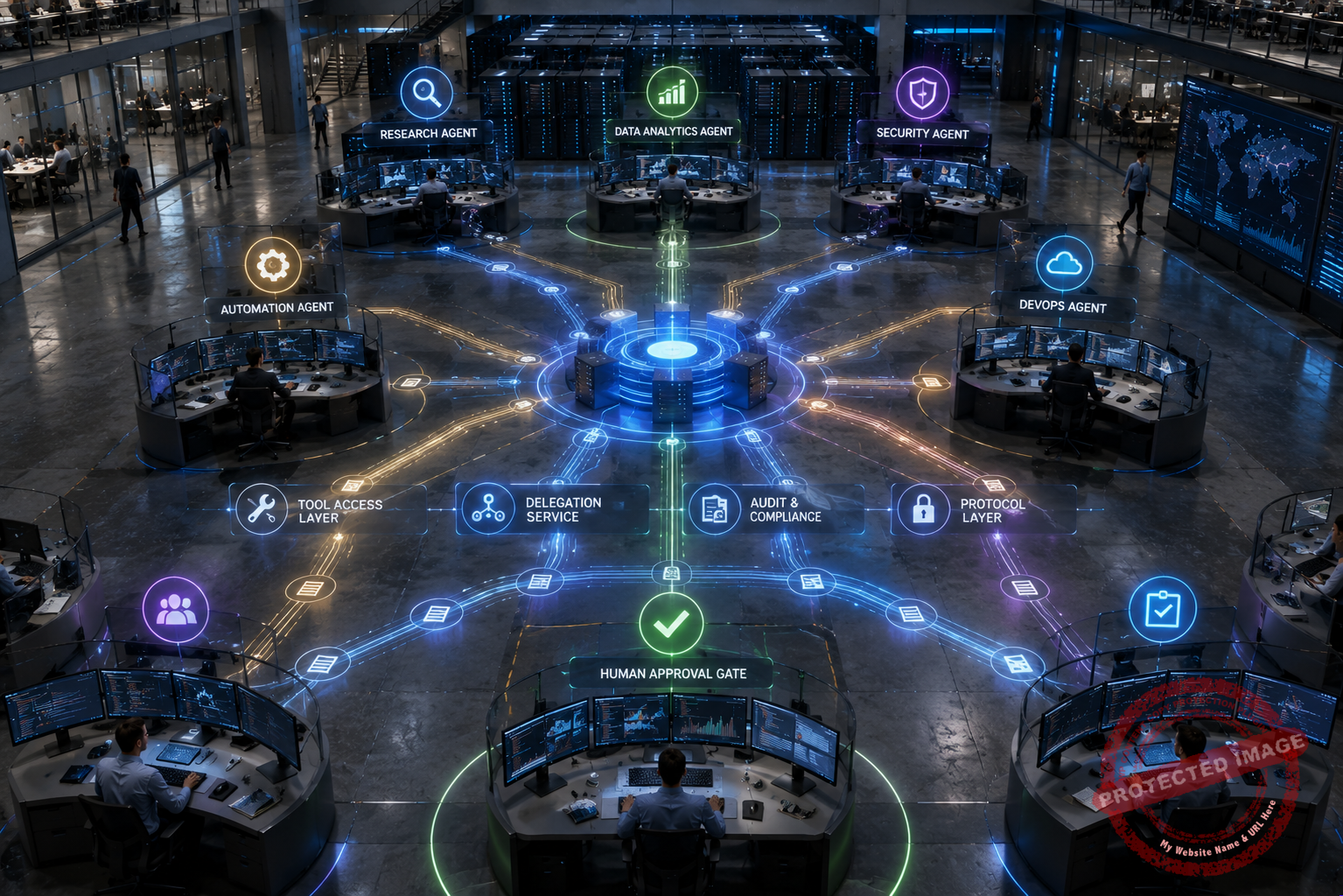
That is why identity and authorization are becoming first-class infrastructure. The emerging pattern is close to zero-trust architecture for agents: authenticate the agent, authorize the action, constrain the data, log the event, inspect the output, and require escalation when risk changes. For high-impact workflows, enterprises will need “agent circuit breakers” that can pause delegation, revoke credentials, or force human review when behavior deviates from policy.
This will become a procurement issue. By early 2027, serious buyers will ask vendors whether their agents support open protocol interoperability, scoped credentials, audit export, policy engines, test harnesses, and incident response controls. The winning platforms will not be those with the most theatrical autonomy. They will be those that make autonomy measurable, interruptible, and governable.
What to Watch Next
The next six months will determine whether enterprise swarms become a disciplined architecture or another wave of automation sprawl. Watch for three signals. First, whether A2A and MCP implementations pass real interoperability tests across vendors, not just demos. Second, whether agent identity work produces usable authorization patterns for enterprises that already live with IAM, SIEM, GRC, and change-management systems. Third, whether regulated industries publish concrete operating models for tiered autonomy.
The direction is clear: the swarm-agent era will not be won by bigger models alone. It will be won by coordination, permissions, memory boundaries, observability, and governance. In late 2026 and early 2027, the enterprise question is no longer whether agents can act. It is whether many agents can act together with enough discipline to be trusted.
Researched and written by Peter Jonathan Wilcheck
References
- Linux Foundation: A2A Protocol Surpasses 150 Organizations
- Google Developers Blog: Announcing the Agent2Agent Protocol
- Anthropic: Donating MCP to the Agentic AI Foundation
- NIST: AI Agent Standards Initiative
- Gartner: Governance Gaps and Autonomous AI Agent Failure
Post Disclaimer
The information provided in our posts or blogs are for educational and informative purposes only. We do not guarantee the accuracy, completeness or suitability of the information. We do not provide financial or investment advice. Readers should always seek professional advice before making any financial or investment decisions based on the information provided in our content. We will not be held responsible for any losses, damages or consequences that may arise from relying on the information provided in our content.
 AAPL
AAPL AMD
AMD CIS.HA
 DELL
DELL IBM
IBM INTC
INTC MSFT
MSFT GOOG
GOOG HPE
HPE NVDA
NVDA TSLA
TSLA TMC
TMC MSI
MSI NOK
NOK ECDH26.CME
 OPEAZZX