


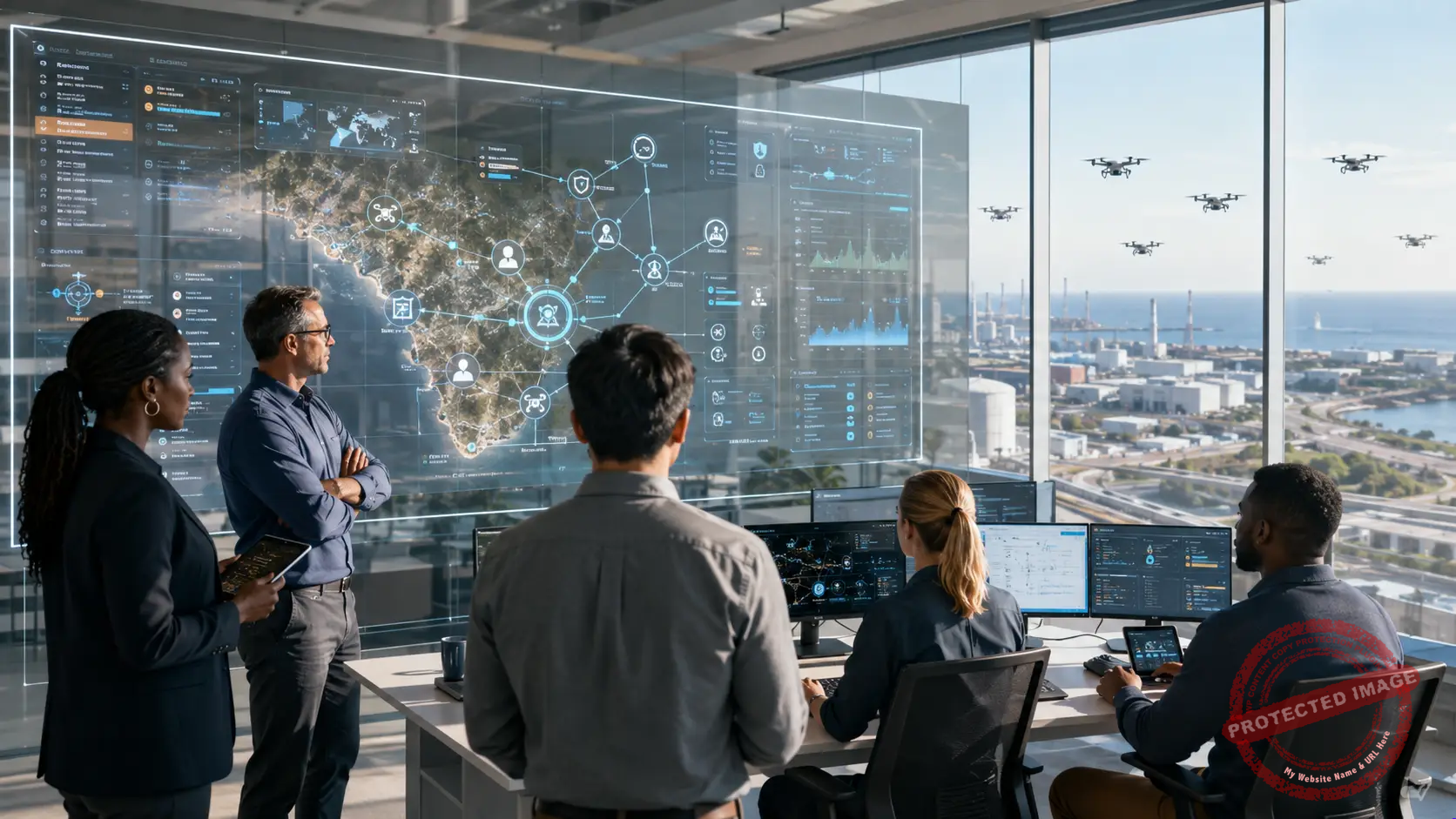
In this article, we will explore the latest technology focused on an industry I am very familiar with. This week, I will be covering one of the most talked-about autonomous swarm topics in the U.S. Armed Forces. This article is not only about drones. It is about control. The Pentagon’s decision to consolidate oversight of unmanned and autonomous systems under a direct-reporting portfolio manager is a visible defense signal, but the same pattern is appearing in enterprise AI: organizations are moving from isolated agents to coordinated fleets that need identity, authorization, monitoring, and mission limits. In physical systems, that fleet may be drones, ground robots, or uncrewed vessels. In digital systems, it may be coding agents, incident-response agents, procurement agents, finance agents, and security agents collaborating across tools.
That is why defense consolidation and dual-use autonomy belong in the same conversation. The technical problem is no longer whether one agent can perform one task. It is whether many agents can operate under a command model that is fast enough to be useful, constrained enough to be trusted, and observable enough to survive adversarial environments.

From Drone Programs to Autonomy Portfolios
The Pentagon’s consolidation effort matters because it reflects an organizational shift that enterprises will recognize. When a capability becomes strategic, fragmented ownership becomes a liability. Separate teams can experiment quickly, but they struggle to set standards, prioritize procurement, manage security, or decide which systems deserve scale. Autonomous systems make that tension more urgent because the software layer changes faster than the hardware layer.
The March 2026 acquisition of Apium Swarm Robotics by Red Cat Holdings shows the commercial version of the same logic. Red Cat did not merely buy another airframe. It acquired distributed control software for autonomous swarming drones and uncrewed surface vessels. That is the strategic layer: command-and-control, coordination, and mission execution across many assets.
In dual-use markets, the same software patterns can support reconnaissance, border monitoring, warehouse inspection, coastal restoration, disaster response, and environmental sensing. The operational distinction is the governance envelope around the drone: who can assign the mission, what data it can collect, whether it can adapt its route, when a human must approve escalation, and how the system proves afterward that it stayed inside policy.
The Digital Frontier: Enterprise Orchestration and Identity
The parallel inside the enterprise is the rise of agent orchestration. A single AI assistant can draft a report or summarize a ticket. A swarm can decompose work: one agent plans, another retrieves data, another writes code, another tests, another checks policy, and another opens the change request. That model compresses cycle time. It is also dangerous if every agent borrows a human’s credentials, retains broad access, or acts without an audit trail.
The Cloud Security Alliance’s Agent Identity Governance Framework is important because it reframes agents as first-class identity subjects. That sounds procedural, but it is foundational. If an agent can call APIs, read documents, modify code, purchase cloud capacity, or trigger workflows, it is not just a model output. It is an actor inside the enterprise.
A practical custom AI swarm framework should therefore start with identity rather than prompts. Each agent needs a purpose, owner, runtime boundary, credential set, allowed tools, data classification limit, logging requirement, and decommissioning path. The orchestrator should be a policy enforcement layer that grants short-lived access, routes tasks to specialized agents, and interrupts the swarm when risk conditions change.
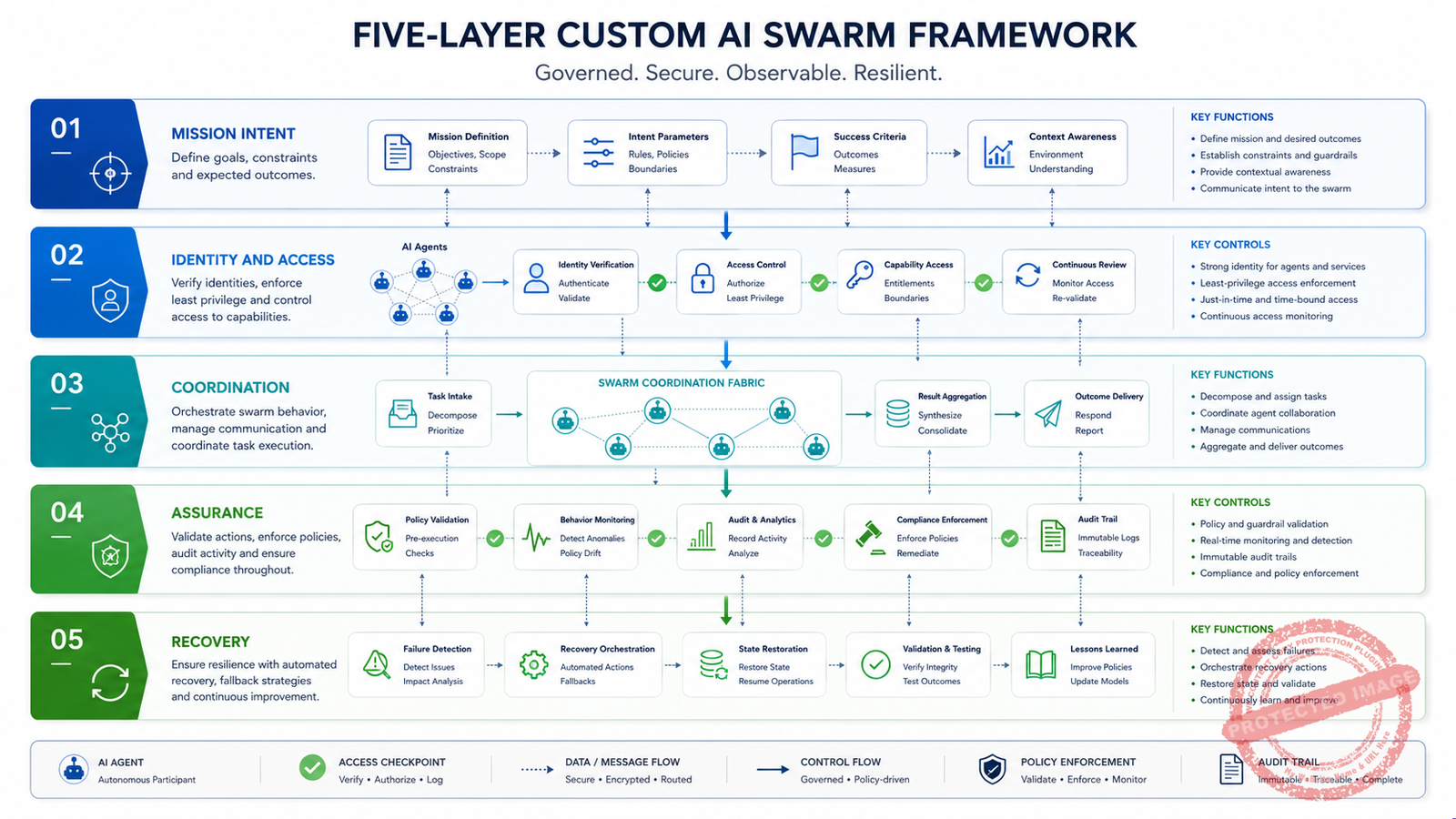
A useful enterprise pattern is the five-layer swarm stack. The first layer is mission intent: the business outcome, constraints, and unacceptable actions. The second is identity and access: unique agent identities, cryptographic authentication, just-in-time authorization, and least privilege. The third is coordination: task planning, state sharing, dependency handling, and conflict resolution. The fourth is assurance: evaluation agents, policy checks, provenance logs, and human approvals. The fifth is recovery: kill switches, rollback plans, credential revocation, and post-incident review.
Cybersecurity Threat Scenarios: When Swarms Attack
Security teams are already modeling what happens when adversaries use agent swarms. Agentic applications can be abused through credential theft, tool misuse, prompt injection, unsafe code execution, data leakage, and indirect attacks through connected systems. A swarm makes those risks harder to contain because the attack can become parallel and adaptive.
A malicious digital swarm might assign one agent to map exposed assets, another to scrape employee context, another to test phishing language, another to probe identity misconfigurations, another to search code repositories for secrets, and another to adjust tactics based on blocked attempts. Traditional defenses often expect a sequence. Swarms create simultaneity.
The most serious near-term threat is not a fully autonomous super-attacker. It is ordinary agent capabilities arranged into an offensive operating model: faster reconnaissance, more believable social engineering, automated exploit chaining, and continuous adjustment. That can compress the time between initial access and meaningful damage. It can also overwhelm teams with low-quality but context-aware probes that are individually minor and collectively revealing.
Prompt injection becomes more dangerous in swarm settings because one compromised agent can contaminate shared state. Tool permissions become more dangerous because a planner agent may instruct an executor agent to take actions the planner itself cannot perform. Identity sprawl becomes more dangerous because unused or poorly governed agents become silent access paths.
Defense Measures Against AI Swarms
The defensive answer is not to ban agents. It is to make swarm behavior governable. Security programs should borrow from zero trust, cloud posture management, software supply-chain security, and incident command.
First, every agent should have a unique identity. Shared service accounts and borrowed human tokens are the fastest way to lose control. Agent identities should be scoped by mission, environment, and time, with automatic expiry.
Second, tool access should be mediated. Agents should not directly inherit broad access to email, repositories, cloud consoles, ticketing systems, and data warehouses. A gateway should enforce tool-level policy, redact sensitive data where possible, rate-limit dangerous actions, and require human approval for irreversible steps.
Third, swarms need behavioral telemetry. Logs should capture not only final outputs, but task assignments, tool calls, retrieved data, inter-agent messages, policy overrides, and failed attempts. Security teams cannot defend what they cannot reconstruct.
Fourth, enterprises should use defensive swarms against offensive swarms. Detection agents can watch for anomalous agent behavior. Policy agents can inspect proposed actions before execution. Deception agents can seed monitored canary credentials and synthetic documents. Incident agents can summarize evidence for human responders without being allowed to remediate independently.
Fifth, shared memory must be treated as a sensitive system. Many swarm designs rely on vector stores, task queues, message buses, or shared workspaces. These can leak secrets, preserve malicious instructions, or create indirect control channels. Access control, retention limits, poisoning detection, and provenance tracking belong in the design from day one.
Commercial Drone Swarms Beyond Defense
The most useful commercial drone-swarm examples are not theatrical light shows, although those prove coordination at scale. The more strategic examples involve repeated sensing, distributed coverage, and data products.
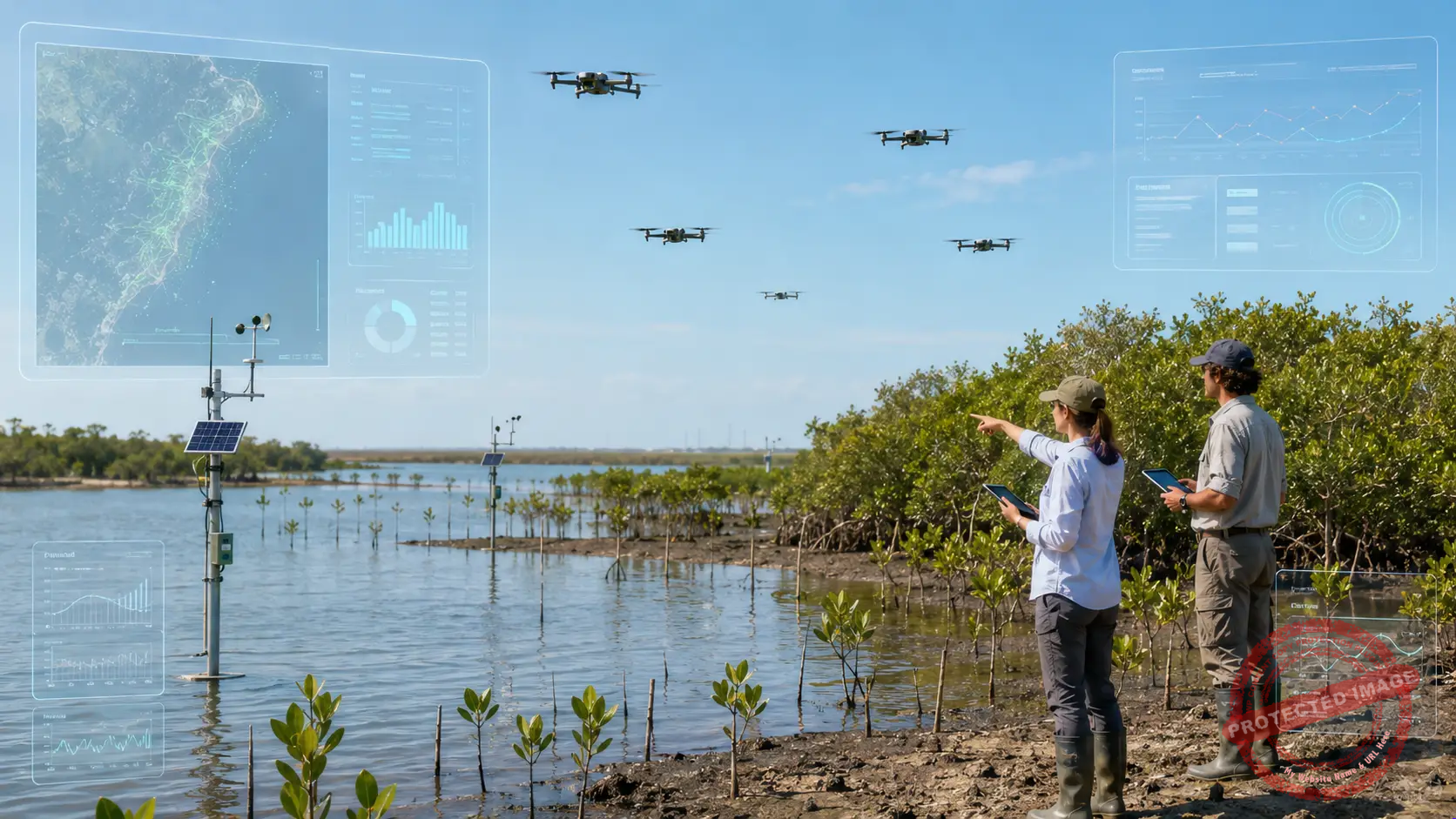
Environmental monitoring is a timely case. Swarmer, Tekmara, and Florida International University announced work exploring autonomous drone swarms for coastal restoration and monitoring in endangered marine environments. That is a dual-use autonomy pattern without being a military application: one operator coordinates many vehicles to collect data across complex terrain, then turns that data into restoration decisions.
Ecosystem restoration firms such as Dendra Systems have shown how drones, AI analysis, and automated seeding can scale rehabilitation of degraded land. In these missions, the swarm value is coverage, repeatability, and feedback. A coordinated aerial fleet can map a site, seed it, revisit it, and compare ecological change over time.
In logistics, warehouse inventory drones show another commercial pattern. Companies such as Verity and Gather AI use autonomous drones to scan pallet locations and reconcile physical inventory with warehouse systems. These are not always marketed as “swarms,” but the architectural direction is swarm-like: fleets of autonomous sensing agents operating on schedules, feeding shared software, and reducing risky manual work at height.
Construction and infrastructure inspection add a third pattern. DroneDeploy and similar platforms let teams automate data collection across sites, roofs, facades, utilities, and large capital projects. As docks, remote operations, and beyond-visual-line-of-sight permissions mature, the enterprise value shifts from “send a drone” to “operate a persistent sensing fleet.”
What Leaders Should Build Now
For developers, the message is clear: build swarms as governed systems, not clever clusters of prompts. Design for explicit roles, bounded authority, durable audit trails, and failure recovery. Assume some agents will receive malicious instructions. Assume some tools will behave unexpectedly. Assume orchestration state will become a target.
For enterprises, the governance model should resemble a merger of identity security and operations management. A swarm should have an owner, a business purpose, an approved tool set, a risk classification, and a measurable performance envelope. Leaders should ask: Can we revoke this swarm quickly? Can we explain why it acted? Can we prove which data it touched? Can we prevent one compromised agent from steering the rest?
For security teams, the near-term priority is visibility. Inventory the agents already running in pilots, developer environments, SaaS platforms, and automation scripts. Identify where credentials are being shared. Put the highest-risk tools behind approval gates. Run tabletop exercises in which multiple agents act at once, because the operating tempo is the point.
What to Watch Through 2026 and Into Early 2027
The next phase of swarm autonomy will be decided less by model intelligence than by control architecture. Defense agencies will keep consolidating authority because fragmented autonomy cannot scale safely. Commercial robotics firms will keep acquiring coordination software because fleets are more valuable than individual platforms. Enterprises will discover that agent identity is not an IAM footnote; it is the foundation of agentic operations.
The winners will be the organizations that can move quickly without making autonomy unaccountable. The losers will either freeze useful automation out of fear or deploy swarms with human-era controls that cannot keep up. Dual-use autonomy is becoming normal infrastructure. The real question is whether we build it as infrastructure we can govern.
Researched and written by Peter Jonathan Wilcheck
References
- Department of War establishes Direct Reporting Portfolio Manager for Unmanned Systems
- Red Cat closes acquisition of Apium Swarm Robotics
- Cloud Security Alliance: Agent Identity Governance Framework
- Palo Alto Networks Unit 42: AI agents and cybersecurity threats
- Swarmer, Tekmara, and Florida International University explore autonomous drone swarms for coastal restoration
Post Disclaimer
The information provided in our posts or blogs are for educational and informative purposes only. We do not guarantee the accuracy, completeness or suitability of the information. We do not provide financial or investment advice. Readers should always seek professional advice before making any financial or investment decisions based on the information provided in our content. We will not be held responsible for any losses, damages or consequences that may arise from relying on the information provided in our content.
 AAPL
AAPL AMD
AMD CIS.HA
 DELL
DELL IBM
IBM INTC
INTC MSFT
MSFT GOOG
GOOG HPE
HPE NVDA
NVDA TSLA
TSLA TMC
TMC MSI
MSI NOK
NOK ECDH26.CME
 OPEAZZX