


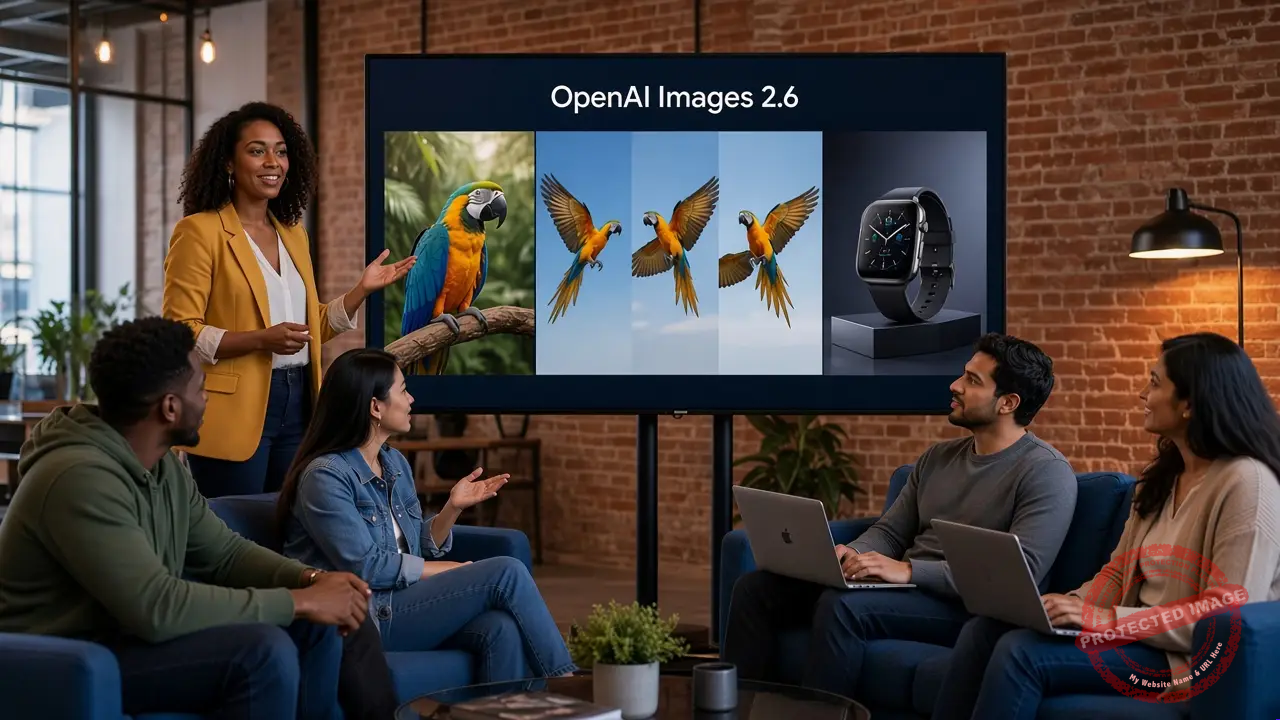
New tools in ChatGPT, Codex, and the API target the journey from an initial visual idea to a usable production asset.
OpenAI has introduced Images 2.6, expanding its image generation platform with animated GIF creation, faster rendering, and additional controls for developers. Announced November 4, the update reaches ChatGPT, Codex, and the API, positioning visual AI less as a standalone novelty and more as part of everyday creative production. OpenAI says availability spans subscription tiers globally, although individual features may roll out gradually. [1][4]
The release was also promoted through OpenAI’s official X account, which highlighted GIFs and faster generation. That makes it a concrete product announcement worth examining, rather than proof that it is the biggest technology story across the platform. The substantive question is whether its new capabilities can reduce friction between imagining an asset, refining it, and putting it to work. [2]
Speed matters beyond the first image
OpenAI says Images 2.6 generates images 50% faster than before. Its announcement also says the Flare API model can produce an image in as little as six seconds when quality is set to low. These are company performance claims, not results from independent testing by TechOnlineNews.com. Actual turnaround will depend on the request and selected settings. [1]
The distinction matters because creative work rarely ends with one generation. A marketer might test several compositions, correct a product detail, change a background, and prepare variations for different placements. Faster individual steps could make that cycle more practical, but they do not automatically establish that an entire campaign takes half as long.
OpenAI’s two API options reflect different priorities. GPT-Image-2.6 Flare emphasizes speed and improved layouts for professional visuals. GPT-Image-2.6 Sunburst emphasizes detail and consistency across edits at medium or high quality. Teams should therefore compare finished outputs against their actual requirements instead of assuming that one model is universally preferable. [1]
A useful evaluation would measure time to an approved asset, not merely time to the first picture. That includes corrections, rejected attempts, and human review. Such a test could reveal whether faster generation creates meaningful productivity gains or simply increases the number of options a team must assess.
GIFs give generated images a new role
The most immediately visible addition is animation. OpenAI describes GIF use cases ranging from moving brand mascots and product loops to reactions, memes, and storyboards. Its announcement shows examples built around sequential frames and consistent characters, illustrating how a static visual concept can become a short, repeating narrative. [1]
“GIFs are the native language of social media,” said Coco Mao, CEO and cofounder of OpenArt, in a statement included in OpenAI’s announcement. Her observation captures the appeal: short loops can convey an emotion or demonstrate an idea without demanding the production effort or viewing commitment of a longer video. [1]
That endorsement comes from a company featured in the launch, not an independent assessment. Still, it identifies a plausible commercial opening. Businesses that already commission static promotional images may experiment with modest motion before investing in more elaborate animation. The opportunity is especially clear when the movement itself carries useful information rather than merely decorating a message.
PCMag contributor Jibin Joseph reported trying GIF creation and described a successful example involving a person walking into a door. That provides a limited published observation beyond OpenAI’s demonstrations, but one example cannot establish reliability across different subjects, movements, or visual styles. Broader testing remains necessary before calling the feature production ready for every use. [3]
More precise editing enters the API
For developers, the update is also about directing revisions. OpenAI says image markup, already available in ChatGPT, now reaches the API, allowing teams to indicate where changes should happen. SVG exports extend the workflow toward assets intended for websites, applications, and print. These capabilities potentially matter as much as faster rendering because they address what happens after generation. [1]
Consider a hypothetical retailer that likes a promotional composition but needs a background element changed. A targeted edit could be more useful than requesting a complete regeneration and risking unwanted changes elsewhere. That is a workflow illustration, not a guarantee that every edit will preserve every detail.
OpenAI also introduces a complexity parameter that governs how much planning goes into meeting a request. The company distinguishes that control from image quality, which concerns visual detail and fidelity. It recommends low complexity for most editing tasks, while suggesting higher settings for scenes containing numerous elements or constraints. [1]
This separation gives developers another variable to evaluate. A simple revision may not need the same planning effort as a crowded scene with multiple requirements. The practical challenge will be choosing settings that deliver acceptable results predictably, without treating maximum settings as the default answer to every task.
Creative leaders emphasize continuity
Itay Schiff, creative director at Figma Weave, framed the update around bringing speed and control together while preserving the defining details of characters, products, and brands. In OpenAI’s announcement, he said Figma Weave was excited to add the model to its creative production workflow. His emphasis is continuity, not merely generating more pictures. [1]
That is an important distinction for organizations. A visually impressive image may still be unusable if it changes packaging, alters a character, or weakens a carefully maintained identity. Consistency is therefore a business requirement, not just an aesthetic preference. The relevant benchmark is whether an asset remains faithful through repeated revisions.
Schiff’s comments should also be understood as a launch endorsement. They explain what an industry participant values, but they do not replace an independent comparison. Creative teams can use that perspective to formulate tests: preserve a product’s shape, maintain a character’s appearance, and change only the element requested.
Independent signals and remaining limitations
There is an independent quality signal to consider. At the time of review, Artificial Analysis ranked GPT Image 2.6 Sunburst at its maximum setting first on its AA-Image-T2I v2.1 leaderboard. Its score was 1,259, based on 4,947 comparisons. Flare at its maximum setting appeared second. The leaderboard uses blind pairwise image comparisons to measure human preference. [5]
That result supports a narrower conclusion than universal superiority. A text prompt preference leaderboard does not independently verify OpenAI’s speed claim, measure GIF quality, or establish dependable editing performance. Nor does a maximum setting result describe every lower quality configuration. Buyers should match the evaluation method to the capability they actually need.
Heise’s reporting offers a useful counterweight to launch enthusiasm. It notes continuing difficulties involving text, complex layouts, and character consistency, attributing those limitations to OpenAI. These are exactly the areas that professional users should inspect before treating generated material as finished work. Better performance and remaining failure modes can coexist. [4]
For publishers, the review obligation is particularly clear. An attractive illustration can still mislead if readers mistake it for documentary photography. Generated graphics should be presented honestly, while factual labels, numerical claims, and depictions of real products deserve careful checking. Animation does not reduce that responsibility; it can make a misleading impression more memorable.
Adoption should begin with a bounded test
A sensible first deployment would start with a defined assignment: an internal concept board, an illustrative product loop, or a social graphic that receives human approval before release. Teams can record the prompt, model, settings, revision count, and final acceptance decision. Those records turn a promising demonstration into evidence relevant to their own work.
Cost should be evaluated alongside quality and speed. More variations are not automatically more value, especially when each requires review. Organizations should consult current pricing and their own usage patterns before estimating savings. The launch materials establish new capabilities, but they do not establish a universal return on investment for every creative department.
Accessibility belongs in that assessment too. A looping graphic should communicate something understandable, not require viewers to infer essential information from motion alone. Publishers can pair it with descriptive text and avoid using animation as the only way to convey an instruction. Those are editorial design choices, not capabilities automatically supplied by the model.
Procurement teams should separate access from operational readiness. Availability across subscription tiers does not, by itself, explain every account limit, contractual condition, or suitability for confidential work. Before uploading sensitive campaign material, an organization should review the terms and controls applicable to its specific account. A feature announcement is not a substitute for that review.
Finally, teams should preserve a clear distinction between experimentation and deployment. An impressive concept can help a designer choose a direction even when it is unsuitable for direct publication. That intermediate value is worth measuring separately. Treating every generated output as either a finished replacement or a complete failure would overlook how creative decisions actually develop through drafts, revisions, and deliberate human selection.
Looking ahead: from generation to dependable production
Images 2.6 points toward a broader ambition for visual AI: combining initial creation, selective revision, animation, and usable output formats inside connected workflows. Its potential significance lies in that combination rather than in a single headline statistic. Faster rendering is valuable when it helps people reach a correct, useful result with fewer obstacles.
The next test is dependability. Creators and developers will need to determine whether the models retain essential details, follow revision instructions, and deliver consistent value under ordinary working conditions. OpenAI has supplied an expanded toolkit and compelling demonstrations. The stronger story will emerge from how reliably that toolkit supports real production, with human judgment remaining responsible for what ultimately reaches an audience.
Written by: Peter Jonathan Wilcheck and Ray Anderson.
References
- OpenAI. “Introducing Images 2.6.” November 4, 2026. [Read source](https://openai.com/index/introducing-images-2-6/)
- OpenAI. Official Images 2.6 announcement on X. November 4, 2026. [Read source](https://x.com/OpenAI/status/2118124944928432327)
- Jibin Joseph, PCMag. “ChatGPT Rolls Out Images 2.6 Model With Support for GIF Creation.” Updated November 6, 2026. [Read source](https://au.pcmag.com/ai/120780/chatgpt-rolls-out-images-26-model-with-support-for-gif-creation)
- Tomislav Bezmalinović, heise online. “ChatGPT Images 2.6 adds GIFs, SVGs and speed.” November 5, 2026. [Read source](https://www.heise.de/en/news/ChatGPT-Images-2-6-adds-GIFs-SVGs-and-speed-11512895.html)
- Artificial Analysis. “AA-Image-T2I v2.1 Leaderboard.” Reviewed November 7, 2026. [Read source](https://artificialanalysis.ai/image/leaderboard/text-to-image)
Post Disclaimer
The information provided in our posts or blogs are for educational and informative purposes only. We do not guarantee the accuracy, completeness or suitability of the information. We do not provide financial or investment advice. Readers should always seek professional advice before making any financial or investment decisions based on the information provided in our content. We will not be held responsible for any losses, damages or consequences that may arise from relying on the information provided in our content.

 AAPL
 AMD
 CIS.HA
 DELL
 IBM
 INTC
 MSFT
 GOOG
 HPE
 NVDA
 TSLA
 TMC
 MSI
 NOK
 OPEAZZX
