


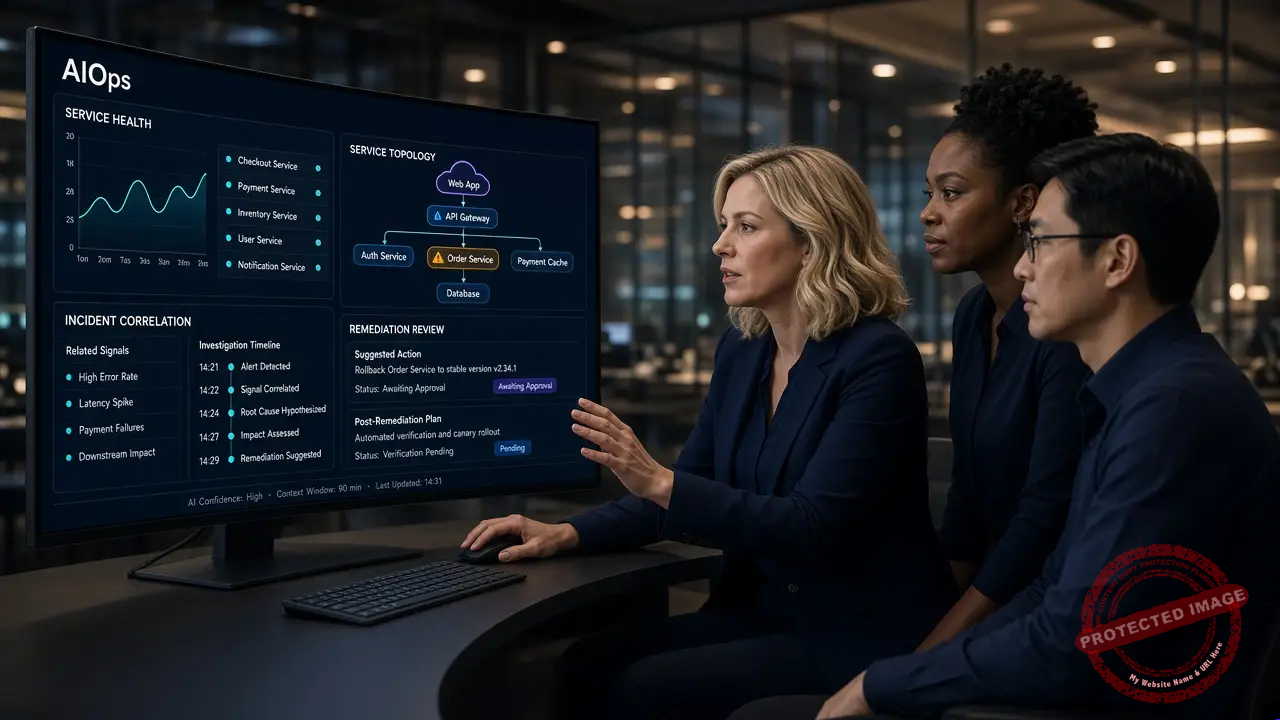
New reliability agents can investigate alerts, connect production evidence and prepare remediation. Enterprises now face a sharper buying decision: which work can be delegated, and what proves that customers are better off?
An incident investigation often begins with a familiar scramble: an engineer opens several monitoring tools, checks recent deployments and asks colleagues which service depends on what. The alert arrives quickly. A credible explanation takes longer.
A new wave of AIOps products is targeting that gap. PagerDuty has announced general availability of Paige and its PD Reliability Platform. Honeycomb has introduced Personal and Team Agents in early access. ServiceNow’s AIOps AI Specialist documentation describes automated triage with remediation left to operators.123
These developments make AI-assisted reliability operations a consequential purchasing topic, not a proven popularity winner. No comparable audience ranking establishes which announcement attracted the most interest. More importantly, product availability does not establish reliable performance inside a particular enterprise.
The meaningful shift is from collecting operational signals to assigning investigative work. The management challenge is to preserve the distinction between a plausible explanation, an authorized change and a verified improvement in service.
This Is AIOps, Not Simply Operations for AI
AIOps applies artificial intelligence to IT operations: correlating signals, investigating service problems and supporting responses across applications and infrastructure. That differs from operating the models themselves, although AI applications can also become services that AIOps monitors.
An SRE agent adds a more active workflow. Instead of displaying a fixed dashboard, it may query telemetry, examine a deployment, compare explanations and prepare a next step. Site reliability engineering supplies the discipline around customer experience, service objectives and operational tradeoffs.
The combination is useful only if the investigation has access to relevant evidence. A fluent summary cannot compensate for missing traces, stale ownership information or an incomplete dependency map.
For buyers, the question is therefore not whether a product calls itself an agent. It is which investigation steps it actually performs, what information supports its conclusions and where its authority stops.
Availability Conceals Important Differences
PagerDuty describes Paige as an SRE agent coordinating signal intelligence, incident management and automation. Its announcement offers both human-approved remediation and autonomous operation in well-understood scenarios, with visibility for operators. The PD Reliability Platform and Paige are described as generally available.1
Honeycomb’s release takes a different route. Its Personal Agent supports individual investigations, while Team Agents pursue goals such as watching releases, investigating alerts and improving instrumentation. Those offerings are explicitly in early access, not presented as universally available production capabilities.2
ServiceNow’s documented AIOps AI Specialist handles alerts within a defined scope, assesses impact and surfaces remediation options. Operators activate remediation; the specialist does not autonomously change the environment.3
Dynascale’s newly introduced Nocto provides another approval-centered example. The company says it investigates infrastructure and prepares changes, with people approving them and actions recorded in an audit log. Its launch page offers early access.4
These are vendor descriptions, not independent comparative tests. They show why buyers should distinguish triage automation, investigation assistance, prepared remediation and autonomous execution rather than placing every product in a single self-healing category.
Evidence Should Travel With the Recommendation
The strongest operational question is simple: show the work. A useful recommendation should connect an affected service to the telemetry, deployment or configuration evidence that supports the proposed explanation.
Honeycomb CEO and co-founder Christine Yen states the ambition directly: “Our agents investigate, show their work, and earn your trust.” The announcement says Team Agents link findings to underlying queries, traces, deployments or tickets and distinguish confirmed findings from hypotheses.2
That is a product claim worth evaluating, not a substitute for evaluation. Correlated events do not necessarily establish causation. A deployment and a latency increase may coincide while another dependency explains the failure.
A reviewable investigation should therefore preserve competing explanations and missing evidence. If the agent cannot inspect a service, it should not quietly imply that the service has been ruled out.
This matters commercially because an elegant but unsupported explanation can redirect scarce engineers toward the wrong fix while customers continue experiencing the original problem.
A Prepared Fix Is Not an Approved Change
Consider a hypothetical checkout service slowing after a release. An agent identifies a recent configuration change and proposes a rollback. That may be reasonable, but the decision still depends on what else changed, which transactions are in flight and whether the earlier version remains compatible.
The example is illustrative, not a reported customer deployment. It demonstrates why organizations need different permissions for investigation and execution.
Reading logs, drafting a ticket and changing production are not equivalent actions. Each should have an owner, scope and escalation path. A team may automate an established low-risk operation while requiring review for a change that could affect customer transactions.
The product differences already visible across these announcements make that choice unavoidable. ServiceNow retains operator activation, while PagerDuty describes optional autonomous scenarios. Buyers should verify their actual configuration rather than assume that a reassuring phrase such as human oversight defines the same boundary everywhere.13
Approval also needs a completion check. A command can execute successfully while the service remains degraded, or while another problem appears elsewhere. The operating procedure should define the expected observation window, the signs that the intervention worked and the conditions requiring reversal or escalation. Preserve the proposed action, its approver and the subsequent observations together. This record helps responders distinguish a failed hypothesis from a failed execution and prevents the incident narrative from being rewritten around the first attractive explanation. It also gives service owners a concrete basis for deciding whether the same action deserves broader automation later. None of this requires assuming that every incident has one cause or one permanent solution under the conditions present in production today.
Measure Customer Recovery, Not a Quieter Queue
Alert reduction can help exhausted teams, but a smaller queue is not proof of healthier service. An incorrectly closed alert can make the dashboard look better while concealing continuing customer impact.
Google’s SRE Workbook grounds reliability decisions in service level objectives, or SLOs, that reflect what users experience. It describes error budgets as a way to balance reliability work with other engineering priorities, and emphasizes stakeholder agreement on how those objectives guide decisions.5
Applied to AIOps, that means judging the intervention against the affected user journey. Did customers regain the ability to complete their task? Did latency recover? Did the response preserve correctness, not merely restore a green infrastructure indicator?
These are proposed evaluation questions, not promised gains from any product. The appropriate measures depend on the service and its users.
An agent that accelerates diagnosis without reducing customer harm may still be useful. But the business case should describe that narrower benefit honestly instead of converting faster explanation into an unsupported uptime claim.
Give Shared Memory an Expiration Policy
Both PagerDuty and Honeycomb describe learning or shared memory across investigations. That could reduce repeated discovery work, but the operational value depends on whether remembered context remains valid.12
A runbook written before an architecture change may point to the wrong owner. A successful workaround can become dangerous after a database migration. An earlier diagnosis may have been reasonable but later disproved.
Enterprises should ask how findings are corrected, which sources remain attached and who can approve persistent operational knowledge. Memory should preserve uncertainty where uncertainty exists, rather than turn a provisional explanation into organizational fact.
This is a governance recommendation, not evidence of a defect in the announced products. It addresses the difference between remembering an incident and maintaining an accurate understanding of a changing service.
Reviewing the knowledge lifecycle belongs beside evaluating model quality, integrations and automation permissions.
Start With One Service and a Clear Comparison
A practical evaluation should begin with one important service whose telemetry and ownership are sufficiently understood. Compare the agent-supported workflow with the existing response process using approved historical cases and controlled exercises.
Track investigation time, evidence quality, incorrect conclusions, reviewer effort and the outcome of proposed changes. Count occasions when the agent correctly declines to recommend a fix because information is insufficient. Restraint can be valuable in production operations.
Include integration and consumption costs. PagerDuty describes pricing that combines platform capacity with events, actions and seats; that structure illustrates why the cost of an agent cannot always be compared with a simple subscription price.1
The evaluation should also identify work transferred rather than eliminated. Engineers may spend less time searching logs but more time validating recommendations or maintaining service context. That tradeoff can be worthwhile, but it should be measured instead of hidden.
Looking Ahead: Reliability Must Remain the Product
The latest releases sharpen an important distinction. AIOps is no longer limited to presenting signals, yet the arrival of investigative agents does not remove the need for engineering judgment, service ownership or change discipline.
The promising direction is an evidence-backed operating model: agents assemble context and undertake bounded work, people retain meaningful authority, and success is measured through the service customers actually receive.
General availability, early access and approval requirements describe different stages and choices, not a single inevitable march toward unattended production changes. Enterprises should buy the capability they can validate today and treat future autonomy as a separate decision.
The next advantage will not belong to the team with the most confident automated explanation. It will belong to the team that can establish what happened, choose an appropriate intervention and demonstrate that the service recovered.
Written by: Peter Jonathan Wilcheck and Ray Anderson.
References
- PagerDuty: Paige, the PD Reliability Platform and PD Labs — official launch announcement
- Honeycomb: AI SRE Agents That Go Beyond Incident Chasing, with Goal-Oriented Continuous Improvement
- ServiceNow: AIOps AI Specialist release notes
- Dynascale: Introducing Nocto — AI operations, with engineers behind every fix
- Google SRE Workbook: Implementing SLOs — Steven Thurgood and David Ferguson, with Alex Hidalgo and Betsy Beyer
Post Disclaimer
The information provided in our posts or blogs are for educational and informative purposes only. We do not guarantee the accuracy, completeness or suitability of the information. We do not provide financial or investment advice. Readers should always seek professional advice before making any financial or investment decisions based on the information provided in our content. We will not be held responsible for any losses, damages or consequences that may arise from relying on the information provided in our content.

 AAPL
 AMD
 CIS.HA
 DELL
 IBM
 INTC
 MSFT
 GOOG
 HPE
 NVDA
 TSLA
 TMC
 MSI
 NOK
 OPEAZZX
