


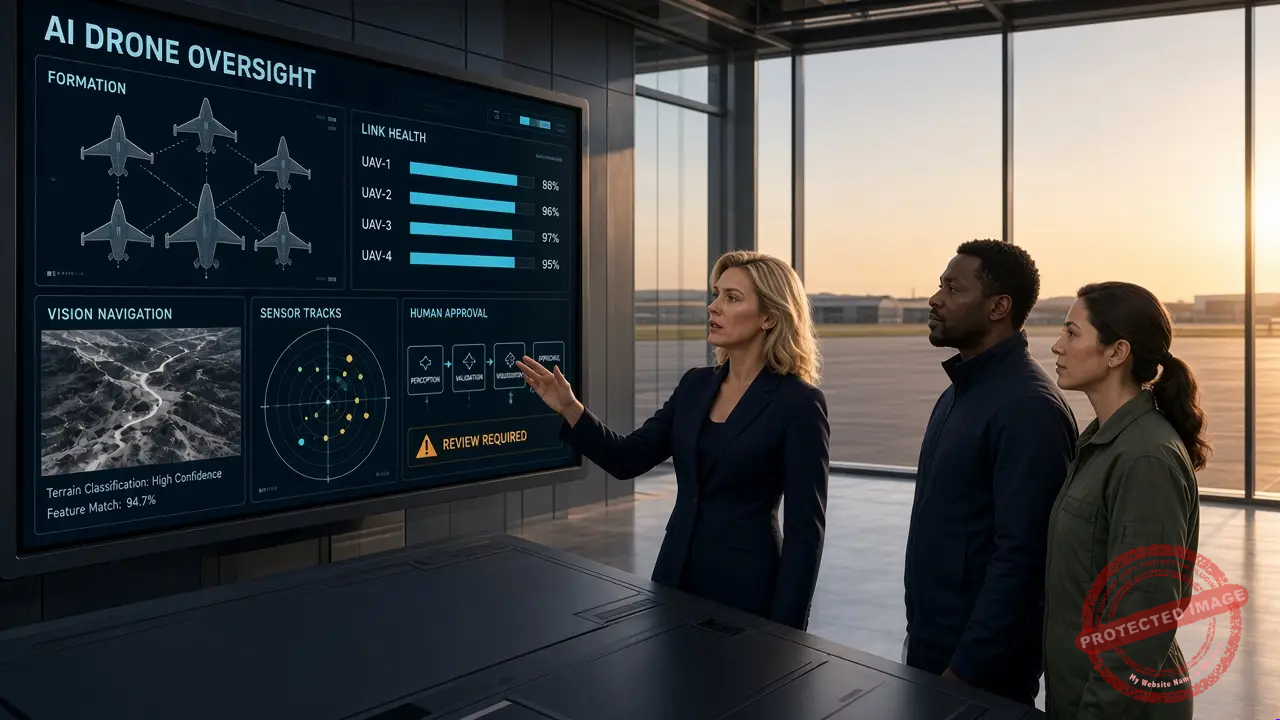
From robotic wingmen to allied swarms, autonomy is moving from the lab toward the force. The hardest engineering problem may be keeping people meaningfully in charge.
Written by: Peter Jonathan Wilcheck and Ray Anderson
For most of the last two decades, a military drone was essentially a remotely piloted aircraft. A crew on the ground flew it, watched its video feed and made every important decision. That model is changing quickly. Artificial intelligence is now being built into navigation, perception, coordination and defense, and armed forces on both sides of the Atlantic are reorganizing programs, budgets and experiments around autonomous systems.
The shift is not a single breakthrough. It is a stack of technologies maturing at different speeds. Some are already in use in active conflict. Others are in production but not yet in service. Many remain in trials and demonstrations. For defense leaders, investors and technology suppliers, separating those stages is the first step toward understanding where the market is really heading.
Here are five technologies doing the most to reshape the field, and the human-control questions that travel with each of them.
1. Robotic wingmen: uncrewed aircraft that fly alongside pilots
The most visible symbol of the change is the U.S. Air Force’s Collaborative Combat Aircraft program, often described as robotic wingmen. These are uncrewed, jet-powered aircraft designed to operate alongside crewed fifth- and sixth-generation fighters, extending reach and adding sensing and mission capacity without putting another pilot at risk.
The program has moved beyond paper. At the Air & Space Forces Association conference in September 2026, Air Force Secretary Troy Meink said the first Increment 1 aircraft from General Atomics and Anduril had begun rolling off production lines, now designated the FQ-42A Vengeance and the FQ-44A Fury. The Y prefix used for prototypes was dropped as the designs moved into production. He also set a goal of at least 500 of the aircraft in service by 2032. That number is a stated plan, not a fielded fleet, and an Experimental Operations Unit at Nellis Air Force Base is still working out how the aircraft will integrate with existing squadrons.
What makes the effort strategically interesting is not only the airframes but the software model. According to DefenseScoop, mission autonomy is being supplied separately through a government-owned reference architecture, with Collins Aerospace and Shield AI under contract. Separating the “brain” from the aircraft is meant to let the service upgrade autonomy in increments and keep competition alive across suppliers. For industry, that design choice may matter as much as any single production award.
2. Collaborative autonomy and swarms that share what they see
If robotic wingmen are about one aircraft working with one pilot, swarming is about many systems working with each other. The core idea is collaborative autonomy: groups of drones that divide tasks, share sensor data and adjust when one member drops out, while an operator supervises the group rather than flying each aircraft.
Allied experiments in 2026 show where the practical challenge sits. During the British Army’s Army Warfighting Experiment 2026, troops from the United Kingdom, the United States and Australia focused on drone swarms. The British Army described its biggest achievement as a system that let the three nations’ swarms share information with each other instantly. The project lead framed the problem in plain terms: machines need common languages to work together.
NATO is pursuing the same interoperability challenge at larger scale. In October 2026, NATO Allied Command Transformation led an experimentation campaign in Latvia with more than 30 countries and about 100 industry partners. The culminating event used nearly 400 drones in a battlefield-informed scenario involving swarms, cross-border incursions and simulated electronic warfare.
Both efforts are experiments, not deployed swarm fleets. Their lesson is that the bottleneck is less about flying many drones and more about standards, data sharing and agreed rules that allow equipment from different countries and manufacturers to operate as one system.
3. Navigation when satellite signals and links fail
Modern conflict has made one weakness of drones impossible to ignore. Satellite navigation and radio links can be disrupted, and a drone that depends entirely on them can become useless. As a result, navigation that does not rely on GPS has become one of the most urgent areas of investment.
Ukraine provides the clearest real-world evidence. Ukraine’s Ministry of Defence says its forces already use more than 70 systems based on artificial intelligence and computer vision. According to IN Defence, the ministry describes computer-vision approaches that compare terrain and landmarks with stored maps to estimate position when satellite signals are unavailable, by day and at night.
This is one of the areas where AI capability is already in use, not merely promised. It is also where reliability matters most. Vision-based navigation can degrade in poor weather, over featureless terrain or when conditions differ from the data a model was trained on. Militaries adopting the technology must test it across those conditions rather than assume a laboratory result will hold in the field.
4. Onboard perception: AI at the edge of the network
The fourth technology is edge AI, meaning processing that happens on the drone itself rather than in a distant data center. Onboard perception allows a drone to detect, classify and track objects using its own cameras and processors, which matters when a link to the operator is weak, delayed or lost.
According to IN Defence, Ukraine’s Ministry of Defence wants every frontline drone equipped with computer vision and AI, and the Brave1 marketplace lists dozens of AI solutions covering functions such as object recognition and optical stabilization. The country has also built shared data infrastructure so companies can train and validate models against common datasets.
That data work is the unglamorous core of perception. At the British Army experiment, a drone pilot from the Irish Guards described labeling large numbers of battlefield images as a “mammoth task” that steadily improves capability. Models need representative, accurately labeled data, and they can perform worse when the environment changes. Edge AI therefore creates a continuing obligation: update, retest and control software versions across fleets that may include many different cameras, processors and airframes.
5. Counter-drone defense: detecting and stopping drones at scale
Every gain in drone capability creates demand for defenses against drones. Counter-drone systems now combine radar, radio-frequency and optical sensors with software that fuses tracks and helps operators decide how to respond. Increasingly, AI is used to sort real threats from clutter and to manage many incoming objects at once.
NATO’s Latvia campaign placed layered counter-drone defense alongside digital connectivity and next-generation targeting, with teams using AI agents to strengthen interoperability. Footage released by NATO shows tracking equipment, drone swarms and a drone interception during testing. Industry is also demonstrating swarm-based defensive concepts at military experiments, though such demonstrations remain claims to be validated through formal testing.
Defense also has an economic dimension. Using an expensive interceptor against an inexpensive drone is not sustainable for long, so planners are looking for layered options that match the cost of the response to the threat. For governments, counter-drone capability is no longer only a battlefield problem. Airports, power plants, data centers and borders face similar detection challenges, which means military investment is likely to spill into civilian security markets.
Where human control still matters
Every one of these technologies raises the same question: who is responsible for a decision when software performs more of the task?
United States policy offers a useful reference point. Department of Defense Directive 3000.09 requires autonomous and semi-autonomous weapon systems to be designed so commanders and operators can exercise appropriate levels of human judgment over the use of force. It requires rigorous verification, validation and realistic testing, interfaces that trained operators can readily understand, and systems that either complete engagements consistent with commander intent or stop and seek more operator input.
The directive also distinguishes semi-autonomous systems, where an operator selects the targets, from autonomous ones, and requires senior review before certain autonomous systems are developed or fielded. Those distinctions are exactly why the details matter. Ukraine’s defence ministry states that a human still makes the final decision. At the British Army experiment, participants compared autonomous systems to soldiers who need clear orders about what they are and are not allowed to do.
The leadership view
The leaders driving these programs are clear about their ambition. Meink has said the Air Force will add large numbers of highly autonomous systems and that the force of the early 2030s will look significantly different. The more durable insight, however, may come from the allied experiments: autonomy only becomes useful when machines, data and rules work together across organizations. Next year’s British experiment is planned to mix real drones with virtual ones to replicate realistic swarm sizes, a sign that testing itself is scaling.
Conclusion: capability without accountability is not progress
AI military drones are moving from concept to production, from single aircraft to coordinated groups and from fragile links to more self-reliant navigation and perception. The organizations that succeed will not simply be those with the most aircraft or the most advanced algorithms. They will be those that can prove their systems are reliable in difficult conditions, secure against interference, auditable after the fact and governed by clear lines of human responsibility.
For technology companies entering this market, that is the real specification. Performance gets attention. Trust, testing and accountability determine what is allowed to fly.
References
Air Force plans to field 500 CCA drones by 2032 – DefenseScoop (Sep 14, 2026) – https://defensescoop.com/2026/09/14/air-force-plans-to-field-500-cca-drones-by-2032/
NATO tests future technologies to connect the battlefield – NATO (Nov 6, 2026) – https://www.nato.int/en/multimedia/multimedia/videos/2026/11/06/nato-tests-future-technologies-to-connect-the-battlefield
Strength in swarms: shaping the future of allied drone warfare – British Army – https://www.army.mod.uk/news/strength-in-swarms-shaping-the-future-of-allied-drone-warfare/
Ukraine scales AI across military drone fleet – IN Defence (Aug 21, 2026) – https://indefencemag.com/ukraine-scales-ai-across-military-drone-fleet/
DoD Directive 3000.09, Autonomy in Weapon Systems – U.S. Department of Defense – https://media.defense.gov/2023/Jan/25/2003149928/-1/-1/0/DOD-DIRECTIVE-3000.09-AUTONOMY-IN-WEAPON-SYSTEMS.PDF
#AIMilitaryDrones #DefenseTech #DroneSwarms #CollaborativeCombatAircraft #CounterUAS #EdgeAI #AutonomousSystems #ResponsibleAI
Post Disclaimer
The information provided in our posts or blogs are for educational and informative purposes only. We do not guarantee the accuracy, completeness or suitability of the information. We do not provide financial or investment advice. Readers should always seek professional advice before making any financial or investment decisions based on the information provided in our content. We will not be held responsible for any losses, damages or consequences that may arise from relying on the information provided in our content.

 AAPL
 AMD
 CIS.HA
 DELL
 IBM
 INTC
 MSFT
 GOOG
 HPE
 NVDA
 TSLA
 TMC
 MSI
 NOK
 OPEAZZX
