


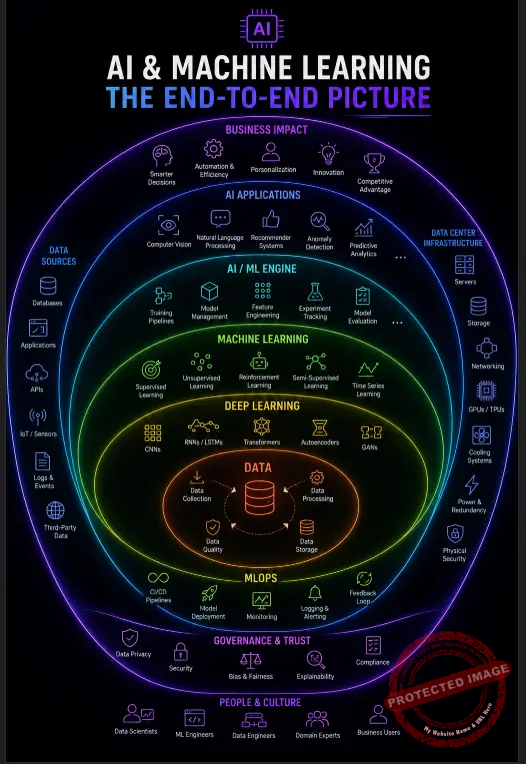
Artificial intelligence in June 2026 is best understood as an ecosystem, not a ladder. Machine learning still provides the pattern-finding foundation. Deep learning supplies the neural architectures that can understand language, images, audio, video, code, and business data. Generative AI turns those learned patterns into useful outputs. AI agents connect models to tools, memory, data, and workflows. Agentic systems coordinate many agents so work can move from request to result with less manual handoff.
The latest advancement is that these layers are becoming more tightly coupled. Google’s I/O 2026 announcements emphasized an “agentic Gemini era,” with Gemini 3.5 Flash positioned for coding and long-horizon agent tasks, Gemini Omni combining reasoning with multimodal creation, and managed agents in the Gemini API. Anthropic’s recent Claude releases highlight stronger computer use, browser navigation, long-context reasoning, and agent planning. OpenAI’s GPT-5 era has pushed unified systems that decide when to answer quickly and when to reason longer, while its 2026 research points to models contributing to scientific discovery. Microsoft, Asana, Salesforce, and others are packaging agents as workplace infrastructure, not just chat assistants.
Machine learning is the base layer. It trains systems to predict, classify, rank, recommend, detect anomalies, and optimize decisions from data. In business terms, ML is why a lender can flag risk, a retailer can forecast demand, or a manufacturer can predict equipment failure. In 2026, the important shift is not that ML disappeared behind generative AI; it became more embedded. Predictive models now feed agents with signals, trigger actions, evaluate results, and personalize workflows. Traditional ML remains essential wherever accuracy, speed, cost, and explainability matter.
Deep learning is the engine behind today’s AI leap. Neural networks, especially transformer-style architectures, learn rich representations from massive datasets. They power large language models, vision-language models, speech systems, code models, diffusion models, and video generators. Recent progress centers on multimodality, longer context windows, better tool use, and more efficient inference. Instead of processing text alone, leading systems can work across documents, images, charts, screens, audio, and video. That matters because real business problems rarely arrive in one neat format.
Generative AI is the interface most people recognize. It creates text, images, code, audio, video, summaries, plans, and synthetic data. By June 2026, the frontier has moved from “write me a draft” to “understand this messy situation and produce the next useful artifact.” Multimodal tools can turn video into edits, transform files into presentations, generate code from a product idea, or explain charts in plain English. The benefit is speed and leverage; the limitation is that generation still needs grounding, review, and guardrails because fluent output can be wrong.
AI agents add action. An agent uses a model to interpret a goal, plan steps, call tools, retrieve information, remember context, ask for approval when needed, and complete tasks. A customer support agent might look up an order, apply a policy, draft a response, and update a CRM. A coding agent might inspect a repository, change files, run tests, and summarize the result. The newest agents are better at computer use and browser tasks, meaning they can operate software through APIs or graphical interfaces instead of simply giving instructions to a human.
Agentic systems are the operating model that makes agents useful at scale. They include orchestration, permissions, monitoring, memory, evaluation, data access, and handoffs among specialized agents. One agent may gather evidence, another may draft, another may check policy, and another may execute approved changes. This is why enterprise platforms now talk about agent marketplaces, managed agents, “AI teammates,” and autonomous productivity assistants. The real innovation is coordination: giving AI enough context and authority to help, while keeping humans, policies, and audit trails safely in control.
Trust is also becoming a product requirement. Watermarking, provenance, sandboxed execution, role-based permissions, evaluation harnesses, and human approvals are now part of the AI stack. These controls do not slow adoption; they make adoption possible in regulated, customer-facing, and mission-critical settings where mistakes have visible consequences.
These technologies complement one another naturally. ML supplies predictions and business signals. Deep learning provides perception and reasoning across complex data. Generative AI creates the content or code needed to move work forward. Agents decide which tools to use and when. Agentic systems organize multiple agents into reliable workflows. Together, they turn AI from a passive answer engine into an active business capability.
The practical takeaway for leaders is to avoid treating these categories as competing buzzwords. A strong AI strategy needs all of them. Use machine learning for measurable predictions, deep learning for unstructured data and pattern complexity, generative AI for creation and synthesis, agents for task execution, and agentic systems for governed, repeatable work. The winners in 2026 will not be the organizations with the flashiest chatbot. They will be the ones that connect models, data, tools, people, and controls into systems that improve how work actually gets done.
References and Sources consulted: Google I/O 2026 AI announcements, Google Managed Agents in the Gemini API, Anthropic Claude Opus 4.8, Anthropic Claude Sonnet 4.6, OpenAI GPT-5, and MIT Sloan on agentic AI
Written by Peter Jonathan Wilcheck
AI, Machine learning, Agentic AI
Post Disclaimer
The information provided in our posts or blogs are for educational and informative purposes only. We do not guarantee the accuracy, completeness or suitability of the information. We do not provide financial or investment advice. Readers should always seek professional advice before making any financial or investment decisions based on the information provided in our content. We will not be held responsible for any losses, damages or consequences that may arise from relying on the information provided in our content.

 AAPL
AAPL AMD
AMD CIS.HA
 DELL
DELL IBM
IBM INTC
INTC MSFT
MSFT GOOG
GOOG HPE
HPE NVDA
NVDA TSLA
TSLA TMC
TMC MSI
MSI NOK
NOK OPEAZZX