


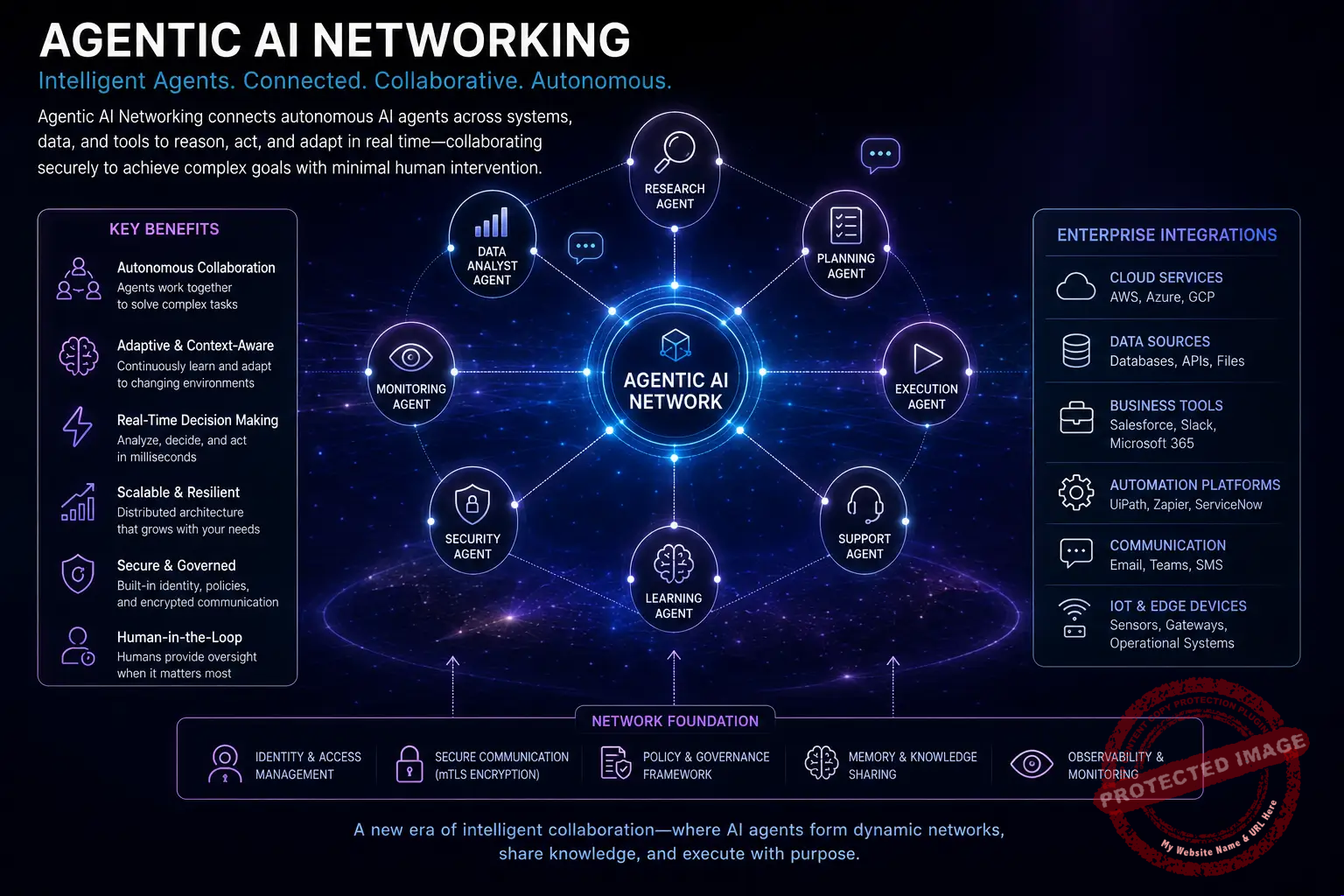
AI infrastructure is entering a new phase. The first wave of generative AI was built around training frontier models and serving chatbot-style prompts. The next wave is being shaped by autonomous agents: systems that plan, call tools, retrieve context, coordinate with other agents, and continue working across multi-step tasks.
That shift changes the infrastructure problem. A chatbot can often be modeled as a request-response workload. An agentic system behaves more like a distributed application: it keeps state, makes repeated inference calls, queries databases, invokes APIs, spawns subtasks, and may coordinate with other agents before producing a result. For GPU infrastructure providers, that means the network becomes just as strategic as the accelerator.
Image prompt: Hyper-realistic, super high-resolution image of a modern AI data center control room showing engineers monitoring autonomous AI agent workflows across GPU clusters, luminous network topology maps on glass displays, rows of high-density server racks in the background, realistic lighting, cinematic detail, no text overlays.
Why Agentic AI Is Different From Chatbot Inference
Traditional inference is often measured by familiar serving metrics: tokens per second, latency per request, cost per million tokens, and GPU utilization. These still matter. But agentic AI adds a more complex execution pattern.
An agent may break one user request into dozens of model calls. It may retrieve documents, update memory, call external tools, evaluate intermediate results, and retry when a plan fails. In multi-agent systems, one agent may hand off work to another specialized agent, creating internal traffic that never touches the end user directly.
This creates more east-west traffic inside the infrastructure. North-south traffic moves between users and the application. East-west traffic moves between services, GPUs, storage systems, vector databases, orchestration layers, and agent runtimes inside the data center. Cisco’s AI networking guidance emphasizes that AI training and inference clusters require high bandwidth, low latency, predictable delivery, congestion management, and observability. Agentic systems intensify those needs because they generate many small, dependent steps rather than one clean inference event.
The Network Becomes Part Of The Model Runtime
In agentic AI, infrastructure delays compound. A 100-millisecond delay in one inference call may be tolerable. A 100-millisecond delay repeated across 40 planning, retrieval, tool-use, and verification steps becomes visible to the user and expensive for the provider.
That is why GPU infrastructure can no longer be evaluated only by accelerator type. Buyers will increasingly ask:
- How predictable is latency under multi-tenant load?
- Can the network handle bursty agent-to-agent and service-to-service traffic?
- How close are GPUs to vector databases, storage, memory services, and orchestration layers?
- Can the platform observe bottlenecks across the whole agent workflow?
- Does the architecture support long-running, stateful tasks rather than only stateless prompt serving?
NVIDIA’s Spectrum-X platform reflects this broader shift toward Ethernet fabrics designed for AI clouds, with emphasis on scale, predictability, and low-latency performance. The important point is not that every buyer needs one specific networking stack. It is that AI networking is becoming a first-class infrastructure decision.
Rack-Scale Systems Will Matter More For Agentic Workloads
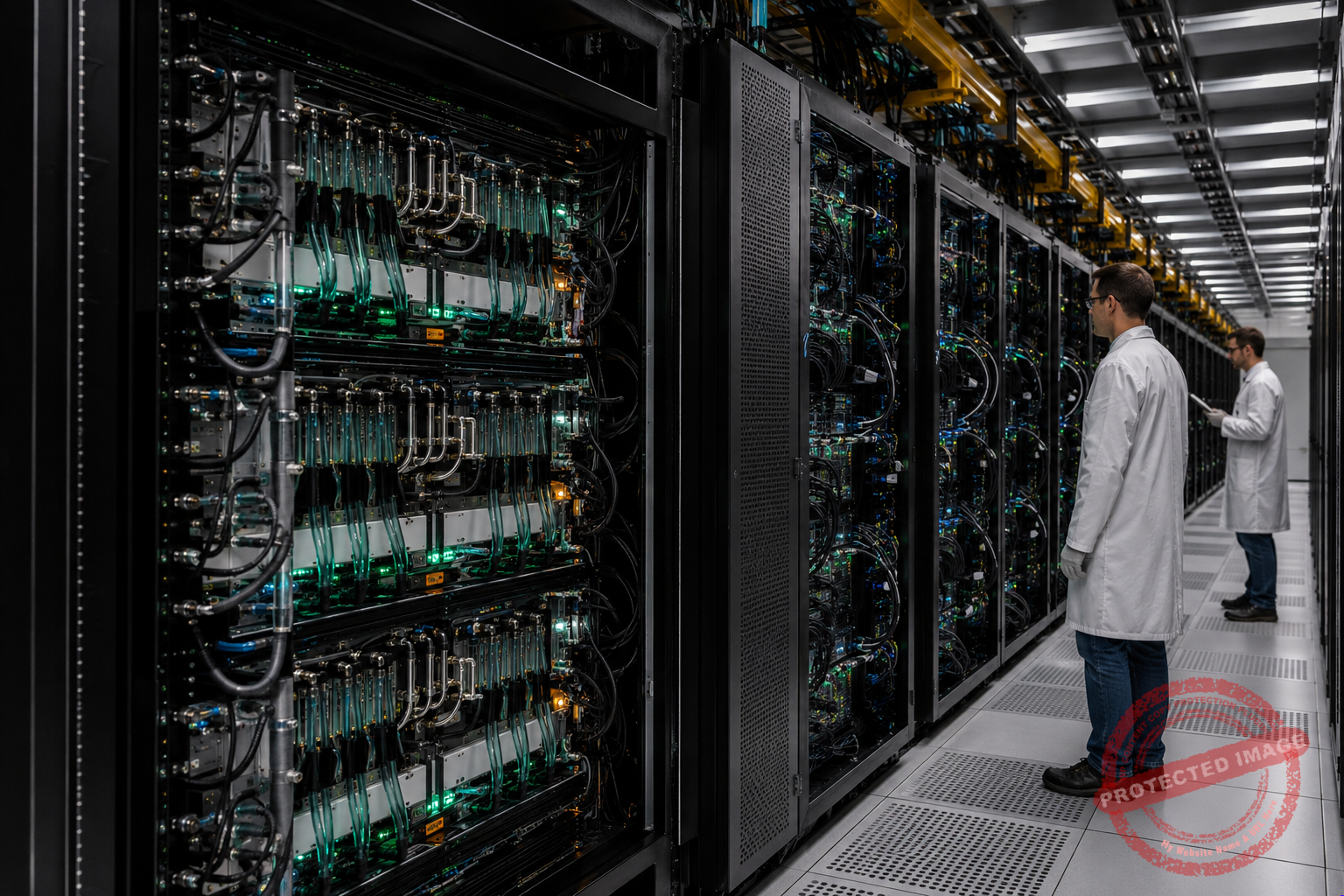
Agentic AI also makes rack-scale architecture more important. NVIDIA’s GB200 NVL72, for example, connects 72 Blackwell GPUs and 36 Grace CPUs in a rack-scale, liquid-cooled design with a 72-GPU NVLink domain. Systems like this point toward an industry direction where the rack becomes the unit of AI compute, not the individual server.
For agents, this matters because complex workflows benefit from locality. If the model runtime, memory cache, retrieval layer, and supporting services are constantly crossing slow or congested network boundaries, the agent becomes slower and more expensive. Better locality can reduce coordination overhead and improve consistency.
The New Bottleneck: Coordination, Not Just Compute
Training clusters are often judged by how efficiently they synchronize massive GPU fleets. Inference clusters are judged by throughput, latency, and cost. Agentic AI adds another constraint: coordination efficiency.
An autonomous workflow may depend on several infrastructure layers working together:
- GPU inference servers for model execution
- CPU services for planning, routing, and tool calls
- Vector databases for retrieval
- Object storage for documents, logs, and artifacts
- Memory systems for persistent state
- Policy engines for permissions and governance
- Observability tools for tracing agent behavior across steps
If these systems are loosely connected, the agent may spend too much time waiting. If they are tightly integrated but poorly isolated, one noisy workload can hurt many others. The best agentic infrastructure will balance locality, isolation, elasticity, and observability.
This is where neoclouds, hyperscalers, and private AI environments will compete. Hyperscalers have broad platform services and global reach. Specialized GPU clouds may offer tighter AI-native performance and bare-metal-like control. Private or sovereign environments may win when data control, latency, or compliance matters more than instant global scale.
Custom Silicon And Agentic Inference
Agentic AI will not run only on GPUs. Google Cloud’s AI Hypercomputer and Ironwood TPU announcements show how providers are designing infrastructure around inference efficiency, power efficiency, and integrated compute, storage, networking, and software. For some agent workloads, especially predictable high-volume inference, custom accelerators may offer compelling economics.
But agentic AI is rarely just one model call. It mixes reasoning, retrieval, tool execution, ranking, embedding, reranking, memory updates, and sometimes multimodal processing. That diversity keeps GPUs highly relevant because they remain flexible across changing model architectures and serving patterns.
The practical answer is not “GPUs or ASICs.” It is workload placement. Stable, high-volume inference may shift toward specialized silicon. Complex, fast-changing agent workflows may continue to favor flexible GPU infrastructure, especially where teams need rapid model iteration.
What Infrastructure Buyers Should Look For
The rise of agentic AI changes the buying checklist for GPU hosting. Raw GPU availability is no longer enough. Buyers should evaluate the full execution environment.
A strong agentic AI platform should provide predictable low-latency networking, high-throughput east-west traffic handling, GPU scheduling, observability across distributed workflows, fast access to storage and retrieval systems, and support for both stateless and stateful inference patterns.
Kubernetes GPU scheduling remains part of the operational picture, especially for teams standardizing on containerized infrastructure. But agentic workloads may require more than basic GPU allocation. They need orchestration that understands service dependencies, placement, traffic patterns, and cost controls across a multi-step workflow.

The Strategic Takeaway
Agentic AI will reshape GPU infrastructure because it changes the shape of demand. The workload is no longer just “serve this model quickly.” It is “coordinate many model-driven actions reliably, securely, and cheaply across a distributed system.”
That makes networking, placement, observability, and orchestration central to AI infrastructure strategy. The winners will not simply be the providers with the most GPUs. They will be the providers that can make autonomous AI workflows run with predictable latency, efficient utilization, strong isolation, and enough flexibility to support the next generation of agent architectures.
Researched and written by: Peter Jonathan Wilcheck
Reference Sites
- NVIDIA Spectrum-X Ethernet Platform for AI Networking: https://www.nvidia.com/en-us/networking/spectrumx/
- NVIDIA GB200 NVL72: https://www.nvidia.com/en-us/data-center/gb200-nvl72/
- Cisco AI Networking in Data Centers: https://www.cisco.com/site/us/en/solutions/artificial-intelligence/ai-networking-in-data-center/index.html
- Google Cloud AI Hypercomputer and Ironwood TPU updates: https://cloud.google.com/blog/products/compute/whats-new-with-ai-hypercomputer
- Kubernetes GPU Scheduling Documentation: https://kubernetes.io/docs/tasks/manage-gpus/scheduling-gpus/
Post Disclaimer
The information provided in our posts or blogs are for educational and informative purposes only. We do not guarantee the accuracy, completeness or suitability of the information. We do not provide financial or investment advice. Readers should always seek professional advice before making any financial or investment decisions based on the information provided in our content. We will not be held responsible for any losses, damages or consequences that may arise from relying on the information provided in our content.

 AAPL
AAPL AMD
AMD CIS.HA
 DELL
DELL IBM
IBM INTC
INTC MSFT
MSFT GOOG
GOOG HPE
HPE NVDA
NVDA TSLA
TSLA TMC
TMC MSI
MSI NOK
NOK ECDH26.CME
 OPEAZZX