


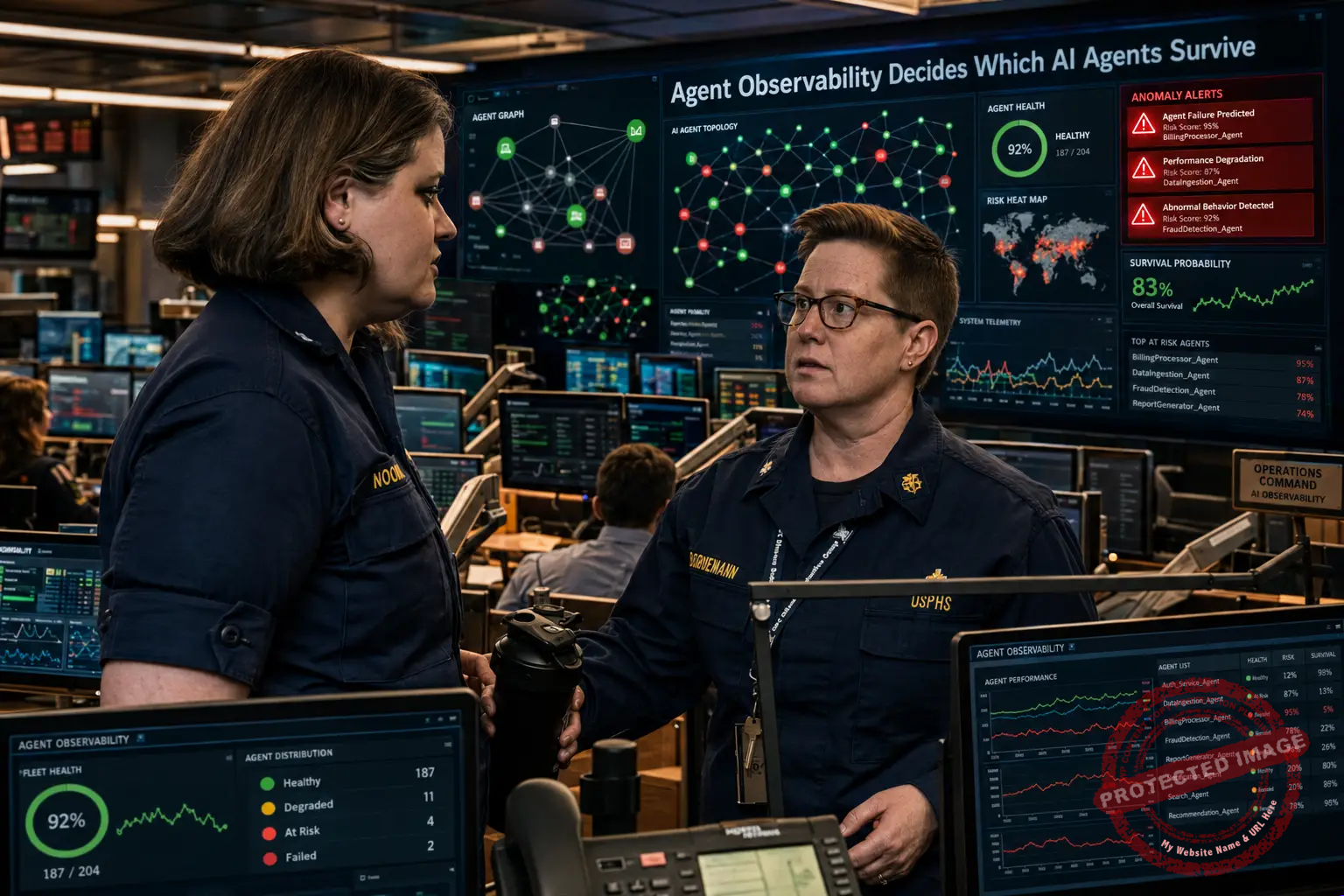
Enterprises spent the last eighteen months teaching AI agents to act. The harder problem in 2026 is proving what they did, why they did it, and what it cost. That proof layer now has a name — agent observability — and after OpenTelemetry’s graduation inside the Cloud Native Computing Foundation, it finally has a vendor-neutral standard behind it.
OpenTelemetry’s Graduation Reset the Baseline
On May 21, 2026, at the Observability Summit in Minneapolis, the CNCF announced that OpenTelemetry had graduated — the foundation’s highest maturity tier, shared with Kubernetes and Prometheus. The numbers behind that decision are not ceremonial. OpenTelemetry now counts more than 12,000 contributors from over 2,800 companies, and holds the second-highest project velocity among more than 240 CNCF projects, behind only Kubernetes. In the twelve months before graduation, the OpenTelemetry JavaScript API package was downloaded more than 1.36 billion times and the Python API surpassed 1.3 billion, both setting monthly records in April 2026.
What makes the timing matter for agent builders is who spoke up. “Observability is the foundation of trust in AI agents,” said Preethi CN, director of AgentCore, Agentic AI at Amazon Web Services, in the CNCF announcement. Microsoft’s Brendan Burns framed the same point from the infrastructure side, calling open-standard monitoring “an even more important cornerstone in delivering agentic experiences.” When hyperscalers describe telemetry as trust infrastructure rather than as ops tooling, the category has moved.
What Agent Observability Actually Captures
Traditional application performance monitoring asks whether a service responded and how quickly. Agent observability asks a harder set of questions: which tools did the agent call, in what order, how many times did it re-plan, how many tokens did each hop consume, which retrieved document justified the final answer, and where did a multi-agent handoff drop context.
The mechanism is distributed tracing applied to reasoning. Each model call, tool invocation and decision step becomes a structured span, and the parent-child relationships between spans reconstruct the control flow the agent actually built at runtime — not the control flow a developer intended when writing the orchestration code. That gap is the entire problem. In deterministic software, the code is the map. In agentic systems, the trace is the only map.
OpenTelemetry’s GenAI semantic conventions supply the shared vocabulary for that map: a common set of gen_ai.* span and metric attributes so instrumentation emitted by one library can be ingested by any backend. Teams adopting them today should plan for churn, however. The GenAI-specific conventions are still evolving toward a stable release, and attribute names can change between versions — a meaningful caveat for anyone hard-coding dashboards or alert rules against them.
The Failure Modes You Cannot See Without Traces
Four failure patterns dominate production agent incidents, and none of them raise a conventional alert.
The silent loop. An agent re-plans against the same unsatisfiable goal. No exception is thrown. Latency looks like a slow task, not a runaway one. Without span counts per run, a looping agent and a busy agent are indistinguishable until the invoice arrives.
Handoff amnesia. In multi-agent workflows, a specialist agent receives a task stripped of the constraint that mattered. The output is fluent, confident and wrong. Only a cross-agent trace shows which context survived the delegation boundary.
Cost drift. Token spend per completed task rises gradually as prompts accrete, retrieval returns more chunks, and retries increase. Aggregate cloud spend hides it; cost-per-successful-outcome does not.
Quality regression without errors. Accuracy degrades after a model or prompt change while every request returns HTTP 200. Catching this requires evaluation scorers attached to live production traces, not a test suite that ran last quarter.

Governance Needs Evidence, Not Policy Documents
The governance case is now the sharpest argument for instrumentation. In a May 26, 2026 press release, Gartner predicted that by 2027, 40% of enterprises will demote or decommission autonomous AI agents because of governance gaps identified only after production incidents occur.
“Enterprises are treating AI agent governance as binary, either locked down or fully trusted, and that is the root cause of failure,” said Shiva Varma, Senior Director Analyst at Gartner. The recommended alternative is proportional governance across four autonomy levels: Observe (read-only retrieval and summarization), Advise (recommendations a human executes), Act with Approval (writes gated by explicit human sign-off), and Act Autonomously (execution inside defined guardrails, with humans reviewing exceptions rather than individual decisions).
Read the controls Gartner attaches to the top tier — continuous monitoring, enforced guardrails, rapid rollback mechanisms, and circuit breakers that halt agent operation on threshold violations — and every one is a telemetry consumer. A circuit breaker needs a metric to trip on. An audit trail needs spans to audit. Proportional governance is unimplementable without proportional instrumentation.

Interoperability Solved the Wiring. Observability Solves the Accounting.
Agent-to-agent coordination is no longer the bottleneck it was. In April 2026, the Linux Foundation reported that the Agent2Agent (A2A) Protocol had passed 150 supporting organizations in its first year, with integration across Google, Microsoft and AWS platforms and production deployments in supply chain, financial services, insurance and IT operations. Version 1.0 delivered a stable specification with multi-tenancy, modernized security flows and Signed Agent Cards for cryptographic identity verification, and the project has surpassed 22,000 GitHub stars across five production-ready SDK languages.
A2A and the Model Context Protocol are complementary: A2A governs how agents coordinate across organizational boundaries, MCP governs how an agent reaches its tools and data. Together they make cross-vendor agent work routine — which is precisely why the accounting problem gets harder. When a task crosses three vendors and two clouds, the trace is the only artifact that spans all of them.
Why It Matters
The competitive question in agentic AI has quietly shifted. It is no longer which framework you picked or which model you fine-tuned; those decisions are increasingly reversible. The durable question is whether you can answer, on demand, what your agents did last Tuesday and what it cost per successful outcome. As InfoQ noted in its coverage of the graduation, the industry conversation is moving from collecting telemetry to reasoning about it, as agentic systems generate orders of magnitude more operational data than the applications that came before.
Organizations that instrument first get to expand agent autonomy with evidence in hand. Organizations that instrument after the incident get to explain the incident — and, per Gartner’s forecast, often get to switch the agent off.
The Takeaway
Agent observability is not a monitoring upgrade. It is the control plane that determines how much autonomy a business can responsibly grant. With OpenTelemetry now a graduated, vendor-neutral standard and the GenAI conventions converging, there is no longer a credible reason to run production agents blind. Instrument the agent before you widen its permissions — not after.
Questions for Readers
If an autonomous agent in your organization made a costly decision last week, how long would it take you to reconstruct exactly why?
Do you measure agent performance by cost per successful outcome, or only by aggregate cloud and token spend?
Which autonomy level are your agents actually operating at — and does your governance match that level, or the level you assumed when the pilot launched?
Reference Sites
- CNCF — Cloud Native Computing Foundation Announces OpenTelemetry’s Graduation (May 21, 2026)
- OpenTelemetry — OpenTelemetry is a CNCF Graduated Project
- Gartner — Applying Uniform Governance Across AI Agents Will Lead to Enterprise AI Agent Failure (May 26, 2026)
- Linux Foundation — A2A Protocol Surpasses 150 Organizations in First Year (April 9, 2026)
- InfoQ — OpenTelemetry Graduates to CNCF’s Highest Maturity Level (July 3, 2026)
Researched and written by: Peter Jonathan Wilcheck and Ray Anderson
Post Disclaimer
The information provided in our posts or blogs are for educational and informative purposes only. We do not guarantee the accuracy, completeness or suitability of the information. We do not provide financial or investment advice. Readers should always seek professional advice before making any financial or investment decisions based on the information provided in our content. We will not be held responsible for any losses, damages or consequences that may arise from relying on the information provided in our content.
 AAPL
AAPL AMD
AMD CIS.HA
 DELL
DELL IBM
IBM INTC
INTC MSFT
MSFT GOOG
GOOG HPE
HPE NVDA
NVDA TSLA
TSLA TMC
TMC MSI
MSI NOK
NOK OPEAZZX